Replacement theology
A few years ago, I had some dialogue some Christian friends about the place of Israel in God’s purposes. I wrote up my thoughts at the time in some of the posts that you will find linked to this one.
One of those friends has recently placed into my hands a copy of Derek White’s booklet Replacement theology: it’s [sic] origin, history, and theology.
White was one of the founders of Christian Friends of Israel (CFI) in 1985. Among the Foundation Principles of this organisation are the beliefs that:-
‘…the restoration of the Jewish people to the Land of Israel is in accordance with promises contained in the Old and New Testaments, and that God’s time to “favour Zion” has begun.’
and:-
‘…Israel (people, land, and nation) has a Divinely ordained and glorious future, and that God has neither rejected nor replaced His Jewish people.’
Summary
I’m going to summarise White’s booklet as even-handedly as I can. Then I’ll offer some comments by way of assessment.
Although the early Church was entirely Jewish, she soon severed herself from her Jewish roots, and this has led to large-scale departures from biblical truth and lifestyle. Indeed (says White), many of the woes that have befallen the Church can be seen as divine judgments for her anti-Semitism.
To the Hebrew mind, everything is viewed in the light of God’s sovereign control. The Christian Church, however, from an early date fell into the trap of separating life into the sacred and the secular.
The Bible (Rom 11:16-26) depicts God’s plan for the Church as an olive tree. The olive tree represents Israel, rooted in the patriarchs. Gentile believers were a wild olive tree, grafted on to Israel through their faith in the Messiah, Eph 2:13, and receiving nourishment from that root stock. The picture, then, is not of the Church replacing Israel, but of being engrafted into Israel. ‘Thus unsaved Jews (cut-off natural Israel), saved Jews (natural branches attached to the tree), and Gentile Believers (grafted-in wild branches) each have their own on-going participation in the one Israel.’
Early on in Church history, Origen (born 186AD) and others adopted a Platonic approach to theology and biblical interpretation. According to this approach, Scripture admits of three-fold interpretation that corresponds to the threefold nature of man: the ‘bodily’ (literal interpretation), ‘psychical’ (ethical interpretation), and ‘pneumatic’ (allegorical or mystical interpretation). According to Origen’s allegorical interpretation God has rejected the Jewish nation, and the Christian Church is now the ‘new Israel’. It is to be noted, however, the later Christian fathers thought that Origen had gone too far in his allegorical approach, and Luther rejected it outright.
It was out of this idea that God has rejected Israel, and in its place constituted the Christian Church, that ‘replacement theology’ grew. The ultimate redemption of Israel, so dear to Paul’s heart, is scarcely mentioned in the writings of the Church Fathers.
In rejecting God’s purposes for Israel, the Church appropriated the spiritual and national background of Judaism. All the promises addressed in the Old Testament to Israel are now the exclusive property of the Church, as the ‘true Israel’. Israel herself has been ‘completely disinherited and excluded’.
According to White, it was only a short step to the anti-Semitism which has beset the Church for centuries. Jerome regarded the Jewish place of worship as ‘the synagogue of Satan’ (cf. Rev 2:9; 3;9). Ambrose described the synagogue as a ‘home of unbelief, a house of impiety, a receptacle of folly.’ Augustine taught that continued observance of the Jewish law by Christians was inadmissible, and equivalent to denying that salvation is through Christ alone. Chrysostom regarded the Jews with contempt.
This hatred of Jews spilled over into the horrors of the Blood Libel, the Crusades, the Inquisition, Pogroms, and so on.
Towards the end of his life Martin Luther laid the ground for the Holocaust with his vitriolic denunciations of the Jews. According to Hans Kung, although the mass murder of Jews was carried out by godless criminals, it could not have taken place at all without the almost 2,000-year history of Christian anti-Semitism. Hitler himself believed that he was doing the will of the Lord in his treatment of the Jews.
One way in which the Church distanced herself from her Jewish roots was in legislating that Easter must be celebrated on a Sunday and must never coincide with the date of the Jewish Passover. Another move was to forbid Christians to observe the Jewish Sabbath, and to require them to honour Sunday in its place.
The Church of Constantinople decided that Jewish converts to Christianity must denounce all Hebrew beliefs and practices.
Having uprooted herself from her Jewish origins, the church planted her roots in pagan soil. Jerusalem was replaced by Athens and Rome. Platonism, as has been noted, led to the separation of sacred and secular that had been so inextricably entwined in Jewish thought. Platonic thought was also rather tolerant of homosexuality, and also formed the basis for the fascist model of government.
White suggests that ‘the Dark Ages, which spanned at least a thousand years, would surely never have befallen the Church had she not turned her back on her Jewish heritage.’
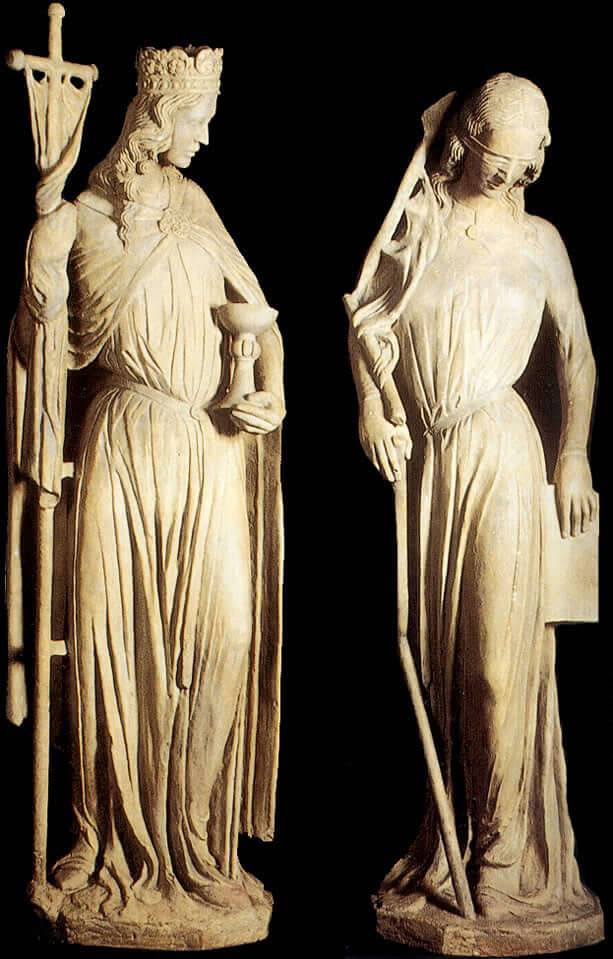
‘Replacement theology’ has been expressed in the Church in art, with Jesus and the disciples portrayed as fair-haired, Gentile-looking people, and Judas and the Pharisees etc as dark-skinned Jews; the Medeba Map (AD 560-565) depicting Jerusalem with various churches, but without the Temple Mount area; and Ecclesia and Synagoga, two female figures featuring prominently in 10th-14th centuries, who represent one (Ecclesia) as crowned and triumphant and the other (Synagoga) blindfolded and holding a broken staff.
The chapter headings of some editions of the Authorised Version of the Bible transfer the prophetic blessings from the Jews to the Church, while assigning the curses to the Jews.
An extreme version of Replacement Theology is found in ‘Kingdom Now’ or ‘Dominion’ Theology. This teaches that the Church will rule the world in preparation for the return of Jesus Christ. In this way the Church usurps the central role for which Israel was chosen.
Replacement Theology typically asserts that the nation of Israel has no more significance in the mind and purpose of God than any other nation.
However, Replacement Theology has not been the universal view of Christian teachers: it was not the view of the Puritans, nor was was it the view of many of the leaders of the 17th-early 19th centuries.
[The teaching of the Puritans is clarified by I.H. Murray in The Puritan Hope: ‘A number of the Puritans believed that the Jews would be restored to their own country,’ p78. However, adds Murray, none supposed that the land of Israel would ever again have the theocratic and symbolic significance which it possessed during the Old Testament era.’ Murray cites the Puritan William Greenhill as stating: ‘The Jews’ return to their own land is denied by some, questioned by many, and doubted by most’, p274]
Over the past 50 years or so, Replacement Theology has focused Jewish people’s right to the land as an unalienable possession. This is the major assertion of Colin Chapman, in his book Whose Promised Land? The Land of Israel becomes the whole world; Jerusalem becomes a heavenly city, the spiritual Zion; the promised ingathering of the Jews (Isa 43:5-7) becomes the gathering of believers into the Church; the resurrection of Israel (Hos 6:1f) is seen as fulfilled in the resurrection of Christ; and the reign of the Messiah is interpreted as Jesus reigning spiritually through his Church.
Proponents of Replacement Theology sometimes attempt to re-badge it as ‘fulfilment theology’ – i.e. that the Old Testament promises have all been fulfilled in Christ. But it still amounts to a disinheritance of Israel, in which there is no covenant right to the Land, no promise of a latter-day restoration to the Land, or any place for Israel as a nation (regenerate or otherwise).
Replacement Theology (claims White):-
- disregards the teaching of Jesus, when he said, “I did not come to abolish the Law of the Prophets”, Mt 5:17f.
- ignores Paul’s teaching when he wrote, “God has not rejected his people”, Rom 11:1.
- severs the link God has forged between the ingathering of Israel and the vindication of his Holy Name, Ez 36:22-44.
- makes nonsense of biblical exegesis, in that it applies one verse (Ez 37:11) to the Jewish people, but the next verse (Eze 37:12) exclusively to the Church.
- disrupts the harmony between the Old and New Testament. It fails to recognise that the New Testament does not repeat all the promises because it presupposes them.
- mistakenly assumes that ‘Israel’ in the New Testament can generally be substituted with ‘the Church’.
- ignores the fact that in the New Testament the teaching is ‘even as Israel, so also the Church’, and not, ‘instead of Israel, now the Church.’ Example: 1 Pet 2:9.
- challenges the unchanging nature of God’s character and the reliability of his Word (see Jer 31:35-37). If, as Replacement Theology teaches, God has rejected Israel, then he could just as easily reject this church. And, after all, the Church has not shown herself to be more worthy of God’s grace than Israel, especially taking into consideration the greater light that the Church enjoys in the new covenant.
- misunderstands the nature of the biblical covenants. Most of these covenants are unconditional, and it is clear from numerous divine promises that the Land has been given eternally and unconditionally to Israel (although her presence in the Land is conditional upon her obedience). And rejection by God of Israel is, accordingly, only ever temporary, and designed to lead to repentance. See Isa 49:14-18.
In conclusion, White says, God requires the Church to show mercy to the Jewish people, just as she herself has received mercy from him. Over the past nineteen centuries the Church has failed to do this. She has rejected the Jewish people, persecuted them, and claimed that the promises made to them belong exclusively to herself. The present day may offer our last chance to put this right.
Derek White, Replacement theology: it’s [sic] origin, history and theology. CFI Charitable Trust.
2. Assessment
(a) Points of agreement
I agree with Derek White that:-
(i) the Christian Church has sometimes been guilty of terrible anti-Semitism. I further agree that this stemmed, in considerable measure, from a form a ‘replacement theology’ that predominated in the Patristic period.
(ii) Christian people have not always shared Paul’s conviction that the God has not forsaken his historic people or his passion for their salvation.
(iii) Christian theology has sometimes been too indebted to pagan thought (including Platonism), and has neglected its Jewish roots.
(b) Points of disagreement
But on the question of whether Derek White’s version of Christian Zionism is the answer to these ills, I demur. In fact, I have a number of points of disagreement:-
(i) The ‘literal truth’ of Scripture
White asserts that Jesus ‘presupposed that all the Old Testament prophetic Scriptures were valid and literally true’. ‘Unlike Jesus,’ he adds, ‘advocates of Replacement Theology cannot accept the literal truth of the Old Testament.’ But, firstly, since White has not told us who these alleged ‘advocates of Replacement Theology’ are, we cannot check their statements against his. And, secondly, the very concept of the ‘literal truth’ of biblical prophecy is far too simplistic. To take one example: in Ezekiel 36:24 the Lord promises, “‘I will take you out of the nations; I will gather you from all the countries and bring you back into your own land'”. It is claimed that this is a literal return to a literal land. But is what follows also literal – King David on the throne, the rebuilding of the temple, and the offering of sacrifices? Surely not – this is a highly spiritualised account of the Messianic kingdom, begun now, and consummated in the hereafter.
(ii) ‘Conditional’ and ‘unconditional’ covenants
Something similar may be said about the nature of covenants in the Bible. White quotes Ruth Fleischer (from her in-house CFI article) in support of the idea that there are two kinds of covenant in the Bible. God has promised the Land to Israel unconditionally, whereas Israel’s presence in the Land is conditional upon her obedience (page 41). White cites Isaiah 49:14-18 as an example of God’s eternal and unconditional promise to ‘His people’. But if a neat distinction can be made between ‘unconditional’ and ‘conditional’ covenants, how can Isaiah 25:5 complain that ‘the earth is defiled by its people; they have disobeyed the laws, violated the statutes and broken the everlasting covenant‘ (my emphasis)?
In fact, many OT promises were ‘for ever’, and yet manifestly temporal in duration. Examples include: the Aaronic Levites as priests, 1 Chron 23:13, and the descendants of David as kings, 2 Sam 7:12-16. Both have come to an end and are fulfilled in Christ.
(iii) The New Testament’s silence on the question of ‘the Land’
Arguments from silence are notoriously suspect. It is, therefore, quite wrong of Derek White to claim, without evidence or reasoning, that the New Testament’s silence on the question of Israel inheritance of the Land is due to Christ and the apostles taking the Old Testament teaching (understood ‘literally’) ‘as read’. (And, yes, I am aware of White’s more detailed defence of this position, but I find it unconvincing).
Among other things, White would need convincingly to show why, within his scheme of interpretation, the promise of Psa 37:11 (‘the meek will inherit the land’) is universalised by our Lord in Matthew 5:5 “Blessed are the meek, for they will inherit the earth”, and by Paul in Rom 4:13 ‘Abraham and his offspring received the promise that he would be heir of the world’. White would need to explain why, in Eph 1:1-23, the inheritance of God’s people is extended to the entire cosmos. In Christ, paradise restored is not a return to the land, but a new heaven and a new earth as the home of the faithful.
(iv) ‘Fulfilment theology’ is not the same as ‘Replacement Theology’
Derek White insists (page 34) that ‘fulfilment theology’ is the same as ‘Replacement Theology’. According to ‘fulfilment theology’, ‘the Old Testament promises concerning Israel have all been fulfilled in Christ’ (White’s words). This is a glorious truth, taught most extensively in the Epistle to the Hebrews, and which recognises, among other things, that the Church consists of Jewish and Gentile followers of Jesus Christ, who himself is the ‘true Israelite’. And this is not at all the same as saying that God has rejected Israel and replaced her in his plan and purposes with the Church. In failing to distinguish between these two, White has, by implication, discounted the careful and believing scholarship of many within mainstream evangelicalism
Derek White fails to tell us who, among recent Christian scholars, theologians and preachers, he thinks teaches Replacement Theology. Who are these people who assert that ‘God has terminated His covenant with Israel and replaced her with another body – the Church’ (p40)? White cites just one recognised evangelical biblical scholar – the late Dick France – and this is a second-hand quotation (found in a book by Colin Chapman), and one on which White does not offer any response: does he think that France is self-evidently wrong on this point?. [In fact, I find this to be a persistent trend in those writing about so-called ‘replacement theology’ – they just assume that it is ‘out there’, but do not take the trouble to tell us exactly where they think that have found it.]
White does, in fact, quote quite extensively (page 32ff) from Colin Chapman’s book, Whose Promised Land? But he does not actually discuss what Chapman is saying: again, he seems to simply regard it as self-evidently wrong. He seriously misrepresents Chapman when he states (page 32) that ‘an integral part of Chapman’s teaching is the view that the Church is now Biblical “Israel”‘. This misrepresentation is ironic, in view of the fact that many Bible-believing scholars do think that the Christian Church, comprising Jewish and Gentile believers under Christ, can be regarded as the ‘true Israel’. But Chapman does not think so. In fact, he:-
- not only recognises, but documents in some detail, the sad history of Christian anti-semitism, and explains how Paul’s argument in Romans 9-11 should have been seen as a strong condemnation of this attitude;
- explicitly repudiates supercessionist (replacement) theology (‘Gentile Christians should never think that the church has superseded the Jewish people or taken their place’);
- holds, along with a vast number of Christian thinkers down the ages – Fathers, Reformers, Puritans and Evangelicals alike – the hope of a large-scale turning of Jewish people to Christ in the end times. I would like to add that, if ‘anti-Semitism’ is defined as ‘hostility towards Jews’, then not a trace of it can be found in Chapman’s writings.
(v) Is the choice simply between ‘Replacement theology’ and Christian Zionism’?
Derek White seems to think that we just two alternative positions to choose from: either we take the view that God has rejected Israel, with the Church replacing Israel in his favour and purposes; or we adopt a Zionist position with all its political and geographical entailments.
But there is a rather obvious third way. This is the view which takes God’s promises to Israel, regards them as fulfilled and universalised in Jesus Christ, but nevertheless finds in Scripture (particularly Romans 11) the prospect of a large-scale turning of Jewish people to Christ in the last days. This was the view of the majority of Fathers, Reformers, and Puritans, 19th-century evangelicals, and continues to be the majority opinion amongst evangelical scholars today. Of these, it was only the 19th-century evangelicals amongst who held belief in re-possession of the Land as a God-given right. (See, for example, the discussion of Moo in his commentary on Romans). Unfortunately, White seems not to have considered this alternative, (or, if he has considered it, perhaps he thinks that it is just another form of ‘replacement theology’).
(vi) Is it necessarily anti-Semitic to be critical of Christian Zionism?
Derek White accuses those who reject his own position of ‘a subtle, deeply engrained spirit of pride, arrogance and contempt towards the Jews’ (page 40). Now, I grant that White is comparatively measured in his comments about those with whom he disagrees, but the implication that any critique of Christian Zionism amounts to anti-Semitism is actually quite sinister. Rather than impugn the attitudes and motives of (largely unnamed) fellow-Christians who think differently to himself, he would do better to show from Scripture why his understanding is the right one: and this he has signally failed to do.
Conclusion
I’m afraid that I found Derek White’s argumentation very weak. Perhaps he should not have even have attempted to deal with the ‘origin, history and theology’ of ‘Replacement Theology’ in just 40-odd pages. He has left too many questions unanswered, too many stones unturned. Too often, assertions were given without reasons, sweeping statements without qualification, and quotations without context. The latter problem was particularly serious regarding the biblical quotations, the interpretation of which is, of course, critical to the whole question. I can only see someone who is already committed to his position being impressed by his booklet.
Far from being ‘nothing other than classic “disinheritance” or Replacement Theology, and a perpetuation of the Church’s rejection of her Jewish roots’, the mainstream evangelical position is, in fact, an ‘extension theology’ or ‘fulfilment theology’, in that the promises once made to Israel are now in Christ universalised, bringing Jewish and Gentile believers together as one people, confessing one faith and honouring one Lord.
Mainstream evangelicals do not think that the Lord has forgotten or rejected Israel. Many believe that Paul, in Romans 9-11, does hold out the prospect of a latter-day large-scale turning of Jewish people to Christ. But to attempt to separate God’s purposes for Israel and his purposes for Gentile believers any further than that is to repudiate much of Christ has achieved, and to undermine the unity of the one people of God who have been bought with his blood.
In Christ, and in church, the body of Christ, Israel’s hopes have been realised, not set aside.
For further thoughts of my own on the subject, I refer my reader to the related posts, and also to my comments on several of the Scripture passages cited by White in apparent support of his position.
See also:
Rob Dalrymple, These brothers of mine: a biblical theology of land and family and a response to Christian Zionism. Wipf & Stock, 2015. Chapter 11.
Michael J. Vlach, ‘Various Forms of Replacement Theology’. TMSJ 20/1 (Spring 2009) 57-69. Online.