Bart Ehrman’s ‘Top Ten’ spurious verses
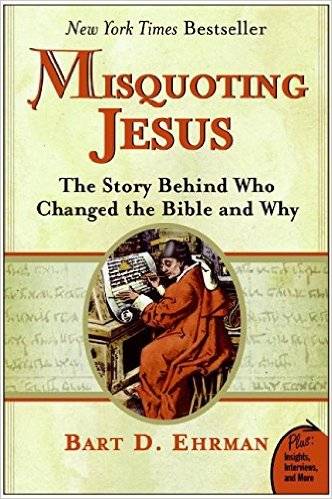
In his book Misquoting Jesus, Bart Ehrman lists ten ‘top verses that were not originally in the New Testament’. These are:-
1 John 5:7 There are three that bear witness in heaven, the Father, the Word, and the Holy Spirit, and these three are one.
This is already recognised in modern Bible translations as a very late addition. For example, NIV (1984) states: ‘not found in any Greek manuscript before the sixteenth century’. If, as is possible, the wording of this verse was included in order to bolster the Christian doctrine of the Trinity, then it should be noted that that doctrine had been accepted by the Christian Church for centuries.
John 8:7 Let the one who is without sin among you be the first to cast a stone at her.
John 8:11 Neither do I condemn you. Go and sin no more.
Modern Bible translations (such as NIV 1984) clearly identify this entire passage (Jn 7:53 – 8:11) as being inauthentic. NIV states that this passage is absent from ‘the earliest and most reliable manuscripts and other ancient witnesses.’
Luke 22:44 In his anguish Jesus began to pray more earnestly, and his sweat became like great drops of blood falling to the ground.
NIV 1984 states that ‘some early manuscripts do not have verses 43 and 44′.
Luke 22:20 And in the same way after supper Jesus took the cup and said, “This cup that is poured out for you is the new covenant in my blood.“
Included in the NIV 1984 without annotation.
Mark 16:17 These signs will accompany those who believe: in my name they will cast out demons and they will speak with new tongues.
Mark 16:18 And they will take up snakes in their hands, and if they drink poison it will not harm them, and they will lay their hands on the sick and they will become well.
NIV 1984 states: the most reliable early manuscripts and other ancient witnesses do not have Mark 16:9-20.’
John 5:4 For an angel of the Lord went down at certain times into the pool and disturbed the waters; and whoever was the first to step in when the water was disturbed was healed of whatever disease he had.
This verse is omitted from NIV 1984, stating in a footnote that ‘some less important manuscripts’ include it.
Luke 24:12 But Peter rose up and ran to the tomb, and stooping down to look in, he saw the linen clothes by themselves. And he went away to his own home, marveling at what had happened.
This verse is included, without annotation, by NIV 1984.
Luke 24:51 And when Jesus blessed them he departed from them and he was taken up into heaven
This verse is included, without annotation, by NIV 1984.
If Ehrman intended his list of ten suspect verses to be the equivalent of as many bombshells, then he was sorely mistaken. If this is his best evidence to support the notion that the New Testament we have in our hands is significantly different from that contained in the original manuscripts, then his case is without foundation.
Consider the following:-
Seven out of ten of the questionable verses are annotated as such in a typical modern translation. So, the very process which, according to Ehrman, calls into question the trustworthiness of the New Testament text has already been used by Bible translators in order to give us confidence about those many verses which should indisputably be in the text of the New Testament, and those few which are probably inauthentic.
The three verses not identified as questionable in NIV 1984 (Luke 22:20, Luke 24:12 and Luke 24:51) convey teaching that is taught elsewhere in the New Testament, in uncontested passages (Matthew 26:28, Mark 14:24, John 20:3-7, Acts 1:9-11).
None of the ten has any impact on any key Christian doctrine.
All of this underline to the lay person what we might call ‘the tyranny of scholarship’. Scholarship become tyrannical when it not only provides us with reliable information (which it usually does) but when it also tells us, uncritically, what inferences we should draw from that information.