Biblical foundations of penal substitution 3 – Isaiah 53
Isaiah 53 (more properly 52:13-53:12) constitutes the fourth ‘Servant Song’. It has traditionally been regarded as teaching penal substitution, with this teaching fulfilled in the suffering of Jesus. This interpretation has not gone unchallenged. R.N. Whybraw, for example, argues that the Servant does not suffer instead of others, as their substitute, but alongside them, as their representative.
But the traditional interpretation is confirmed by the following considerations:-
1. The Servant suffers ‘for’ others. There is a repeated contrast between ‘he’, ‘his’, and ‘him’, on the one hand, and ‘we’, ‘us’, ‘we all’ and ‘us all’ on the other. While it is true that this suffering ‘for’ others can include the notion of suffering ‘because’ of their sins, the idea of substitution is inescapable.
2. The Servant’s suffering brings great benefits to those for whom he suffers – peace, healing, and so on. In context, Isa 53 expresses the means of salvation that is anticipated in Isa 49-52 and in which the people are invited to participate in Isa 54-55. It is not just that the Servant shared the people’s fate, but that he suffered in order that they might not suffer. The Servant achieved what mere participation could not achieve – a ‘guilt offering’; an atonement for sin.
3. The Servant suffering willingly and deliberately. Note the active voice in Isa 53:4, 5, 12.
4. It is God who lays the people’s sin upon the Servant and punishes him, Isa 53:6, 10. But note (taking points 3 and 4 together) that God inflicted punished on a willing, not unwilling victim. [No cosmic child-abuse here!]
5. The Suffering Servant is himself sinless and righteous, Isa 53:9, 11. Therefore, his suffering was not on account of his own sins.
6. The Servant was punished by the Lord, therefore, on account of the sins of others, Isa 53:11f.
7. The Servant suffers as a ‘guilt offering’, Isa 53:10. This is described in Lev 5-7 as an atoning sacrifice for sin. Isa 53 therefore anticipates something that the New Testament will confirm: that the animal sacrifices of Leviticus are ultimately to be fulfilled in the sacrificial death of a person.
Isaiah 53 and the death of Jesus
Isa 53 is quoted seven times in the New Testament (Mt 8:16f; Lk 22:37; Jn 12:38; Rom 10:16; 15:20f; Acts 8:32f; 1 Pet 2:22-25). There are over thirty other allusions. It is undeniable that the NT writers identify Jesus with the suffering Servant. What is disputed is whether these NT references pick up on Isaiah’s penal substutitionary themes. But, of the passages just listed, 1 Peter inescapably teaches penal substitution, and a number of the others probably do so as well.
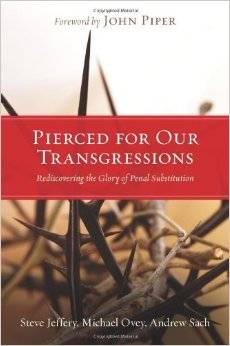
Based on Jeffery, et al, Pierced for our transgressions, 52-67.