A New Heaven and a New Earth, 1-8
21:1 Then I saw a new heaven and a new earth, for the first heaven and earth had ceased to exist, and the sea existed no more. 21:2 And I saw the holy city—the new Jerusalem—descending out of heaven from God, made ready like a bride adorned for her husband. 21:3 And I heard a loud voice from the throne saying: “Look! The residence of God is among human beings. He will live among them, and they will be his people, and God himself will be with them. 21:4 He will wipe away every tear from their eyes, and death will not exist any more—or mourning, or crying, or pain, for the former things have ceased to exist.”
A new heaven and a new earth – The dissolution of the old creation had been spoken of in Ps 102:26; Isa 34:4; 51:6. See also 2 Pet 3:7,10-13. We should not, however, understand these scriptures to teach a total annihilation of the old order. See Rom 8:19-22. This is analogous to the spiritual re-creation spoken of in 2 Cor 5:17: the old nature has not been destroyed, but renewed. See also Mt 19:28; Acts 3:21.
Specifically, this fulfils the hope of Isa 65:17.
Isaiah 65:17 — “For look, I am ready to create new heavens and a new earth! The former ones will not be remembered; no one will think about them anymore.”
It is the same universe, but gloriously renewed:
‘The first heavens and the first earth have passed away. In our imagination let us try to see this new universe. The very foundations of the earth have been subjected to purifying fire. Every stain of sin, every trace of death has been removed. Out of the great conflagration a new universe has been born. The word used in the original implies that is was a “new” but not an “other” world. It is the same heaven and earth, but gloriously rejuvenated, with no weeds, thorns or thistles. Nature comes into its own.’ (Hendriksen, More Than Conquerers)
Hendriksen (More Than Conquerors) writes:
There is a beautiful connection between the first book of the Bible and the last. Scripture resembles a flower. We find the seed in Genesis, the growing plant in the books that follow, the fully developed and beautiful flower in the Apocalypse. Observe the following comparison.
Genesis tells us that God created heaven and earth. Revelation describes the new heaven and earth (21:1).
In Genesis the luminaries are called into being: sun, moon, and stars. In Revelation we read: “And the city has no need of the sun, nor of the moon, to shine in it; for the glory of God lightened it, and its lamp is the Lamb” (21:23).
Genesis describes a paradise that was lost. Revelation pictures a paradise restored (Rev. 2:7; 22:2).
Genesis describes the cunning and power of the devil. The Apocalypse tells us that the devil was bound and hurled into the lake of fire and brimstone.
Genesis pictures that awful scene of man fleeing away from God and hiding himself from the presence of the Almighty. Revelation shows us the most wonderful and intimate communion between God and redeemed man: “Behold, the tabernacle of God is with men, and he shall tabernacle with them” (21:3).
Finally, whereas Genesis shows us the tree of life, with an angel to keep the way to the tree of life, “lest man put forth his hand and take of its fruit,” the Apocalypse restores to man his right to have access to it: “that they may have the right to come to the tree of life” (22:14).
So, again, we ask, what is the theme of this book? It is this: Not the devil but Christ is victorious; God’s plan, though for a while seemingly defeated, is in the end seen to triumph completely. We are conquerors. No; more than conquerors, for not only are we delivered from the greatest curse, indeed from every curse, but we obtain the most glorious blessing besides (Rev. 21:3).
The sea existed no more – Often, in the OT, representing chaos and disorder, and leading to feelings of fear (cf. Rev 13:1).
Jerusalem itself is referred to as ‘the holy city’ in Mt 4:5; 27:53, because of the presence of the temple, God’s dwelling place on earth. Here, it is the people of God who are thus designated. Consistent with NT thought generally, they are the dwelling place of God.
The new Jerusalem, coming down out of heaven – It is clear from what follows that ‘the new Jerusalem’ is nothing other than the people of God. They are already citizens of heaven (cf. Eph 2:6; Phil 3:20).
‘The NT conceives of a heavenly Jerusalem as the dwelling place of God, the true homeland of the saints, and the dwelling place of “the spirits of just men made perfect,” Heb 12:22; cf. Gal 4:26; Php 3:20. While this heavenly Jerusalem is represented as the dwelling place of the departed saints, heaven is not their ultimate destiny, but only the temporary abode of the saints between death and the resurrection, Rev 6:9-11; 2 Cor 5:8; Php 1:23. In the consummation after the resurrection, Rev 20:4, the heavenly Jerusalem will descend from heaven to take up its permanent location in the new earth.’ (Ladd)
Note ‘the direction of travel, with the city coming down out of heaven’. This is:
‘in line with the rest of Revelation and with other expressions of New Testament eschatology, which does not envisage the saved leaving the earth to be with God in heaven, so much as sleeping in death and awaiting the bodily resurrection at the return of Jesus, and it matches the desire expressed in the Lord’s Prayer: “your kingdom come … on earth as it is in heaven”.’ (Ian Paul)
Made ready like a bride adorned for her husband – In Rev 19:7f this adornment represents ‘the righteous deeds of the saints’.
“Look! The residence of God is among human beings” – skēnē, ‘tent’. There is an allusion here to the tent of meeting, which was the dwelling of God as he journeyed with the Israelites in the wilderness (Ex 27:21).
Ian Paul elaborates:
‘Within Revelation, the term (together with its cognate skēnoō, ‘to dwell’) describes God’s protective presence over those who are faithful to him (Rev 7:15), as well as the people of God who (spiritually speaking) reside before the throne (Rev 12:12; 13:6).’
The God who once dwelt with us in weakness will one day do so in glory:
‘The same Greek word as is used of the divine Son “tabernacling among us.” Then he was in the weakness of the flesh: but at the new creation of heaven and earth he shall tabernacle among us in the glory of his manifested Godhead (Rev 22:4).’ (JFB)
“They will be his people” – According to Morris, the better manuscripts have ‘peoples’, indicating that they come from many nations. Many modern translations (e.g. NRSV) reflect this reading.
On the reading ‘peoples’, Mounce comments:
‘Apparently, John modified the traditional concept (Jer 7:23; 30:22; Hos 2:23) and substituted a reference to the many peoples of redeemed humanity. Jesus had spoken of “other sheep that are not of this sheep pen” that must become part of the one flock (John 10:16). It is with the redeemed peoples of all races and nationalities that God will dwell in glory. God himself will be with them, and he will be their God. It is the presence of God, and the fellowship with him of all believers, that constitutes the principal characteristic of the coming age.’
Ian Paul, similarly:
‘It is striking that, whereas the Old Testament uses the singular ‘people’, John uses the plural ‘peoples’, signifying the overflow of grace in the inclusion of those from ‘every nation, tribe, people and language’ (Rev 7:9) in the renewed covenant community. This fulfils the (sometimes muted) note in Old Testament prophetic expectation that sees all the nations coming to worship God in Zion (see Ps. 86:9; Isa. 2:3; 66:20; Mic. 4:2).’
The language here is redolent of the OT covenant formula: ‘They will be my people, and I will be their God’ (cf. Jer. 32:38; Ezek. 37:27.
“He will wipe away every tear from their eyes, and death will not exist any more—or mourning, or crying, or pain”
It is not merely that there will be no weeping, but, in an act of blissful consolation, God will wipe every tear away. Pain will not simply be ended: it will be mended.
Cf. the vision of the eschatological banquet in Isa 25:8 –
‘He will swallow up death permanently. The sovereign LORD will wipe away the tears from every face, and remove his people’s disgrace from all the earth. Indeed, the LORD has announced it!’
Athansius:
‘It will matter little to the faithful what their sorrows may have been in this vain world, since no trace of them will remain when they enter on that ineffable peace which is in store for them in the life to come.’
‘Affliction has a sting, but withal a wing: sorrow shall fly away.’ (Thomas Watson)
“for the former things have ceased to exist” – As Ian Paul remarks, while there is clear continuity between the old order and the new order, there is also radical discontinuity.
As the apostle puts it in 2 Cor 5:17 –
‘So then, if anyone is in Christ, he is a new creation; what is old has passed away—look, what is new has come!’
If suffering of all kinds is banished from every part of God’s new creation, then it would follow (according to conditionalists) that the suffering of hell must also ‘cease to exist’.
Pinnock and Brow comment:
‘According to the traditional view, darkness will hang over the new creation forever. It makes better sense metaphysically to think of hell as final destruction and the dwindling out of existence of the impenitent wicked than to posit the eternal existence alongside God of a disloya opposition in an unredeemed corner of the new creation.’ (Quoted in The Nature of Hell, Evangelical Alliance)
Traditionalists respond by pointing out that, a few verses later, the wicked are still suffering in the lake of fire and still undergoing the ‘second death’ (v8). Furthermore, in Rev 22:15 various evil-doers are cast outside the gates of the New Jerusalem, suggesting that they are experiencing ongoing retribution. For Peterson, Packer and others this means that there must be some corner of the final order that is reserved for the wicked. Powys responds that even if the wicked remain in existence for a while, ‘they would not remain so for long’.
21:5 And the one seated on the throne said: “Look! I am making all things new!” Then he said to me, “Write it down, because these words are reliable and true.” 21:6 He also said to me, “It is done! I am the Alpha and the Omega, the beginning and the end. To the one who is thirsty I will give water free of charge from the spring of the water of life. 21:7 The one who conquers will inherit these things, and I will be his God and he will be my son. 21:8 But to the cowards, unbelievers, detestable persons, murderers, the sexually immoral, and those who practice magic spells, idol worshipers, and all those who lie, their place will be in the lake that burns with fire and sulfur. That is the second death.”
The one seated on the throne said – As Paul observes, this is the first direct speech from God since Rev 1:8. Out of all the previous confusion and chaos emerges the clear, unmistakable voice of him who will make all things new.
“Write it down, because these words are reliable and true” – This is the last of seven occasions when John is commanded to ‘write’. There is an implication of permanence, and also of universality, about this, which contrast with the more limited and localised messages of the OT prophets (cf. Isa. 6:9; Jer. 2:2; Ezek. 3:4).
“I am the Alpha and the Omega” – The first of these is spelt out; the second is given just as the letter.
‘The Greek translation of God’s name YHWH (the Tetragrammaton) was spelt IAO, and this was of interest because the Greek chief of gods, Zeus, was said to hold the beginning, middle and end of all things (in Plato and Plutarch).’ (Paul)
“The beginning and the end” – cf. Isa 41:4; 44:6; 48:12.
The water of life – Here and in Rev 22:1, 17, the water ‘is emblematic of the maintenance of spiritual life in perpetuity.’ (Vine)
Ian Paul provides a comparison of three vice lists:
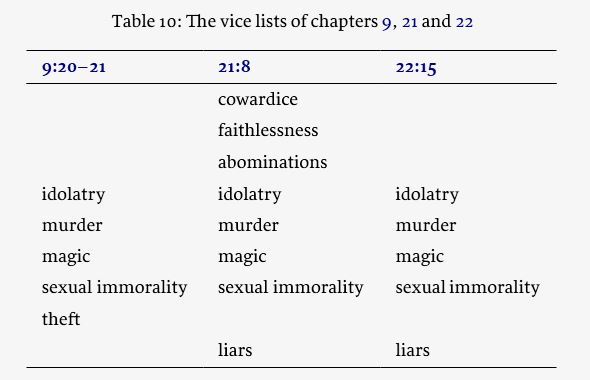
Mounce comments that all eight items may refer to those who have apostasized from the faith.
Cowards – who choose ‘self and safety before Christ’:
‘To be cowardly before the enemies of God at the last is finally to lose the things of God. John is not speaking of natural timidity, but of that cowardice which in the last resort chooses self and safety before Christ, and fears the threats of the beast rather than trusts the love of Christ. God did not give his people such a spirit of cowardice (2 Tim. 1:7).’ (Morris)
‘They are the rootless ones of the Parable of the Sower who “when trouble or persecution comes because of the word … quickly [fall] away” (Matt 13:21).’ (Mounce)
Unbelievers – Those wo have renounced the faith they once professed:
‘The unbelieving are not the secular pagan world (as in 1 Cor 6:6; 7:12ff.; 10:27; 14:22ff.) but believers who have denied their faith under pressure. They are “apostates, those who had renounced, or given up, their Christian faith.”’ (Mounce, guoting Bratcher and Hatton)
Those who lie – ‘The inclusion of “liars” is appropriate in view of John’s emphasis on truth (cf. 1 John 2:21–22; 3:19; 4:6). Throughout Revelation deviation from truth has been stigmatized (Rev 2:2; 3:9; 14:5; 21:27; 22:15).’ (Mounce)
“The second death” – In Rev 2:11 the church in Smyrna is assured that believers who overcome persecution will not be hurt by the second death’. This suggests to some that the ‘second death’ must involve suffering rather than annihilation.
The New Jerusalem Descends, 9-27
21:9 Then one of the seven angels who had the seven bowls full of the seven final plagues came and spoke to me, saying, “Come, I will show you the bride, the wife of the Lamb!” 21:10 So he took me away in the Spirit to a huge, majestic mountain and showed me the holy city, Jerusalem, descending out of heaven from God. 21:11 The city possesses the glory of God; its brilliance is like a precious jewel, like a stone of crystal-clear jasper. 21:12 It has a massive, high wall with twelve gates, with twelve angels at the gates, and the names of the twelve tribes of the nation of Israel are written on the gates. 21:13 There are three gates on the east side, three gates on the north side, three gates on the south side and three gates on the west side. 21:14 The wall of the city has twelve foundations, and on them are the twelve names of the twelve apostles of the Lamb.
“The bride, the wife of the Lamb” – What is v2 is presented as a simile is now strengthened into a metaphor.
Sarah Coakley infers from such references to the church as the bride of Christ that ‘only the feminised soul can fully respond to the embraces of the bridegroom’. Sarah Allen responds:
‘Removing the metaphor from its scriptural context of Christ’s loving self-gift for the Church and covenantal faithfulness, creates a problematically eroticised and individualistic model. Bridal imagery which is used throughout Scripture to describe first Israel and then the church, is always corporate, never applied to individuals, and focuses first on what the Lord has done, as covenant maker, before any bride-like behaviour of his people. Gender reference within the metaphor illustrates this distinction, as well as the loving security of union, far more than other aspects of gender. Male believers do not need to become “feminised” in prayer, though they do need to become dependent and submissive, features also of the child and the servant, which are non-gendered metaphors for believers. Collectively these images define ideas of the church, rather than masculinity or femininity, for the calling to submit to God is issued to all, male and female alike.’
21:15 The angel who spoke to me had a golden measuring rod with which to measure the city and its foundation stones and wall. 21:16 Now the city is laid out as a square, its length and width the same. He measured the city with the measuring rod at fourteen hundred miles (its length and width and height are equal). 21:17 He also measured its wall, one hundred forty-four cubits according to human measurement, which is also the angel’s. 21:18 The city’s wall is made of jasper and the city is pure gold, like transparent glass. 21:19 The foundations of the city’s wall are decorated with every kind of precious stone. The first foundation is jasper, the second sapphire, the third agate, the fourth emerald, 21:20 the fifth onyx, the sixth carnelian, the seventh chrysolite, the eighth beryl, the ninth topaz, the tenth chrysoprase, the eleventh jacinth, and the twelfth amethyst. 21:21 And the twelve gates are twelve pearls—each one of the gates is made from just one pearl! The main street of the city is pure gold, like transparent glass.
21:22 Now I saw no temple in the city, because the Lord God—the All-Powerful—and the Lamb are its temple. 21:23 The city does not need the sun or the moon to shine on it, because the glory of God lights it up, and its lamp is the Lamb. 21:24 The nations will walk by its light and the kings of the earth will bring their grandeur into it. 21:25 Its gates will never be closed during the day (and there will be no night there). 21:26 They will bring the grandeur and the wealth of the nations into it, 21:27 but nothing ritually unclean will ever enter into it, nor anyone who does what is detestable or practices falsehood, but only those whose names are written in the Lamb’s book of life.
I did not see a temple in the city – ‘In a document like Rev. which follows the traditional images and motifs so closely, the idea of a Jerusalem without a Temple is surely novel. John’s statement that he ‘saw no temple in the city’ has been taken to mean that the whole city was a temple; note that the shape of the city is cubical (21:16), like the holy of holies in Solomon’s Temple. (1 Kings 6:20) But that is not what John says. He states plainly that God and the Lamb is the Temple. What he very likely means is that in the place of the temple is God and his Son. Such indeed would appear to be the grand denouement for which the writer prepares his readers. First he dramatically announces that the temple in heaven is opened and its contents laid bare for human eyes to see (11:19). Later he drops the hint that the divine dwelling may be none other than God himself (21:3; note the play on the words skene and skenosei). Finally, he states quite simply that the temple is the Lord God Almighty and the Lamb. One after another the barriers separating man from God are removed until nothing remains to hide God from his people. ‘His servants… shall see his face’ (22:3f.; cf. Isa 25:6ff). This is the glorious privilege of all who enter the new Jerusalem.’ (NBD)
Its gates will never be closed during the day (and there will be no night there) – Rob Bell (Love Wins, p114), speculates that the image of the open gates suggests that people, even in the life to come, will be able to enter heaven (and, indeed, leave heaven). After all, ‘gates are for keeping people in and keeping people out. If the gates are never shut then people are free to come and go’. But, as Paul Coulter points out, the present chapter comes after the final judgement recorded in Rev 20, when those whose names were not found in the book of life are thrown into the lake of fire (Rev 20:15). Moreover, the reason for the ever-open gates is explicitly stated in the present verse: ‘for there will be no night there’. The gates of ancient cities were closed at night for reasons of security. As Coulter remarks,
‘this city does not need such security because there will be no night (the glory of God and the Lamb give it light according to verse 23) and because there is no threat to its security since any threats have been eliminated in the victory of Christ that Revelation describes.’
Ben Witherington argues along similar lines:
‘The problem is that Rob ignores the verse that speaks of angels at the Twelve gates of the city— God’s bouncers, who will never allow the wicked in (check out the angel guarding the Garden of Eden post Fall). Indeed, the fate of the lost is said in Rev. 21.8 to be the second death in the lake of fire. We are not told the angels at the gates have fire extinguishers and will hose down the outsiders, so they can become holy and enter the city. Because, as John says—- you have to be holy, have to be set apart by and for God, to enter the city. In other words, the image of the open gates is a reassurance to John’s persecuted, prosecuted, and executed churches that there will be no more danger to them when they arrive at the crystal city. There will be no more night, no more deeds of darkness— they will be safe and secure in God’s arm forever. Revelation is the book of the martyrs and the imagery here is meant to reassure the martyrs they will not have to deal with their tormentors any more—- ever. It is not meant to encourage speculation about reversals in the afterlife.
Ian Paul remarks on the mixture of inclusive and exclusive language here:
‘On the one hand, these gates are unexpectedly ‘inclusive’; unlike human cities which are anxious about security and safety, and so close their gates at night, this city of God has no such anxiety, and welcomes all who will accept the free but costly invitation to drink from the river of life and feast at the wedding banquet of the Lamb. The ‘nations’ and the ‘kings of the earth’, whom we thought had been lost in their captivation to the power of the beast, make a surprising appearance in the city.
‘But on the other hand, these gates are also unexpectedly ‘exclusive’: ‘nothing impure will ever enter the city’. Most artists omit to include the angels that are stationed at each gate—stationed to check the passports of those who enter, whether their names are written in the Lamb’s book of life. As the text then makes clear, to have your name written there involves having made the change from ‘what some of you were’ to the ‘But now you have been washed’ of Pauline theology—’for their good deeds go with them’ (Rev 14.13). And the list of vices that are excluded in Rev 21.8 and Rev 22.15 (excised by the lectionary) have an obvious relation to the vice lists in both Paul’s and Jesus’ teaching.’
They will bring the grandeur and the wealth of the nations into it – This suggests a continuation of human creativity and productivity in the new creation.
‘In the ancient world, it was desirable to build a temple with the best materials from all over the world; this is what Solomon did for the temple in Jerusalem. More than that, people would bring gifts from far and wide to adorn the temple after its completion. It is probable that the image of kings bringing their gifts to the New Jerusalem flows from this background. It does not seem too much of a stretch to imagine that these gifts are the products of human culture, devoted now to the glory of God.’ (Theology of Work Bible Commentary)
‘Nothing from the old order which has value in the sight of God is debarred from entry into the new. John’s heaven is no world-denying Nirvana, into which men may escape from the incurable ills of sublunary existence, but the seal of affirmation on the goodness of God’s creation. The treasure that men find laid up in heaven turns out to be the treasures and wealth of the nations, the best they have known and loved on earth redeemed of all imperfections and transfigured by the radiance of God.’ (Caird)
‘Do you grasp the beauty of this verse? It says that all the creative splendours of the nations – their best architecture, their mighty feats of engineering, their greatest art and most inspiring literature – will be paraded into the New Jerusalem because the glory of God is where they belong.’ (Harrison, Glynn. A Better Story: God, Sex And Human Flourishing.)
Nothing ritually unclean will ever enter into it, nor anyone who does what is detestable or practices falsehood – For Andrew Perriman, this implies that evil will still exist in the new creation, but that it will be shut out of the holy city. And yet Rev 20:14 and Rev 21:8 teach that all evil has been destroyed in the lake of fire. Perriman’s solution is to posit that this passage (along with many others in Revelation) describes ‘the experience of the church in history’. I’m not sure that I accept Perriman’s premise (that this verse teaches that evil will persist in the new creation), nor his explanation (which appears to suggest that John was ‘wrong’ in his expectations regarding the success of the church’s ministry and mission).