The Visit of the Wise Men, 1-12
2:1 After Jesus was born in Bethlehem in Judea, in the time of King Herod, wise men from the East came to Jerusalem 2:2 saying, “Where is the one who is born king of the Jews? For we saw his star when it rose and have come to worship him.”
After Jesus was born in Bethlehem in Judea – How long after, is not clear. Indications that it was not immediately after are:
- Jesus is referred to as a ‘child’, v11 etc;
- Joseph and Mary are now settled in a ‘house’, v11 (although it is not at all certain that he was born in a stable or cave in the first place: I incline to the view that Jesus was born in Joseph’s [rather overcrowded] family home);
- Herod ordered the slaughter of all boys under the age of 2 years, in response to the information the Magi gave him about the appearance of the star, v16.
Steve Kneale agrees that the timing of their visit is uncertain. ‘What is significant about the visit is not so much the timing as the point that’,
‘whilst the apparent king of the Jews rejects Jesus and seeks to kill him, those from outside Israel come to worship him. The religious leaders in Israel are also setup in the early chapters as in league with Herod, and therefore effectively in league with Rome by proxy, and Matthew’s narrative presents all of them in opposition to the Lord Jesus himself who is often recognised for who he is by those outside of Israel (like the magi) and those inside Israel who are similarly outcast by those who oppose Jesus.’
The following note by Brown makes several unwarranted assumptions…
‘Matthew does not tell us precisely where in Bethlehem Jesus was born, but vs. 11 suggests that the birthplace was the house where Mary (and Joseph) lived. The Lucan version, wherein Mary and Joseph were visitors to Bethlehem without a place to stay and the child was placed in a manger, led to the subsequent Christian tradition that Jesus was born in a cave.’
Brown refers to the ‘many attempts, often quite forced’ to harmonize Matthew’s and Luke’s narrative. But both accounts are consistent with the view that Jesus was born in the crowded home of Joseph’s family, and that the Magi visited either this house, or another, some time after the birth.
Bethlehem – The town is five miles (eight km) S of Jerusalem. Matthew doesn’t mention their journey from Nazareth.
‘The Messiah’s entrance onto the stage of history was geographically unpretentious. This modest arrival contributes to a major theme in Jesus’ ministry, namely the humble nature of his first coming. He was born to an unassuming family (Luke 2:24), in an unconventional dwelling (Luke 2:7), in an insignificant village. He grew up in an unremarkable town (John 1:46), and came to serve not to be served (Matt 20:28). He was a humble king (Matt 21:5; Zech 9:9); a suffering servant (Isa 53), not a conquering emperor.’ (Benjamin A. Foreman, Lexham Geographic Commentary)
King Herod – This was Herod the Great, whose family, though nominally Jewish, was in reality Edomite. He was king, with Roman help, from 37 to 4 B.C. Herod the Great died in 4 B.C.; Jesus was thus born before 4 B.C., rather than in A.D. 1; our calendars are off by several years due to an error of the sixth-century scholar Dionysius Exiguus, who was responsible for the calculations that moved the Western world away from dating according to the year after the foundation of Rome. Herod built the Temple in Jerusalem that Christ knew. Note the contrast between Herod (‘the king’) and Jesus (‘the king of the Jews’).
Of Herod and his character:
‘Herod the Great was a half-Jew, half-Idumean, who, through accommodation to the Romans, ascended to power as client-ruler of Israel in 37 B.C. He was known as a great builder of public works and a shrewd diplomat in his dealings with both Romans and Jews, but he laid oppressive taxes on and conscripted labor from the Israelites. As he grew older, he became increasingly paranoid about threats against his person and throne. He had numerous sons, wives, and others close to him put to death because he feared plots to overthrow him.’ (NAC)
What we read of Herod in this account
‘is what we would expect from a tyrant who shortly before he died ordered that a large group of prominent citizens be imprisoned and put to death at the moment of his own decease. In this way he guaranteed there would be sorrow and tears at the time of his death.’ (Mounce)
Mounce says that
‘Augustus, the Roman emperor, who for years had retained confidence in Herod, finally acknowledged that it was safer to be Herod’s pig (hys in Greek) than his son (hyios).’
Wise men from the East – Magi. Questions such as who they were, and where they came, are discussed in the notes following.
For now, here is John Hudghton’s account of the meaning and significance of the term:
‘Yes the term has been used of some individuals using supernatural powers “magic” as a means of making a living – but the primary usage and common understanding of the term Magi is related to the “tribe” of priests who acted almost like a religious civil service to the various empires of the area, from the Babylonian through to the Medo-Persian era and then to the Parthians. Josephus tells us that no one could be King in Parthia unless they knew the ways of the Magi and were supported by the Magi who some understood to operate in a not dissimilar way to a US senate. They were indeed not the Kings but they were the power behind the throne – the King makers. You may remember in the book of Daniel that Daniel is appointed chief of the Magi. They had a reputation throughout the region for being educated, wise, learned, religious priests with knowledge of religion from previous empires to that of Zoroastrianism, the prevalent religion of the Parthian empire. Conventional learning was interlaced with astrology, alchemy and other esoteric knowledge.’
In his book Mystery of the Magi, Dwight Longenecker develops a case for the Magi of Matthew 2 being courtiers from the kingdom of Nabatea.
Longenecker writes:
‘At the time of Jesus’ birth, the city of Petra was the thriving capital of the Nabatean kingdom, a major power in the Middle East. Covering most of the Sinai Peninsula and extending halfway along the eastern coast of the Red Sea, the Nabatean kingdom, at its height, spread across northern Arabia and present-day Jordan to Damascus in Syria.’ Originally nomadic, the Nabateans had settled around Petra, developing highly sophisticated ways of controlling the water supply, and cornering the market in frankincense, myrrh and other products.
It seems likely that the Nabateans shared a common history with the Jews. Indeed, it is possible that they are to be linked to Nebiaoth, and grandson of Abraham through Ishmael (Gen 28:9). Nebiaoth’s descendants are represented in the OT as the most important of the Arabian tribes.
There is also a link with Moses:
‘When Moses fled from Egypt after murdering an Egyptian slave driver, he took refuge among the Midianites in northwest Arabia. This was the territory in which the Hebrews lived as nomads before entering the Promised Land, and today’s visitor to the area around Petra can visit the purported site of the tomb of Moses’ brother Aaron.’
And there was a yet later Jewish influence:
‘When Nebuchadnezzar conquered Jerusalem in 586 BC, he did not transport all the Jews to Babylon. Poor farmers remained on the land in Judea, and Josephus records that some of the scattered Jews escaped to Arabia.’
Indeed, it is thought that of the many Jewish colonies around Arabia, the one that formed in Northern Arabia is thought to have been the largest. Some of those who settled brought with them traditions and wisdom rooted in Abrahamic faith and which pre-dated Solomon’s temple.
The image of Yahweh as a ‘rock’ is prominent in OT teaching. It is noteworthy that the earlier forms of Nabatean religion did not feature idols. Rather, their gods were represented by standing stones. The parallel with the Jewish prohibition of graven images is striking. Also striking is the resonance with the story of Jacob who, after wrestling with an angel set up a standing stone and called the place ‘Bethel’ (‘house of God’). The Nabatean standing stones are called ‘betyls’.
The Nabatean religion has a further similarity with ancient Judaism by expressing a form of emergent monotheism (henotheism).
There would, then, be ample reasons for the Nabateans to be interested in a newborn king in neighbouring Judea.
Nabatean civilisation was something of a melting pot. In addition to the strong Jewish influence, the Nabateans were open to Persian, Greek and Roman ideas and influences.
The Nabateans were connected to Persia by trade, politics and language (Aramaic being the common tongue). Babylon, too, was cosmopolitan, with Phoenicians, Syrians, Elamites, Egptians and Jews all rubbing shoulders.
Arabian, Jewish and Babylonians influences were found in the northern Arabian oasis town of Tayma,
‘a city important for our story because of the intriguing character who settled there, a man who embodied the blend of Babylonian and Jewish influences—the last king of the Babylonians, Nabonidus.’

Concerning this king:
‘In 1994, in the ancient Edomite hill fort of Sela, just north of Petra, archaeologists discovered a relief carving of a figure in a long Babylonian royal robe and pointed cap. The figure holds a scepter in his right hand, and his left is raised toward a crescent moon, a winged sun, and a seven-pointed star representing the planet Venus. Most scholars believe the carving portrays Nabonidus, the last king of the Neo-Babylonian Empire, who died in 539 BC.’
Nabonidus had invaded northern Arabia and, instead of returning to Babylon established an alternative capital in Tayma, in the heart of what would become Nabatean territory.
So we have in Tayma a strong Jewish presence, along with a strong Babylonian influence. It has been conjectured that the book of Job, and portions of Isaiah, might have originated among the Jewish exiles in Tayma.
It is notable that Nabonidus set about revitalising the worship of the god Sin, the centres of which were Ur, Harran and Tayma. We know that Abraham came from Ur and Harran, and also that Tayma was the name of his grandson (son of Ishmael).
It is quite possible the Nabonidus set about unifying the worship of Sin with that of Yahweh (soe scholars believing that the first was actually a precusor of the second).
The Nabateans were also influenced by Greek philosophy, with Cicero recording that Pythagoras and Democritus visited the magi in Arabia.
There are several reasons why the Nabateans would have been interested in the birth of a new king in Israel. They were, for instance, close neighbours. Moreover, they had strong ancestral links and links to Abrahamic religion.
But were there magi in the region of Nabatea? Nabonidus is known to been a strongly religious king, and the relief carving referred to above has a number of religious symbols:
‘[It] is portrayed with astral signs, including the crescent moon, the sign of the god Sin; Venus, a star that often stood for Zoroaster; and the winged sun, which is a symbol of the Zoroastrian god Ahura Mazda, might the mysterious figure be a magian priest from Babylon?’
It is possible, then, that Nabonidus was not only a king, but a star-gazing priest. A magian, no less.
Aside from these reasonable inferences, there is achaeological evidence of Babylonian magi in Arabia:
‘The tombs and temples in Petra echo the earlier royal tombs in Persia, and a carved head of a priest was uncovered in Petra showing the same high headgear and Babylonian-style facial hair that are found in the carvings of King Nabonidus and in the wall carvings of Persian priests in Persopolis.’
Just as some Jews had fled from Nebuchadnezzar to Arabia in 586BC, so Babylonian magi, who had been suppressed by the Persian conqueror, Darius, also fled to Arabia, some 60 years later. But historians know that Persian magi, too, all over the Middle East. These Persian magi were skilled in mathematics and astrology, and were regarded as the ‘scientists’ of their day. By the time of Christ, their influence was less in Persia, and they would have had little reasons to undertake a long journey to find a new Jewish king.
But the Nabatean magi, on the other hand:
‘had deep roots in Abrahamic religion, had absorbed later Jewish cultural influences, were steeped in the magian lore of Babylon, and, by the time of Christ’s birth, had absorbed elements of Greek religion and philosophy. It was natural that such men should have a deep interest in a newborn king of the Jews.’
In Isaiah 60:4-7, it is Jews from North Arabia – the land of the Nabateans – who lead the way back from exile to Jerusalem:
‘“Ephah” is the son of Midian, one of Abraham’s sons (Genesis 25:4). Ephah gives his name to another northern Arabian tribe, famous for using camel caravans for the frankincense trade. “Sheba” refers to Jews from Yemen or the kingdom of Saba in southern Arabia,22 while the “flocks of Kedar” refer to the northern Arabian tribe of Qedarites who merged with the Nabateans. The “Nebaioth,” as we saw in chapter five, are the tribe many believe are the ancestors of the Nabateans.’
At the time of Christ’s birth, Qumran was occupied by the Essene community. They evidently had a high regard for the book of Isaiah. Indeed, it is possible that the later portions of Isaiah originated among the Jewish exiles in one of the Nabatean colonies. It is known, too, that the Essenes had a strong interest in astrology. This interest may have fed into the decision of Matthew’s Magi to seek the new-born king of the Jews.
Summarising the argument so far:
‘The Nabatean civilization developed out of the melting pot of northern Arabian tribes, exiled Jews, and Neo-Babylonians. The prophecies of Isaiah originated in the Nabatean territory, where they were treasured and preserved. Second Isaiah spoke of a coming savior who would bring justice and open the way for the whole world to worship the one true God, and the Nabatean Jews would be the ones who led the way.’
Turning now to Herod, we find that he was the son of a Nabatean princess and was brought up at the court of the Nabatean royal family. Around 32BC Herod attacked the Nabuteans in a (successful) bid to ingratiate himself to Octavian, who triumphed in the Battle of Actium. Herod proceeded to control the end-points of the Nabatean trade routes, levying heavy taxes on the goods as they passed through. The Nabateans responded by supporting raids on Herod’s northeastern borders.
By 14BC the Nabateans were making diplomatic overtures to Herod. A Nabatean courtier named Syllaeus formed an alliance with Herod by proposing to marry his sister Salome. Herod agreed, providing Syllaeus would convert to Judaism. Skirmishes between Herod and Syllaeus ensued, with Rome siding with the latter.
In 9BC, before Syllaeus could claim the crown in Petra, another courtier seized power, taking the name Aretas IV and offering gifts to Caesar. The emperor was enraged however, and Herod and the new Nabatean king found themselves on the same side: ‘they were both enemies of Syllaeus, who was still in favor with Augustus in Rome, and they both suffered the disfavor of the emperor.’
In 7BC sent trusted enjoys to Rome, pleading his case against Syllaeus, and the latter was executed the following year.
We have now reached 6BC, the year of Jesus’ birth. At this time:
- Aretas IV had a somewhat insecure hold on the Nabatean throne.
- He and Herod had reason to be on good terms with one another. The Nabateans were natural allies, and Herod had been brought up in the Nabatean court. They also had shared religious ties.
- Herod was now in favour with Rome, and Aretas would do well to take advantage of this.
- Herod was by now old and dying. If a new prince was born to the Herodian dynasty, the Nabateans would do well to be the first to pay homage.
- Herod controlled his borders with Nabatea, and so the interests of commerce made this a good time to build bridges.
Indeed,
‘We know that Aretas IV and Herod were forging an alliance at the time of Christ’s birth because soon after Herod’s death two years later, his heir, Herod Antipas, married Aretas IV’s daughter Phasaelis.’
Aretas IV had every reason, then, to send envoys to Herod’s court.
The very gifts they brought – gold, frankincense and myrrh – were precisely the costly commodities associated with that region of the Middle East. Arabian mines yielded fabulous quantities of pure gold. Frankincense came only from trees grown in southern Arabia and certain areas in Eastern Africa. Myrrh came from a wider area in southern Arabia. The Nabateans traded many different goods, but gold frankincense and myrrh were their own produce. And it was the custom of the time for one country to pay tribute to another with such precious gifts.
So:
‘In 6 BC the political situation between the Nabatean King Aretas IV and Herod the Great was exactly what you would expect for tribute gifts to be made. Aretas’s claim to the throne was shaky. Herod had just worked with the lawyers in Aretas’s court to persuade the emperor Augustus that their joint enemy Syllaeus was a scoundrel. Aretas had already sent tribute gifts to Caesar, who grudgingly accepted the gifts and gave his approval to Aretas IV’s claims. Aretas sent sweeteners to Caesar it makes sense that he would do the same for Herod when the proper opportunity arose.’
The Nabatean Magi would have used well-trodden and familiar trade routes to reach Jerusalem. They did not need a star to guide them. Moreover, their knowledge of the area would have enabled them to return from Bethlehem by another route, and Matthew records. At the time of Jesus’ birth Herod and Aretas were forging a new alliance. Herod’s fury at the news of the birth of the new king would have put the Magi in danger with both of them. It is quite possible that their new route took them to Damascus, again, by a familiar trade route.
We should not suppose that the Magi undertook a journey of several months using camels. Rather, they would have travelled on horseback (the Nabateans became famous for their horses, and Arabian horses are celebrated even today). They would have covered the journey of a few hundred miles in just a few days.
When the Magi arrived in Bethlehem, they paid homage (‘worshipped’ is not quite the right word) as to a newborn king. However, we do not need to deny a religious aspect either.
Dwight Longenecker, in his book Mystery of the Magi, proposes that the magi were courtiers from Nabatea (capital: Petra) in Arabia.
Their journey would have been undertaken on horseback and would have taken a few days.
We know from Matthew’s account that they returned by ‘another route’. This might have taken them to Damascus (which was at that time also part of Arabia, but later became part of the Roman empire).
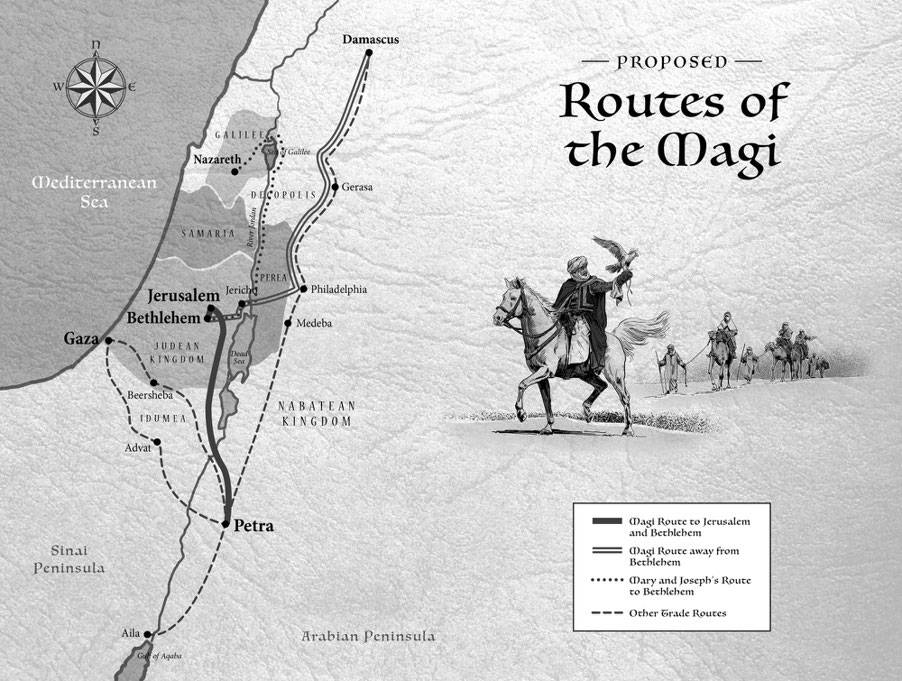
If the magi sheltered in Damascus, they would have been ‘in their own country’ but sheltered both from Herod and from their own king, Aretas III. Some time later, they would have been able to return to Petra via the trade route that stretched southwards from Damascus.
The beginning of this route to Damascus receives support from the existence of a small monastery, dedicated to St. Theodosius, which. according to tradition, marks when the Magi stopped on their journey from Bethlehem.
Putting together fragments of evidence, it is possible that the magi came into contact with Essenes in Qumran, before heading north to shelter with Essenes near Damascus.
In Acts 9 we read that Saul was authorised by the Jewish leaders in Jerusalem to travel to Damascus to round up the Christian believers there. It was on his way there that he received his vision of the risen Christ and was converted. But why was it that there was an important group of believers there? Could it be that they were members of a community established by the Magi after their visit to Bethlehem, 30 years earlier?
After his conversion, Paul states (in Galatians) that he went to Arabia. Following Margaret Barker, Longenecker speculates that Paul may have gone to Nabatea in Arabia, and there taught by a school established by the Magi. We find in Paul’s theology the three strains that would have been found in the Nabateans: (a) Abrahamic Judaism (e.g Gal 4:25); (b) a knowledge of mystery religions (rejected by Paul, but still lending language and imagery to his thinking – see Eph 1:9)); and (c) Greek philosophy (cf. 1 Cor 1:22-25; Acts 17:22-34).
But if the Magi were Nabatean diplomats, why didn’t Matthew say so? Longenecker suggests three reasons.
(a) he didn’t need to; his audience of Jewish Christians in Judea would have understood clearly who the Magi were;
(b) Matthew’s sources may have handed the story down in such a spare form because both Herod and Aretas III were known to be vengeful and paranoic men; and
(c) Matthew may have wished to validate the benign Magian influence without lending credence to false magicians and gnostic sects by making too much of that influence.
All of this is admittedly speculative (more so than Longenecker’s theory that the Magi were courtiers from Nabatea). But it seems to make quite good sense of the available data.
Wilcock asks:
‘Is it not perfectly astonishing that men with so little to go on should venture so far, endure such hardships in travel, and face such uncertainties of finding the one the star betokened?’
Yes, it is astonishing, and we do not have to accept all of Wilcock’s assumptions about the arduousness of the journey to agree that the sign they saw, and the interpretation they felt drawn to, were similarly astonishing.
To Jerusalem – ‘They do not go to Herod but are only summoned to him (v 7) after he has heard of their purpose (v 3)’ (WBC).
We may assume that their seach for the new king began in the temple area (so Benjamin A. Foreman, Lexham Geographic Commentary). But, (as Foreman adds):
‘given the sensitivity of the subject and Herod’s involvement in the religious affairs of the day, they almost certainly would have been quickly summoned to Herod’s palace, 750 yards to the west (perhaps even on the same day).’
Calvin comments on the ‘meekness’ and ‘majesty’ of the circumstances:
‘It was a truly wonderful purpose of God, that he caused the entrance of his Son into the world to be attended by deep meanness, and yet bestowed upon him illustrious ornaments, both of commendation and of other outward signs, that our faith might be supplied with everything necessary to prove his Divine Majesty.’
And on the harmony of Christ’s meekness and majesty, Calvin writes:
‘A beautiful instance of real harmony, amidst apparent contradiction, is here exhibited. A star from heaven announces that he is a king, to whom a manger, intended for cattle, serves for a throne, because he is refused admittance among the lowest of the people. His majesty shines in the East, while in Judea it is so far from being acknowledged, that it is visited by many marks of dishonor. Why is this? The heavenly Father chose to appoint the star and the Magi as our guides, to lead directly to his Son: while he stripped him of all earthly splendor, for the purpose of informing us that his kingdom is spiritual. This history conveys profitable instruction, not only because God brought the Magi to his Son, as the first-fruits of the Gentiles, but also because he appointed the kingdom of his Son to receive their commendation, and that of the star, for the confirmation of our faith; that the wicked and malignant contempt of his nation might not render him less estimable in our eyes.’
So near, and yet so far! –
‘Many times those who are nearest to the means, are furthest from the end. See Mt 8:11-12. The respect paid to Christ by these Gentiles was a happy presage and specimen of what would follow when those who were afar off should be made nigh by Christ.’ (MHC)
“Where is the one who has been born king of the Jews?” Note: ‘born king’ (not ‘born to be king’). There is emphasis in the expression, ‘born king of the Jews’. Herod had no ancestral right to the throne: had been appointed as such by the Romans. The title belonged to Christ from birth, and as his birth-right.
The magi’s question immediately placed Jesus’ life in danger:
‘Herod’s whole life had been a struggle for power and legitimacy. Although he was king of Judea from 37 BCE until his death in 4 BCE, Herod was not a Jew but an Idumean. After his appointment as king by the patronage of Anthony and Octavian, he spent three years suppressing opposition in Judea and Galilee. He hired a mercenary army to protect himself, killed descendants of the Hasmoneans who posed potential threats, and built fortresses throughout his domain so that he would always be near one. To ask Herod where a new king had been born, therefore, immediately placed the child’s life in danger.’ (Culpepper)
What led the magi to interpret the star as indicating the birth of a new king of the Jews?
Dwight Longenecker retells this part of Matthew’s story as follows:
‘Herod was old and dying. The Nabateans, who had a shared ancestry with the neighboring Jews, had a cultural, historical, and religious interest in any newborn heir to Herod.
‘Because their trade routes to the port of Gaza went through Herod’sterritory, they also had an economic interest in who would be the nextking.
‘At the time, Herod was in favor with the emperor Caesar Augustus, while the Nabatean king, Aretas IV, was not. Aretas therefore also had a political motive to please Herod and an interest in the Herodian succession.’
‘He came to his own, and his own received him not’:
‘That was indeed a most shameful thing for the whole Israelite land and nation, that Christ was born in their midst and they should first hear of it from alien and heathen foreigners who came from a far country.’ (Martin Luther, Luther’s Works, vol. 52) (Cited in the Church History Study Bible)
“King of the Jews” ‘is the Gentile way of saying what a Jew would mean by “Messiah” (the term which Herod, who could hardly refer to someone else as “king of the Jews,” substitutes in v. 5).’ (France, NICNT)
Herod is referred to merely as ‘the king’. There is, then, a hint of the legitimacy of Jesus’ kingship over that of Herod, who was not a descendant of David, nor even a full-blooded Jew (he was half-Idumean, and therefore descended in part from Esau).
We see here a contrast between the true king and the false king:
‘Matthew is saying, is the true king of the Jews, and old Herod is the false one, a usurper, an impostor…This Herod died soon after Jesus’ birth; but his sons ruled on, and one of them, Herod Antipas, plays a significant role in the developing story of Jesus himself. The house of Herod did not take kindly to the idea of anyone else claiming to be ‘king of the Jews’.’ (Wright)
We shall meet the title ‘King of the Jews’ again:
‘This title will not reappear in Matthew’s narrative until chapter 27, when it will sum up the political charge against Jesus. There, as here, it will be used only by non-Jews; Jews themselves will use the more theologically loaded equivalents “king of Israel,” “Messiah,” and “Son of David.”’ (France, NICNT)
These words (the only words attributed by Matthew to the magi) suggest that the celestial phenomenon was distinctive, and that it indicated a royal birth. Possibly, the Magi had been taught by exiled Jews that a star would herald the coming of the messianic king, Num 24:17; 1 Sam 7:12-16; Ezek 34:23-31. There was an expectation at the time that a ruler would arise from Judea. This expectation was held not only by the Jews themselves, but was in fact quite widespread. Suetonius writes, “Throughout the whole of the East there had spread an old and persistent belief: destiny had decreed that at that time men coming forth from Judea would seize power [and rule the world]”. Such an expectation was recorded by Josephus and Tacitus. (See the discussion in Holman Apologetics Commentary)
As France (NICNT) notes, several strands of OT anticipation are woven into this account:-
- the explicitly Davidic quotation in v6
- the story of the Queen of Sheba and her visit to Solomon, 1 Kings 10:1-10
- Balaam’s prophecy of a star and a sceptre, Num 24:17-19. (Blomberg: ‘The Magi appear as Balaam’s successors to witness the fulfillment of Num 24:17.’)
- Balaam himself, a non-Israelite, visionary from the east, Num 22:5; 23:7.
- Herod, whose massacre recalls that of Pharaoh, each leading to a period of exile (for Moses and Jesus).
Culpepper discusses the connection with Balaam’s oracle in Num 24:17 – ‘A star will march forth out of Jacob,
and a scepter will rise out of Israel.’ –
‘The oracle of this non-Jewish prophet, fulfilled by David’s devastating defeat of Moab (2 Sam 8:2, 13–14), was later interpreted as prophesying the coming of a Davidic messiah (4QTest 11–13; 1QM 11.6–7; cf. T. Levi 1.3; Isa 9:2; Rev 22:16). Early in the second century, Rabbi Akiva acclaimed Simon Bar Kokhba (son of the star) as the Messiah. Philo referred to Balaam as a magician (magos; Mos. 1.276). The connection with Balaam, therefore, underscores the biblical precedent for magi, or non-Jewish prophets, recognizing the sign (a star) of the Davidic messiah.’
On the surprise that the magi no doubt experienced:
‘Doubtless these simple strangers expected all Jerusalem to be full of its new-born King, and the time, place, and circumstances of his birth to be familiar to every one. Little would they think that the first announcement of his birth would come from themselves, and still less could they anticipate the startling, instead of transporting, effect which it would produce-else they would probably have sought their information regarding his birthplace in some other quarter.’ (JFB)
“Star” – The word ἄστρον, astron can refer to ‘any luminous, non-terrestrial body, other than the sun and the moon, found in the sky’ (The Lexham Bible Dictionary). Therefore, suggestions that what the magi saw was a comet, say, lie comfortably within the range of this word. (Even today, astronomers do not hesitate to refer to the planet Venus as either ‘the Morning Star’ or ‘the Evening Star’, according to whether it is observed in the East, in the morning, or in the West, in the evening. And we commonly call meteors ‘shooting stars’.)
“We saw his star when it rose” – or, ‘in the east’. The word anatole can mean either. In v1 it clearly means ‘east’ (as in Rev 21:13), whereas in v2 it probably carries the alternative meaning (as in Lk 1:78).
But was the star in the east, or were the magi in the east when they saw the star? If they saw the star ‘in the east’, then this raises the question of why they then headed off in the opposite direction, west, towards Jerusalem. Some think that the meaning therefore is, “We, being from the east, saw his star.” So Culpepper: ‘in the East we saw his star’.
If the star was a purely supernatural phenomenon, then, of course, it could have ‘arisen’ anywhere in the sky, including in the west.
However, it is possible that the magi did see the star ‘in the east’, or, ‘rising in the east’. There is nothing in the text at this point to suggest that the star was ‘pointing’ anywhere in particular, or that they ‘followed’ the star in the direction to which it was ‘pointing’. That comes later in the narrative. The star may have been in the eastern sky, but conveying a message that indicated that the royal birth was to take place in Judea, in the west.
This latter interpretation is favoured by Nicholl and others, and implies that the Magi are referring back to the appearance of the comet in the constellation of Virgo, low down in the eastern morning sky (see the notes on Rev 12:1-5). Specifically, Nicholl thinks that this expression refers to the comet’s ‘heliacal rising’ – that is, its first appearance in the morning sky just before its light is overwhelmed by that of the Sun. Such a heliacal rising was considered significant in ancient times. A heliacal rising in on zodiacal constellation would add further significance to the event. Such a rising is suggested by the prophecy of Balaam, Num 24:17; cf. Zech 6:12; Lk 1:78; 2 Pet 1:19; Rev 2:26-28; 22:16.
Elsewhere in the NT Jesus is himself referred to as the rising star, Lk 1:78; 2 Pet 1:19; Rev 22:16.
Gundry understands the text to refer to the star’s ‘rising’. He comments:
‘The star’s rising indicated the birth of the Jews’ king. Like Balaam, a Gentile prophet in Old Testament times, the astrologers arrived “from the East” (Numbers 23:7). Balaam too saw a rising royal star, one that represented David just as the present rising star represents Jesus as a king in David’s lineage and likeness (Numbers 24:17–19).’
With regard to the identity of the ‘star of Bethlehem’ (Matthew 2), scholars have considered various options. If it was not a purely supernatural phenomenon, then I think that the theory that it was a comet seems to best fit the available data. See longer note following.
Nicholl argues that Matthew’s account is consistent with the celestial picture drawn in Rev 12;1-5, and that both describe the appearance of a comet in the constellation of Virgo.
Astronomical phenomena came particularly to be associated with kings and rulers in 44 BC, when a nova appeared in the sky over the funeral pyre of Julius Caesar. During the 1st century AD there was a strong rumour, reported by Tacitus, Josephus and Seutonius, that a world leader would come out of Judea. It is therefore not surprising that the Magi inferred political upheavals in the star they saw. The Jewish messianic expectation included reference to a star, Num 24:17. Accordingly, it can be seen that both Gentile and Jewish worlds were predisposed to seeing significance in celestial occurrences.
Babylonian astrologers believed that a person’s fate was determined by the positions of stars and planets at the time of birth. It would appear that, on this occasion, they saw something unique: unusually conspicuous, and disclosing information about a royal birth hundreds of miles away.
How did the magi know about the meaning and significance of this birth? –
(1) They could have been Jews who remained in Babylon after the Exile and knew the Old Testament predictions of the Messiah’s coming.
(2) They may have been eastern astrologers who studied ancient manuscripts from around the world. Because of the Jewish exile centuries earlier, a large Jewish population still existed there, and they would have had copies of the Old Testament.
(3) They may have had a special message from God directing them to the Messiah.’ (Life Application Bible Commentary, paragraphing added)
Matthew Henry:
‘The birth of Christ was notified to the Jewish shepherds by an angel, to the Gentile philosophers by a star: to both God spoke in their own language, and in the way they were best acquainted with.’ (MHC)
A very similar observation, in Lange’s commentary:
‘Gerlach, in his Commentary, says: As Jesus adapted Himself to the fishermen by the miraculous draught of fishes; to the sick, by the curing of their infirmities; and to all His hearers, by parables relating to the circumstances around, and the affairs of, ordinary life; so did He draw these astronomers to Himself by condescending to their favorite science.’
‘The idolaters worshipped the stars as the host of heaven, especially the eastern nations, whence the planets have the names of their idol gods; we read of a particular star they had in veneration, Am 5:26. Thus the stars that had been misused came to be put to the right use, to lead men to Christ; the gods of the heathen became his servants.’ (MHC).
“We…have come to worship him” – Although this expression could be used simply to refer to paying homage to a person of higher rank (see Mt 18:26), for Matthew it usually implies an act of worship directed towards a deity. Whatever the Magi’s intentions, Matthew’s readers know the real meaning of what the magi have come to do better than the magi themselves knew, namely, “worship” in its full sense. That is, Jesus is the manifestation of God’s presence, Mt 1:23, the son of God, Mt 2:15 in a unique sense, and thus one to be worshiped.
Longenecker suggests that:
‘They came to pay him homage because their king, Aretas IV, was building an alliance with Herod. Paying homage to a newborn prince with rich gifts was the traditional royal protocol. It was also the perfect step to build goodwill with Herod.’
Calvin ponders the motives of these foreign visitors:
‘The reason why the star had been exhibited was, to draw the Magi into Judea, that they might be witnesses and heralds of the new King. So far as respects themselves, they had not come to render to Christ such pious worship, as is due to the Son of God, but intended to salute him, according to the Persian custom, as a very eminent King. For their views, with regard to him, probably went no farther, than that his power and exalted rank would be so extraordinary as to impress all nations with just admiration and reverence. It is even possible, that they wished to gain his favor beforehand, that he might treat them favorably and kindly, if he should afterwards happen to possess dominion in the east.’ (Calvin)
‘Herodotus says that the Magi were priests of the race of the Medes. It is likely that they were astrologers. It may seem strange that these Medians should have known of the Jewish Messiah, but the Jews had spread through the former Persian empire and many would have spoken of the promise found throughout the OT. Daniel the Jew had also gained a reputation as a wise man under the Babylonian and Persian empires. Thus wise men of the East would have been aware of the belief that a great Ruler was to be born among the Jews.’ (ISBE)
Michael Green ponders the wholeheartedness of their search for the new King:
‘Impressed by what they saw in the skies at night, they journeyed west to Judea to find out what it meant. Is it not perfectly astonishing that men with so little to go on should venture so far, endure such hardships in travel, and face such uncertainties of finding the one the star betokened? What is more, they wanted to give him costly gifts and the worship of their hearts…I find their faith, their insight, their wholehearted search and adoring worship, utterly amazing. It is one of the many surprises in the Gospel. But then God is the God of surprises. How sad that in many churches, this element of surprise is almost entirely absent, and boring predictability governs all that happens!’
Green adds that Matthew, in recording all this, had an eye on his own day:
‘By the time he wrote, Gentiles were flooding into the church, whereas most of his Jewish compatriots did not want to know.’
Matthew Henry comments on the comparing of notes by Gentiles and Jews:
‘The Gentiles know the time of his birth by a star; the Jews know the place of it by the scriptures; and so they are capable of informing one another.’ (MHC)
But there are also stark contrasts between the two groups:
‘Matthew made a significant point in highlighting the worship of these wise men (who were pagan astrologers, wise in the ways of secular science, diviners, and magicians) in contrast to the Jewish religious leaders who knew the Holy Scriptures and did not need to travel far to find their Messiah. The Jewish leaders directed the wise men to Bethlehem but apparently did not go themselves. (Mt 2:4-6) Some scholars say these wise men were each from a different land, representing the entire world bowing before Jesus. These men from faraway lands recognized Jesus as the Messiah when most of God’s chosen people in Israel did not. Matthew pictures Jesus as King over the whole world, not just Judea.’ (Life Application)
John Thornbury supposes that the Magi came from Babylon (modern Iraq), and that their journey would have taken about four months. Whether this is so or not, it is clear that they expended considerable effort and determination. Application:
‘When God’s grace gets ahold of the hearts of people, they become earnest and determined seekers for God’s revelation to their hearts. Sometimes, when the great truth of salvation by grace is preached, especially when God’s sovereign agency is acknowledged in the opening of men’s hearts, people mistakenly believe that all they have to do is to wait for the ‘lightning bolt’ of divine power to strike them.’
Jesus taught that we are to ‘labour…for the food that endures to everlasting life’ (Jn 6:29). God expects people to actively seek him, and not simply sit back and wait for him to act (Acts 17:22-25).
2:3 When King Herod heard this he was alarmed, and all Jerusalem with him.
King Herod…was disturbed – This is too weak: ‘greatly disturbed’ would be better. And well he might be, for he had obtained his kingdom through fraud and violence, and would have been very fearful that the throne might be occupied by a more rightful heir.
Matthew Hentry:
‘Carnal wicked hearts dread nothing so much as the fulfilling of the scriptures.’
Morris:
‘The news that the Magi were bringing sounded suspiciously like the emergence of a genuine descendant of the royal line of David as a claimant to the throne.’
Alan Millard:
‘Herod was suspicious of anyone whom he thought could try to take the throne away from him. One-time friends, servants, countless enemies, priests, nobles, and all who crossed him in some way were killed.’
Michael Wilkins (Holman Apologetics Commentary) argues that since the Magi probably travelled in a sizeable company, this gave Herod the impression that forces were gathering that would oust him from his throne and usher in the rightful Messiah.
Benjamin A. Foreman (Lexham Geographic Commentary) notes Herod’s extreme instability and paranoia at this time:
‘A good case can be made for dating this event to late 5 BC, several months before Herod’s death. According to Josephus, Herod was deathly ill at this point and extremely paranoid about conspiracies to seize his throne (e.g., Ant. 17.167–168). A short while earlier he had killed his sons Alexander and Aristobulus after suspecting them of plotting his assassination, and in the final days of his life he executed his son Antipater, outliving him by only five days (War 1.664–5). After executing his son Antipater, he changed his will for the seventh time and named his sons Archelaus, Philip, and Antipas as his successors. In short, talk of a newly-born king of the Jews could not have come at a worse time.’
All Jerusalem with him – This probably refers to the religious leaders – the chief priests and the scribes, mentioned in the next verse. This rejection of Jesus by Jerusalem foreshadows the pattern of his adult ministry (cf. Mt 27:15-26). Carson remarks that their concern was not born out of any sympathy with or admiration for Herod, but rather an awareness that the very thought of a possible rival for the paranoid king would result in yet more cruelty (as indeed it did). France adds that Matthew may have mentioned this as the beginning of ongoing antagonism of the Jerusalemites to Jesus (culminating in their willingness to take responsibility for his execution, Mt 27:24f).
Wilkins thinks that
‘their reaction gives a clue to the spiritual health of Israel’s leadership. They have aligned themselves politically with Herod, and if his power base is threatened, so is theirs.’
John Hudghton notes:
‘The Herodian-appointed Priests who depended on his patronage would have been as disturbed as Herod himself at the news of a new King. Had these strangers been wandering Gypsylike fortune tellers they would neither have gained access to Herod’s court or been given any credibility. However as they were the respected Magi – the Parthian religious civil service they received a hearing.’
We need not assume that the Jerusalemites had not seen the star. Rather, what they had not perceived was its significance.
Neither Herod, the reigning king, nor the Jews of Jerusalem, make any attempt to seek out Jesus, let alone worship him. It is the pagan astrologers who do that. It is fitting that Matthew should record this, since he writes especially for the Jews, and moreover records their rejection of Christ as well as the outreach of the Gospel to the Gentiles.
On the differing reactions to the birth of Christ, Matthew Henry comments:
‘The first who took notice of Christ after his birth were the shepherds, (Lk 2:15, etc.) who saw and heard glorious things concerning him, and made them known abroad, to the amazement of all that heard them, Mt 2:17,18. After that, Simeon and Anna spoke of him, by the Spirit, to all that were disposed to heed what they said, Lk 2:38. Now, one would think, these hints should have been taken by the men of Judah and the inhabitants of Jerusalem, and they should with both arms have embraced the long-looked-for Messiah; but, for aught that appears, he continued nearly two years after at Bethlehem, and no further notice was taken of him till these wise men came.’
‘When Jesus was born into our world, people immediately began to react. His presence did not soothe and comfort people; instead, it startled and disturbed them. In some, he awakened spiritual longings; in others, fear and insecurity.’ (Life Application)
‘Here, at the very start of his life, we see two camps forming: one full of praise and welcome; the other full of hatred and opposition. Herod and the Magi stand out in strong contrast, a contrast that will deepen as the story of Jesus’ life unfolds towards the cross.’ (Wilcock)
‘The sharp contrast between these well-motivated foreigners and the unscrupulous jealousy of Herod, the official King of the Jews (and all Jerusalem with him), foreshadows the response which official Judaism will make to Jesus, and the future welcome of Gentile believers into the true people of God.’ (NBC)
Bruner finds in Matthew’s first two chapters ‘a Gospel in miniature’:
Matthew 1 and 2’s teachings of revelation (Matt 1) and of response to revelation (Matt 2) make the Christmas stories a Gospel in miniature (Brown, Birth, 183).
The Magi’s faith dominates the first half of chap. 2, Herod’s unfaith, the second half (see the neat outline in Davies and Allison, 1:224 and Luz, 5th ed., 1:158).
The irony is that outsiders seek, find, and worship the Messiah of Israel, while insiders’ leadership seeks to eliminate its most sought-after king (Lohmeyer, 26; McKenzie, 67; Schweizer, 37; Davies, 327).
Thus the first are last and the last first, a frequent theme in Matthew (Mt 19:30; 20:16, 26–27; 23:12, etc.).
Indeed, the heathen preach Christ to Israel (2:2), and, even more, it is “star-crossed” Magi(cian) heathen who do the preaching, persons considered the antonym of Spirit-inspired prophets (Schlatter, Das Evangelium, 13; cf. McNeile, 22).
Thus the NT Magi parallel the OT Balaam, the pagan magician who, though a pagan, knew God (Num 24:4, 16 LXX), came from the mountains of the East (Num 23:7; 22:5), preached salvation to Israel, and spoke of a scepter star that will “rise out of Israel” (Num 24:17) (Lohmeyer, 25; Schweizer, 37; Luz, 5th ed., 1:161). (Re-paragraphed)
2:4 After assembling all the chief priests and experts in the law, he asked them where the Christ was to be born. 2:5 “In Bethlehem of Judea,” they said, “for it is written this way by the prophet:
2:6 And you, Bethlehem, in the land of Judah,
are in no way least among the rulers of Judah,
for out of you will come a ruler who will shepherd my people Israel.’ ”
Chief priests – Strictly speaking, there was only one, but the plural may be given to cover a range of officials.
He asked them where the Christ was to be born – That Herod had to ask this question at all shows that he had only a superficial knowledge of the Jewish Scriptures.
The magi had limited information, but the came, and saw, and worshiped. The chief priests and experts in the law, on the other hand, had much accurate information, but did nothing.
“In Bethlehem in Judea” – The answer is supplied from Mic 5:2. This would have seemed remarkably apt to the Magi, since ‘Bethlehem’ means ‘house of grain’ in Aramaic (spoken in Mesopotamia and Judea) and Hebrew, and Spica, the brightest star in Virgo, was strongly associated with an ear of corn. Given that the zodiacal constellations were (and are) referred to as ‘houses’, both Virgo and Bethlehem were known as ‘house of grain’.
‘The context of the passage in Micah seems clearly messianic and was regularly so taken by pre-Christian Jews. The remainder of the verse which Matthew leaves unquoted (“whose origins are from of old, from ancient times”) suggests more than a mere mortal is in view. Perhaps Micah even had in mind the child of Isa 7:14 and Isa 9:6. Certainly such a prophecy excludes many potential messianic aspirants and refutes the argument that Jesus claimed to be the Messiah simply by setting out to fulfill all of the Scriptures relevant to the office. He scarcely could have chosen his place of birth.’ (NAC)
This verse appears to be in contradiction with Jn 7:42, where it is stated that ‘when the Christ comes, no one will know where he is from.’ See note following.
‘There is more gross ignorance in the world, and in the church too, than we are aware of. Many that we think should direct us to Christ are themselves strangers to him.’ (MHC)
Ryle says that this passage teaches that ‘there may be knowledge of Scripture in the head, while there is no grace in the heart.’ The priests and elders could give a ready and accurate answer to Herod’s enquiry, but not one of them made their way to Bethlehem to seek the Saviour for themselves. They had head-knowledge, but no heart-response.
Herod’s ‘scripture experts’, who told the Wise Men where the Messiah was to be born, ‘do not feel prompted to take any practical steps as a result.’ Does this, asks Joseph Ratzinger (Pope Benedict XVI), ‘furnish us with the image of a theology that exhausts itself in academic disputes?’ (Jesus of Nazareth: The Infancy Narratives)
‘They thus showed, as Ridderbos points out, that their failure to believe was not due to ignorance: “Israel knew precisely where the King of the Jews would be born, but it was the Gentiles who worshiped him first”.’ (Morris)
See also Jn 7:42. This may be a continuation of the quote by the Jewish leaders, or alternatively it may be an annotation by Matthew.
The quotation is based on Mic 5:2, but with the latter part drawing on 2 Sam 5:2.
The quotation has been adapted to show that the fulfilment is yet more expansive then the prediction:
‘Bethlehem is no longer “of Ephratha” but “in the land of Judah”, and it is no longer “one of the little clans” but the opposite: “by no means least among the rulers.” Rather than simply “ruling” in Israel, the citation in Matthew speaks of the coming ruler “shepherding” Israel.’ (DJG, 2nd ed., art. ‘Birth of Jesus’).
Gundry states:
‘Matthew edits the following quotation to bring out Jesus’ Davidic messiahship: it’s as though he subpoenas the chief priests and scholars to testify on his behalf about Jesus as the fulfillment of Micah’s prophecy. “Land of Judah” replaces Micah’s “Ephrathah” for an allusion to the man Judah, progenitor of David’s royal tribe (1:2–3). Then Matthew inserts “by no means” to deny emphatically the leastness of Bethlehem in Micah’s text. For Matthew, in other words, Jesus’ birth has transformed Bethlehem from the unimportant village it was during Micah’s time into the supremely important birthplace of the messianic king from David’s line.’
The mention of ‘the land of Judah’ is, says France, in order to bring out Jesus’ Judean origins and therefore his entitlement to the throne of David.
“In no way least” – Mic 5:2 has ‘though you are small’.
The quotation refers back to Mic 5:2. Among a number of differences between the original and this quotation in Matthew, the most significant is the fact that Micah, in referring Bethelehem, has ‘though you are small’; whereas Matthew has ‘you…are in no way least’.
Any ‘contradiction’ is more formal than material. Matthew’s version simply brings out and emphasises what is already latent in the original. See longer note, below.
“The shepherd of my people Israel” – Mic 5:2 has ‘ruler over Israel’. The present wording draws in the thought of 2 Sam 5:2 – ‘You will shepherd my people Israel, and you will become their ruler’ (the Lord’s words to David).
Not only place, but character:
‘Matthew’s quotation not only answers Herod’s and the Magi’s question regarding the place of the Christ child’s birth while showing the city once despised as now honored, but it also adds another aspect to the work of the royal Messiah. He will not only rule but also “shepherd” the people of Israel. A shepherd as an image of a ruler of God’s people appeared commonly in the Old Testament (see Ezek 34). It implies guidance, pastoral care, and a sense of compassion. (see Mk 6:34) The final phrase of Matthew’s quotation comes from 2 Sam 5:2, in which godly shepherding formed part of the role assigned to Israelite kings. What they often failed to carry out, the Messiah will now perform properly.’ (NAC)
Albert Barnes:
‘Though a small place so far as population is concerned, yet it shall not be small, or least, in honour; for the Messiah shall be born there. His birth gave the place an honour which could not be conferred on the larger cities by all their numbers, their splendour, and their wealth. The birth of a distinguished personage was always supposed to give honour and importance to a city or country. Thus seven cities contended for the honour of giving birth to Homer; Stratford-upon-Avon is distinguished as the birth-place of Shakespeare; and Corsica as the birth-place of Napoleon.’
2:7 Then Herod privately summoned the wise men and determined from them when the star had appeared. 2:8 He sent them to Bethlehem and said, “Go and look carefully for the child. When you find him, inform me so that I can go and worship him as well.”
Herod called the Magi secretly – Secretly, so as not to endanger his evil plan to eliminate his ‘rival’. No doubt Herod reasoned that if he knew the exact time the star appeared, he would know the age of the child.
Matthew Henry:
‘He would not openly own his fears and jealousies; it would be his disgrace to let the wise men know them, and dangerous to let the people know them. Sinners are often tormented with secret fears, which they keep to themselves.’
The exact time the star had appeared – This suggests a different time-scale to the one which applies to Luke’s shepherds:
‘If the initial appearance of the star was understood to mark the time of the Messiah’s birth (as Herod apparently thought, v. 7), the visit must be sufficiently long after that to allow the magi to reach Jerusalem from their unspecified country of origin; the contiguous arrival at the manger of Luke’s shepherds and Matthew’s magi thus owes more to theatrical convenience than to historical probability!’ (France, NICNT)
He sent them to Bethlehem – Sceptics wonder why he entrusted the Magi with this task, rather than sending some of his own men.
The 19th-century rationalist critic David Friedrich Strauss questioned the plausibility of Herod’s action: With regard to Herod’s instructions to report back to him, Strauss notes that surely the magi would have seen through his plan at once. There were also less clumsy methods Herod might have used to find out where the child was; why did he not, for example, send companions along with the magi to Bethlehem?
Ian Paul remarks that
‘we know from Josephus that Herod had a fondness for using secret spies. And in terms of the story, the magi are unaware of Herod’s motives; we are deploying our prior knowledge of the outcome to decide what we think Herod ought to have done, which is hardly a good basis for questioning Matthew’s credibility.’
France agrees:
‘Herod had a liking for the use of under-cover agents, and he had no reason to doubt their compliance, while an armed escort might well have jeopardized a successful search for the family concerned.’
France adds:
‘We may well suppose that the magi, even before their dream in v. 12, would have had their suspicions aroused by the desire of the reigning king to pay homage to a supposed “heir to the throne” whose whereabouts he did not know and of whose very existence he had hitherto been ignorant.’
The comment of Robert Clifton Robinson…
‘Contrary to the traditional Christmas story, the Magi came to see their baby after Joseph, Mary and Jesus were back in Jerusalem; not at Bethlehem during the manger scene that is depicted in the gospels earlier.’
…is confused. He is correct in judging that the Magi’s visit probably took place some time after the ‘manger scene’, but incorrect if he thinks that they visited Jesus and his parents in Jerusalem. According to the present verse, it was to Bethlehem that they were sent.
2:9 After listening to the king they left, and once again the star they saw when it rose led them until it stopped above the place where the child was. 2:10 When they saw the star they shouted joyfully.
They went on their way – Unaccompanied by the ‘great and the good’ of Jerusalem:
‘But where were ye, O Jewish ecclesiastics, ye chief priests and scribes of the people? Ye could tell Herod where Christ should be born, and could hear of these strangers from the far East that the Desire of all nations had actually come: but I do not see you trooping to Bethlehem – I find these devout strangers journeying there all alone. Yet God ordered this too, lest the news should be blabbed, and reach the tyrant’s ears, before the Babe could be placed beyond his reach. Thus, are the very errors and crimes and cold indifference of men all overruled.’ (JFB)
The star they had seen in the east went ahead of them until it stopped over the place where the child was – To some (both believers and sceptics), this apparent movement makes the explanation that the star was a natural phenomenon rather difficult. According to the Sceptics’ Annotated Bible, ‘if the star “went before them,” leading them to Bethlehem, then it couldn’t have been a star or any other astronomical object or event.’ But such scepticism is found to be misplaced, given Nicholl’s recent work.
If the ‘star’ was, as many assume, a conjunction, then it can hardly be described as moving ‘ahead of them until it stopped.’ But, as Mounce suggests, this may be ‘no more than a way of saying that what they had seen in the heavens “led” them to find the newborn Messiah.’ Longenecker is sympathetic to the idea that this ‘stopping over’ describes the retrograde and then stationary movement of Jupiter. But he also notes the (to my mind more probable) theory of Nicholl and others that what is being described here is the ‘pointing’ downward of the tail of a comet.
This is the only indication in the narrative that the star ‘led’ and the magi ‘followed’. But a highly influential mythology has been built up around ‘following the star’.
Until it stopped – more literally, ‘until, having come, it stopped’, which Nicholl understands as referring to its descent towards the horizon.
Humphreys regards this description of the star as ‘standing over’ the place where Jesus was born (either the town, or the very house) as ‘the most powerful evidence that the star of Bethelehem was a comet.’
Nicholl regards it as probable that the star became visible in the southern sky at sunset. Its ‘stopping over the place where the child was’ suggests its dropping towards the western horizon in the now-dark sky. Of course, they already knew to go to Bethlehem, and they did not need celestial help in finding it; we therefore infer that ‘the place’ in question is ‘the house’ of v11.
Nicholl remarks that the comet’s tail may have played different roles up to this point: it may have been the water being poured from Aquarius’ jug and the arrow of the bow of Sagittarius the archer. It had also taken the role of a royal scepter. Now it is a pointer to the precise place where the Messiah lay.
According to ISBE:
‘In the Bible at least three astronomical miracles are recorded: Joshua ordering the sun to “be still,” (Jos 10:13) the shadow going back on the dial of Ahaz, (2 King 20:8-11) and the star of Bethlehem. (Mt 2:1-11) There are three common ways of attempting to understand miracles in the biblical narratives. The first is to try to find a natural explanation for an apparently supernatural phenomenon. [The second] is to understand it as poetical hyperbole. The third way is to regard the biblical narrative as an essentially accurate account of a truly supernatural event. The Bible itself suggests that these miracles are the mighty work of God and not astronomical flukes. The God of the Bible is the creator of all celestial objects and they bear witness to him. He can certainly intervene and change their natural course’
The foregoing does not quite cover all the options, however: a number of such miracles may be miracles of timing, in that the events are natural, but their timing providential.
However,
‘the apparent disappearance and reappearance is what makes some scholars believe this to be a planetary conjunction in which the planets came together, then parted, then reconverged.’ (HSB)
More plausible still is the cometary theory. According to Nicholl, the comet would have appeared first in the eastern sky in the morning, and then dropped below the horizon, reappearing a month or two later in the southern sky in the evening. This reappearance is hinted at by the magi’s joyful surprise, noted in v10. If the comet was in the southern sky, directly in front of them, then it would seem to go ‘ahead of them’. Its tail would point to the very place ‘where the child was’.
Over the place where the child was – Over Bethlehem, or over the house itself? If Bethlehem, then we may suppose that the presence of the star simply confirmed what the magi had already been told. For, as Carson remarks, the shepherds, who had visited earlier, had publicised the birth throughout the neighbourhood (Lk 2:17f). If the house itself, then we have to wonder how any astronomical phenomenon can pinpoint an earthly location with such position.
‘The Magi appear as Balaam’s successors to witness the fulfillment of Num 24:17.’ (NAC)
When they saw the star, they were overjoyed – This, together with the previous verse (‘…the star they had seen in the east…’) suggests that the star made a reappearance, having been unobservable for a while. They had probably not been expecting it to reappear. It had previously been in the east, but now it is in the south.
On the joy of the Magi, Gundry comments:
‘The combination of “rejoiced,” intensified by “exceedingly,” and “joy,” magnified by “great,” puts enormous emphasis on the astrologers’ joy, which anticipates the joy of Christian disciples in the gaining of God’s kingdom (Mt 13:44), in the discovery of Jesus’ resurrection (Mt 28:8–9), in their eternal reward (Mt 25:21, 23), and even in their present persecution (Mt 5:10–12).’
2:11 As they came into the house and saw the child with Mary his mother, they bowed down and worshiped him. They opened their treasure boxes and gave him gifts of gold, frankincense, and myrrh.
The absence of any mention of Joseph is a quiet confirmation of the truth of Mt 1:18-25, namely, that Jesus was born of a virgin in fulfilment of Isa 7:14.
As they came into the house – The bare reference to ‘the house’ implies that it was Joseph’s house; although Joseph is not mentioned here.
Of course, later Christian tradition has tended to amalgamate the visit of the shepherds and the Magi. But the visit of the Magi may have taken place some time – up to two years after the birth of Jesus. But it is by no means certain that Luke regards Jesus as having been born in a stable, Lk 2:7. So it is quite possible that the shepherds and the magi visited the same dwelling.
It is curious that even careful readers of the biblical text slip into an assumption that Jesus was born in a stable, when the text says no such thing.
Longenecker, for example, writes:
‘The wise men came to a house, not a stable. Mary and Joseph, therefore, must have moved into better accommodations.’
Culpepper says that:
‘Matthew gives no indication of Luke’s account that Mary and Joseph traveled to Bethlehem and that Jesus was born in a stable.’ (Emphasis added)
Osborne:
‘Some see a contradiction with Luke 2:7, which has Jesus born in a stable.’
(But then Osborne goes on to state:
‘The idea of a separate stable is wrongheaded. Palestinian homes at that time had mangers at the edge of the living area with the animals, kept either downstairs or (in a one-room home) in one end of the house. So this could be the same home in which Jesus was born.’)
Hagner:
‘The words εἰς τὴν οἰκίαν, “into the house,” show that Matthew apparently does not know of the Lukan tradition that the child was born in a stable (Luke 2:7), just as he does not appear to know of a previous residence of Mary and Joseph in Nazareth (Luke 1:26).’
Unwarranted assumptions abound, including: (a) that according to Luke, Jesus was born in a stable; and (b) that the magi’s visit took place at the time or, or soon after, the Saviour’s birth.
The child – paidion. The word itself does not establish Jesus’ age at this time, for the same term is used of Jesus at his birth and presentation in the Temple (Lk 2:17,27).
They bowed down and worshiped him – They may not have fully realised it, but their actions suggest that the now-born baby is to be regarded as not only of a royal, but also of a divine, character.
They came – having traveled far and long
They saw –
They bowed down and worshiped –
They gave – of their best
‘For these foreign dignitaries to prostrate themselves in homage before a child in an ordinary house in Bethlehem is a remarkable illustration of the reversal of the world’s values which will become such a prominent feature of the Messiah’s proclamation of the kingdom of heaven (Mt 18:1–5; 20:25–28 etc.).’ (France)
‘He is seen as man; he is adored as Lord. He lies in swaddling clothes but shines amid the stars. The cradle shows his birth, the stars his dominion.’ (Ambrose, “Exposition of the Christian Faith”) (Cited in the Church History Study Bible)
The first shall be last, and the last first:
‘These verses show us that it is not always those who have most religious privileges, who give Christ most honour. We might have thought that the scribes and Pharisees would have been the first to hasten to Bethlehem, on the slightest rumour that the Saviour was born. But it was not so. A few unknown strangers from a distant land were the first, except the shepherds mentioned by St. Luke, to rejoice at his birth. “He came unto his own, and his own received him not.” (Jn 1:11) What a mournful picture this is of human nature! How often the same kind of thing may be seen among ourselves! How often the very persons who live nearest to the means of grace are those who neglect them most!…Familiarity with sacred things has an awful tendency to make men despise them. There are many, who from residence and convenience ought to be first and foremost in the worship of God, and yet are always last. There are many, who might well be expected to be last, who are always first.’ (Ryle)
Is this the Saviour of the world? –
‘We may well imagine their expectations were raised to find this royal babe, though slighted by the nation, yet honourably attended at home; and what a disappointment it was to them when they found a cottage was his palace, and his own poor mother all the retinue he had! Is this the Saviour of the world? Is this the King of the Jews, nay, and the Prince of the kings of the earth? Yes, this is he, who, though he was rich, yet, for our sakes, became thus poor.’ (MHC)
They honour Jesus, not Herod:
‘We do not read that they gave such honour to Herod, though he was in the height of his royal grandeur; but to this babe they gave this honour, not only as to a king (then they would have done the same to Herod), but as to a God.’ (MHC)
‘How glorious is that faith which triumphs over all visible appearances! To the expectations of these eastern visitors “the house” at Bethlehem would be not a little disappointing. Yet “when they saw the child” – differing in nothing to the outward eye from any other babe – “they fell down and worshipped Him.”‘ (JFB)
They opened their treasures – or, rather, their ‘treasure-boxes’ (WBC). Carson remarks that ‘bringing gifts was particularly important in the ancient East when approaching a superior (cf. Gen 43:11; 1 Sam 9:7–8; 1 Kin 10:2).’
Gifts of gold and of incense and of myrrh – Frankincense and myrrh are associated in Song 3:6 4:6.
All three items are mentioned in Rev 18:12f in the list of luxury goods merchants will weep over, because, after God’s judgement of Babylon, noone will care about them any more.
The number of the gifts has led to the otherwise unfounded tradition that the Magi were three in number.
But why these particular gifts? The deist Thomas Woolston mockingly said that if they had been truly wise they would have brought sugar, soap and candles. These days, it is often quipped that three Wise Women would have asked directions, arrived on time, delivered the baby, cleaned the stable, cooked a casserole, and brought practical gifts.
The key, of course, is in the text, when it is said that the magi ‘worshiped’ him. They were gifts fit for a king, as foreshadowed in Psa 72:8-11 and Isa 60:4-7.
Gundry comments of the significance of the gifts:
‘Elsewhere in Matthew “gift(s)” is used exclusively and often for offerings to God (Mt 5:23–24; 8:4; 15:5; 23:18–19), and the verb “offered” has to do with such offerings in Mt 8:4 and throughout the Old Testament. So the astrologers’ offering of these expensive gifts adds further emphasis on Jesus’ deity and kingship; and the astrologers stand as prototypes of his disciples, who give up earthly treasures for heavenly treasures (Mt 6:19–21; 19:21). Like the Gentile kings in Psalm 72:10–11, 15, the astrologers bring gifts of gold to a superior king in Israel. Like the Gentile kings in Isaiah 60:2–3, 6, they bring gold and frankincense. And as Solomon the immediate son of David is perfumed with myrrh and frankincense in the Song of Solomon 3:6; 4:6, Jesus the later son of David is given frankincense and myrrh.’
Although some critics think that Matthew has ‘invented’ the Magi to suit his own theological purposes, this judgement violates the ‘criterion of embarrassment’. As Ian Paul remarks:
‘Matthew’s inclusion of magi is theologically very problematic indeed. Simon Magus and Elymas (Acts 8.9, 13.8) hardly get a good press, not surprising in light of OT prohibitions on sorcery, magic and astrology. Western romanticism has embraced the Epiphany as a suggestive mystery, but earlier readings (like that of Irenaeus) saw the point as the humiliation of paganism; the giving of the gifts was an act of submission and capitulation to a greater power. For Matthew the Jew, they are an unlikely and risky feature to include, especially when Jesus is clear he has come to the ‘lost sheep of the house of Israel’ (Matt 10.6, 15.24).’
Mounce agrees that
‘the giving of gifts in the ancient East was an act of submission and allegiance (cf. Ps. 72:10–11, 15; Isa. 60:6).’
Dwight Longenecker argues that the gifts are not legendary. But neither do they convey particular symbolic significance; nor do they suggest kingship. Rather, ‘they are the ordinary currencies and commodities of the Middle East in the first century’ (Mystery of the Magi). Such gifts would represent the finest that the country of origin could offer.
Culpepper comments on the construction of the ‘Christmas card’ version of events:
‘Reflection on Isaiah and Psalms shaped later Christian interpretation.
Isaiah says that when the nations come to worship in Jerusalem, “They shall bring gold and frankincense” (Isa 60:6). Psalm 72:15 adds, “May gold of Sheba be given to him. May prayer be made for him continually.” Frankincense and myrrh were sweet gum resins. Although neither is native to Israel, both were used in the temple liturgy. Both came from Arabia, leading to speculation that the magi came from Arabia. Frankincense was used for incense, leading to the pious connection with offering prayer to the Christ child. Myrrh was used for perfumes, incense, and burial spice (John 19:39–40; cf. Luke 24:1; Rev 18:13), leading to the interpretation that it symbolizes Jesus’ death and burial (even though Matthew changes myrrh [Mark 15:23] to gall in 27:34).
The reference to kings in Ps 72:10–11 probably suggested the interpretation that the magi were kings, and the three gifts hinted that there were three magi—hence, “We Three Kings of Orient Are”!
Finally, the reference to camels in Isa 60:6 probably gave rise to the assumption that they rode camels.
The Christmas card is therefore complete: three wise men, kings, riding camels, carrying treasure boxes, and following the star!’
(Paragraphing added)
If (as Colin Adams agrees) the preacher should avoid attaching a symbolic meaning to each of the gifts, what emphases should be brought out from this passage?
Adams offers a few suggestions:
1.Promises of the coming Davidic King are now being fulfilled. Note the significance of Jesus’ birthplace and the allusion to a messianic prophecy (Numbers 24).
2. The contrast between Jewish and pagan responses to Christ’s birth. There is hostility and apathy on the one hand; fascination and worship on the other.
3. Gentile inclusion in the promises of God. This is also suggested in the genealogy of chapter 1 and is a concluding emphasis in Matthew’s gospel (go make disciples of all nations).
4. The Messiah is worshiped. The pagans were unlikely to have viewed Jesus as divine, but they “worshiped better than they knew.” (Carson)
5. There is an echo of Pharaoh’s attempt in Exodus to destroy Hebrew male children and the line of promise. There is, like that occasion, divine preservation. But the Bethlehem persecution anticipates the later plot to kill Jesus as a man.
6. A new exodus is underway. The star goes before the Magi like the cloud went before the Israelites. Jesus will be taken to Egypt like Joseph was in the book of Genesis. He will come out of Egypt, go through water, endure a wilderness before coming to a mountain (Matthew 5).
2:12 After being warned in a dream not to return to Herod, they went back by another route to their own country.
Warned in a dream – This may have entailed the agency of an angel, as in Lk 1:20; 2:13, 2:19.
They went back by another route to their own country – Longenecker speculates that the reticence of Matthew’s source’s reticence about the precise identity of the magi, their place of origin and their routes to and from Jerusalem may be due to concern that they might be persecuted either by Herod or their own king.
As for the route taken on the return journey, Longenecker supposes that:
‘Instead of heading back to Jerusalem, they may have sought refuge in Damascus, traveling east and then north around the Dead Sea and joining the Nabatean trade route that ran north from Petra to Damascus.’
Longenecker adds that:
‘Tradition confirms the beginning of this route. Between Bethlehem and the Dead Sea is the ancient monastery of Mar Saba. A smaller monastery on that road, dedicated to Saint Theodosius, is built on the site of a cave in which, ancient tradition says, the Magi stopped on their journey from Bethlehem.’
Dwight Longenecker, in his book Mystery of the Magi, proposes that the magi were courtiers from Nabatea (capital: Petra) in Arabia.
Their journey would have been undertaken on horseback and would have taken a few days.
We know from Matthew’s account that they returned by ‘another route’. This might have taken them to Damascus (which was at that time also part of Arabia, but later became part of the Roman empire).
If the magi sheltered in Damascus, they would have been ‘in their own country’ but sheltered both from Herod and from their own king, Aretas III. Some time later, they would have been able to return to Petra via the trade route that stretched southwards from Damascus.
The beginning of this route to Damascus receives support from the existence of a small monastery, dedicated to St. Theodosius, which. according to tradition, marks when the Magi stopped on their journey from Bethlehem.
Putting together fragments of evidence, it is possible that the magi came into contact with Essenes in Qumran, before heading north to shelter with Essenes near Damascus.
In Acts 9 we read that Saul was authorised by the Jewish leaders in Jerusalem to travel to Damascus to round up the Christian believers there. It was on his way there that he received his vision of the risen Christ and was converted. But why was it that there was an important group of believers there? Could it be that they were members of a community established by the Magi after their visit to Bethlehem, 30 years earlier?
After his conversion, Paul states (in Galatians) that he went to Arabia. Following Margaret Barker, Longenecker speculates that Paul may have gone to Nabatea in Arabia, and there taught by a school established by the Magi. We find in Paul’s theology the three strains that would have been found in the Nabateans: (a) Abrahamic Judaism (e.g Gal 4:25); (b) a knowledge of mystery religions (rejected by Paul, but still lending language and imagery to his thinking – see Eph 1:9)); and (c) Greek philosophy (cf. 1 Cor 1:22-25; Acts 17:22-34).
But if the Magi were Nabatean diplomats, why didn’t Matthew say so? Longenecker suggests three reasons.
(a) he didn’t need to; his audience of Jewish Christians in Judea would have understood clearly who the Magi were;
(b) Matthew’s sources may have handed the story down in such a spare form because both Herod and Aretas III were known to be vengeful and paranoic men; and
(c) Matthew may have wished to validate the benign Magian influence without lending credence to false magicians and gnostic sects by making too much of that influence.
All of this is admittedly speculative (more so than Longenecker’s theory that the Magi were courtiers from Nabatea). But it seems to make quite good sense of the available data.
JFB remark that,
‘As in the first chapter of this Gospel Christ’s genealogy and His birth of the Virgin show that salvation is of the Jews, so the visit of these eastern Magi, in the second chapter, exhibits the interest of the Gentile world in Christ.’
The coming of Jesus, welcomed by some – the Magi, the shepherds, Simeon and Anna, and others who looked for the consolation of Israel – only stirred up hatred in others – Herod, the priests and the scribes. So it is in every age, that the secrets of many hearts are revealed (Lk 2:35).
‘What a commentary is furnished by this narrative on such sayings as these: “Many shall come from the east and west, and shall sit down with Abraham, and Isaac, and Jacob, in the kingdom of heaven; but the children of the kingdom shall be cast out;” “The last shall be first, and the first last;” “I am found of them that sought me not;” (Mt 8:11-12; 20:16).’
‘See here the importance of the written Word, and of an intelligent acquaintance and familiarity with it; but yet how compatible this is with a total absence of the spirit and life of it.’
Wilkins observes: ‘The picture that Matthew paints of the arrival of Jesus is breathtaking in its potential but alarming in its vulnerability. Jesus is King of the Jews (Mt 2:1), Messiah (Mt 2:4), and Ruler (Mt 2:6), who will “shepherd” his people Israel (Mt 2:6). In him are localized the prophetic hopes of the people of Israel as they strain under the yoke of Rome. This is no ordinary child, but he is the ruler who will once again bring safety to the beleaguered people of God.’ Yet, adds Wilkins, ‘Jesus is just a little child. He has no royal courtiers to care for him, no military guard to defend him. He has no palace or army. In fact, an ominous note is sounded. This vulnerable, humble little claimant to Israel’s throne will be threatened by the conniving tyrant, Herod. Who will care for the little future king? Who will protect him? How can he possibly survive to bring about those roles prophesied for him?’
Mounce observes: ‘By secular observation these gentile astrologers had discerned the coming of the Jewish Messiah, sought him out in order to worship him, and now in obedience to a divine visitation return home without making contact with the religious authorities. All this time the religious leaders of Jerusalem know from their own Scriptures where the Messiah is to be born. But not even the visit of foreign dignitaries piques their curiosity enough to travel six miles to Bethlehem to find out if there is any truth in the report.’
According to Carson, ‘Matthew’s main purpose in this story is to contrast the eagerness of the Magi to worship Jesus, despite their limited knowledge, with the apathy of the Jewish leaders and the hostility of Herod’s court—all of whom had the Scriptures to inform them.’
‘They typify the nations in Isaiah’s “procession of the nations to Zion” theme (Isa 2:2–5; 11:10, 12; 14:1; 49:22; 56:3, 60:3, 6, 11) and reenact the Queen of Sheba’s visit to Solomon with royal gifts (1 Kgs 10:1–10). They also show that indeed the whole world will worship the Messiah and declare him King (cf. Rev 21:24, 26).
As the contributor to Harper’s Bible Commentary says:
‘Chap. 1 had stressed Jesus’ origin in Israel. The Magi story opens the possibility of mission to the Gentiles, thereby reassuring the Jewish members of Matthew’s community that the recent development of a gentile mission, however suspect to some stricter Jewish Christians, was in fact foreshadowed in Jesus’ birth.’
Wright similarly stresses the Gentile theme:
‘The arrival of the ‘Magi’…introduces us to something which Matthew wants us to be clear about from the start. If Jesus is in some sense king of the Jews, that doesn’t mean that his rule is limited to the Jewish people. At the heart of many prophecies about the coming king, the Messiah, there were predictions that his rule would bring God’s justice and peace to the whole world (e.g. Psalm 72; Isaiah 11:1–10). Matthew will end his gospel with Jesus commissioning his followers to go out and make disciples from every nation; this, it seems, is the way that the prophecies of the Messiah’s worldwide rule are going to come true. There are hints of the same thing at various points in the gospel (e.g. Mt 8:11), though Jesus himself did not deliberately seek out Gentiles during his ministry (see Mt 10:5–6). But here, even when Jesus is an apparently unknown baby, there is a sign of what is to come.’
Wright notes how this story anticipates the climax of the gospel.
‘Jesus will finally come face to face with the representative of the world’s greatest king—Pilate, Caesar’s subordinate. Pilate will have rather different gifts to give him, though he, too, is warned by a dream not to do anything to him (Mt 27:19). His soldiers are the first Gentiles since the Magi to call Jesus ‘king of the Jews’ (Mt 27:29), but the crown they give him is made of thorns, and his throne is a cross. At that moment, instead of a bright star, there will be an unearthly darkness (Mt 27:45), out of which we shall hear a single Gentile voice: yes, he really was God’s son (Mt 27:54).’
Osborne remarks that the Magi typify ‘seekers’ today. It’s important to note that they were obedient to everything that God sent them: the star, the prophecy, and the dream. Without obedience, they would never have found the new-born King. They found what they were seeking, and they worshiped. ‘It is critical to realize that seekers, so long as they remain only seekers, continue to reject the Savior every service they attend. The task of the church is not just to be “seeker-sensitive” but far more to be “seeker-challenging,” for until they obey and worship the Lord, they stand with Herod rather than the Magi.’
The Escape to Egypt, 13-18
2:13 After they had gone, an angel of the Lord appeared to Joseph in a dream and said, “Get up, take the child and his mother and flee to Egypt, and stay there until I tell you, for Herod is going to look for the child to kill him.” 2:14 Then he got up, took the child and his mother during the night, and went to Egypt. 2:15 He stayed there until Herod died. In this way what was spoken by the Lord through the prophet was fulfilled: “I called my Son out of Egypt.”
Mt 2:13-23 consists of three short sections, each of which closes with a reference to Scripture. The emphasis is on the fulfilment of Scripture, especially with regard to the geographical locations of Jesus’ early life:
Egypt = freedom
Bethlehem = hope
Nazareth = lowliness
Each move is undertaken by Joseph as the result of a dream, and is linked by Matthew with OT Scripture.
Additionally, the whole section corresponds quite closely to the story of Moses and the exodus:
‘The flight into Egypt recalls the protection of the infant Moses from the plot of a wicked tyrant; the massacre of the innocents recalls the slaying of the Hebrew children by Pharaoh; the return from Egypt is explicitly linked to Israel’s Exodus from Egypt.’
(Harper’s Bible Commentary)
For Culpepper, we have here a recapitulation of Israel’s history in geographical terms:
‘Egypt, the place of the exodus; “the land of Israel,” the promised land; Jerusalem, the epitome of the land; Bethlehem, the city of David; Ramah, the mourning of the exile; and Nazareth, the region of Galilee.’
More controversially, Gundry imagines that Luke’s story of the family going to Jerusalem has been changed by Matthew into the present account of a flight to Egypt.
‘Herod’s order to exterminate the male infants of Bethlehem (Mt 2:16–18) is like Pharaoh’s order to do away with every male Hebrew child (Ex 1). The quotation of Hosea 11:1 in Matthew 2:15 evokes thought of the exodus, for in its original context “out of Egypt I called my son” (NIV) refers to Israel. Jesus, like Israel, is exiled to Egypt and then returns to the land of origin. Matthew 2:19–21 borrows the language of Exodus 4:19–20 so that just as Moses, after being told to go back to Egypt because all those seeking his life have died, takes his wife and children and returns to the land of his birth, so too with Jesus: Joseph, after being told to go back to Israel because all those seeking the life of his son have died, takes his wife and child and returns to the land of his son’s birth.’ (DBI, art. ‘Matthew, Gospel of’)
The references to Scripture, however, are not of the one-to-one prediction/fulfilment type (cf. Mt 2:5).
These repeated references to Scripture, together with guidance by dreams, underline the sense that everything that happened was under God’s providential care. An important sub-theme is the parallel between Jesus and Moses.
‘Josephus…records a tradition that a “sacred scribe” (= astrologer?) foretold to Pharaoh the birth of the deliverer of Israel; Pharaoh in alarm ordered the destruction of all young male children; Moses’ father, however, was told in a dream that it was his son who was destined to deliver Israel, and so rescued him from the massacre. A Jewish reader, aware of this expansion of the Exodus tradition, would the more quickly see Jesus as a second Moses in the narratives of chapter 2′ (France).
Further allusions to Moses in Mt 2:13f (cf. Ex 2:15 and Mt 2:20f (cf. Ex 4:19f) along with the explicit mention of Egypt and of the slaughter of the children, would have alerted the reader.
After they had gone – How soon after? That very night?
“Take the child and his mother” – Jesus is not called Joseph’s child: another allusion to the virginal conception.
“Flee to Egypt” – A natural haven:
‘A large Jewish community had lived there for several centuries, and even from Old Testament times Egypt had often provided a refuge when danger threatened Israel.’ (e.g., 1 Kings 11:40; 2 Kings 25:26; Zec 10:10) (NAC).
See also Jer 26:21.
Since the Ptolemaic period, Egypt had been hospitable towards Jews. According to Philo, about a million Jews lived there.
There are other resonances:
‘For Matthew [Egypt] held extra meaning as the place where Israel’s history as the people of God began.’ (France)
The command was urgent, and Joseph’s response immediate. It was about 70 miles to the Egyptian border.
While a direct route across the desert would have been faster, it is likely that Joseph travelled via the established trade routes that would have taken him through Ashkelon and Gaza. This would have been a less arduous trip.
‘Egypt was a natural place to which to flee. It was nearby, had a well-ordered Roman province outside Herod’s jurisdiction, and had a population of about a million Jews.’ (EBC)
The gifts would have come in useful! –
‘Being warned of the angel to go into Egypt, Mt 2:13, she had scarce enough to bear her charges thither; but see how God provides for her beforehand. By his providence he sends wise men from the east, who bring costly gifts, gold, myrrh, and frankincense, and present them to Christ; and now she has enough to defray her charges into Egypt.’ (Thomas Watson, A Body of Divinity, 120)
‘It’s possible that the treasures provided by the wise men financed the holy family’s subsequent escape to Egypt. It’s doubtful that people who could only afford to offer pigeons at the 40-day purification (Luke 2:24; Lev 12:1–8) could afford such a journey otherwise.’ (Mark Ward)
He was born to die. But not yet:
‘The angel was sent with this charge to Joseph: though he was born to die for the sins of his people, his time was not yet come. He was to grow up to years of maturity. He was to be a preacher of the gospel, to do many miracles, and at last to lay down his life of himself.’ (John Gill, Exposition of the Bible)
Why keep one child safe, but not the others? Culpepper asks a question that must be on many readers’ minds:
‘How could a gracious God deliver his own son from danger while leaving the other children in Bethlehem to perish under Herod’s wrath? Matthew does not address the question, but modern readers can hardly escape it.’
Culpepper continues:
‘Boring observes that this story raises especially acutely the question that accompanies every miracle story. If the miracle was available to one blind man, what about all the other blind people? Some defend the biblical record while others reject miracle stories altogether, but both responses “take the language of the miracle stories as objective, ‘reporter’ language.” Confessional language, on the other hand, “cannot legitimately be made a link in a chain of inferences in the objective world.” It serves rather to make a singular point: “the church’s confession that God was active in preserving the infant Jesus for his future mission” (Boring’s italics).’
I’m not sure that I quite follow Boring’s reasoning. I fully (though regretfully) accept the historicity of ‘the slaughter of the innocents’, together with the escape of the holy family to Egypt. But I would offer an explanation (insofar as one can be offered at all) in terms of the continued presence of evil in the world, and ‘already/not yet’ nature of redemption. As our Lord himself remarked as his enemies closed in on him: “But this is your hour, and that of the power of darkness!” And the scornful remark as he died was at least a half-truth: “He saved others; himself he cannot save.” (Mt 27:42).
He got up, took the child and his mother during the night – By setting out at night, they would be difficult to follow. The implication is that they set out that same night.
Many commentators point out that placing ‘the child’ before ‘his mother’ would be unusual, and is consistent with Matthew’s high Christology. But we should also note the prominence of Joseph here. It is he to whom the angel appears, he who believes and obeys the warning without question or delay, and he who takes ‘the child and his mother’ to a place of safety.
He stayed there until Herod died – Herod died in 4BC. We don’t know how long the family stayed in Egypt. It was, perhaps, not more than a year.
Incidentally, the Jews living in Egypt spoke Greek, and not Hebrew. Indeed, this was the reason the Septuagint was produced for them. This raises the possibility that Jesus’ parents knew Greek, or learned some Greek during their sojourn in Egypt. This is especially so if they headed for Alexandria, which had a large Jewish population.
‘If we read Mt 2:13–14 in the context of Matthew’s Gospel, we realize that even in his childhood the Son of Man already lacked a place to lay his head (Mt 8:20). Disciples would face the same kind of test (Mt 10:23; 24:16).’ (Keener, IVP Commentary)
‘The birth of Jesus Messiah is presented as a stunning combination of the extraordinary, even the miraculous, along with the humble and plain, even the cruel and macabre. On the one hand, the conception itself owes everything to the supernatural intervention of God; and at every stage God’s Son is protected by God’s special initiative and direction. After all, guidance by angels appearing in dreams is rather rare in the New Testament—but it occurs five times in these two chapters! This Child was special, the fulfillment of Old Testament promises, the Saviour of His people, brought here with a divine commission. But on the other hand, He was born into a humble home and forced to flee His native land. His birth precipitated the savage murder of other young boys; and His parents were finally forced to settle in despised Galilee.’
(Carson, God With Us: Themes From Matthew)
David Dickson:
‘The Lord will have ordinary means used when they may be had: he will save Christ by flight, and will do no miracle needlessly.’
McNeile (quoted by Bruner):
‘In spite of the wonder of his birth, the human Infant must be rescued not by miracle but by flight.’
Chrysostom (quoted by Bruner):
‘Joseph, when he had heard [these orders to flee], was not offended, neither did he say, ‘The thing is hard to understand: Didst thou not say just now, that He should “save His people”? and now He saves not even Himself, but we must fly, and go far from home, and be a long time away: the facts are contrary to the promise.’ … [But] if from his earliest infancy [Jesus] had shown forth wonders, He would not have been accounted a Man.’
We might add, that miracles were generally given, not merely to give help in difficulty, but also as signs: and this may be one reason why God often uses ordinary means.
What was spoken by the Lord through the prophet was fulfilled – The quotation is from Hos 11:1.
Keener (IVPBBCNT) comments on the frequent use Matthew makes of the OT scriptures:
‘Matthew builds almost every paragraph from the genealogy to the Sermon on the Mount around at least one text in the Old Testament, explaining some event of Jesus’ life from Scripture.’
“I called my Son out of Egypt” – The quotation from Hos 11:1 appears problemmatic, because it suggests that the text is predictive of an event in the early life of Jesus, whereas, actually, it is a retrospective glance at the Exodus. But Matthew’s idea of ‘fulfilment’ entails a more flexible, nuanced understanding of the relationship between OT text and NT fulfilment. The Evangelist is recognising Jesus as the ‘new Israel’, and his mission as the ‘new Exodus’.
Putting it briefly and simply:
‘When Hosea wrote the line (speaking for God) “Out of Egypt I called my son,” Hosea meant Israel; when Matthew wrote that line he meant Jesus.’ (Bruner)
See longer note below.
Although this verse is often cited as notable example of the New Testaments ‘misuse’ of the Old Testament, it actually sheds helpful light on how we should understand the ways in which Jesus ‘fulfils’ Scripture.
‘If Jesus “fulfills” the OT only by doing what specific OT prophecies say the Messiah will do, then Matthew 2:15 is a problem because Hosea 11:1 simply states a fact (i.e., God called Israel out of Egypt) and does not prophesy that the Messiah will depart Egypt. But the meaning of “fulfill” (plēroō) is not so narrow. The NT authors use this word as a general way of describing the relationship of the OT to the NT. It describes how the new, climactic revelation of God in Christ “fills up,” brings to its intended completion, the OT as a whole (the preparatory, incomplete revelation to and through Israel).’
(Moo & Naselli, in The Enduring Authority of the Christian Scriptures, p710)
According to the Holman Apologetics Commentary, this passage allows us to see that:
Matthew has a multifaceted perspective on the different ways that Jesus “fulfills” the OT Scriptures.
First, “fulfill” in Matthew can indicate the way in which the events of Jesus’ earthly life and ministry fulfill predictive prophecy. This present case may be one particular prediction, as in Matthew 1:22-23, where Jesus fulfills the prediction of a virgin-born messianic deliverer, or it may be a collective predictive theme, as in Mt 3:15, where Jesus’ ministry brings to actualization the collective OT prophecy of salvation-historical righteousness.
Second, Matthew can use “fulfill” to indicate that Jesus brings to its intended full meaning the entire OT, as he declares in the Sermon on the Mount, “Don’t assume that I came to destroy the Law or the Prophets. I did not come to destroy but to fulfill” (Mt 5:17).
Third, Matthew’s use of “fulfill” can indicate that Jesus’ earthly life and ministry corresponded analogically or typologically (recapitulated or repeated) to key aspects of Israel’s national history. This is apparently what Matthew has in view presently (Mt 2:15; cf. Mt 2:17-18). In the context of his prophecy, Hosea recounts how God faithfully brought Israel out of Egypt in the Exodus. Matthew’s point of comparison is the corporate solidarity between Israel as God’s son being rescued and delivered by God, and Jesus as the One who is revealed to be God’s “Son” par excellence.’
Many scholars have commented on the ways in which, in this chapter (as throughout this Gospel) Jesus is shown to recapitulate Israel’s history and fulfil her mission.
Bruner is just one example:
‘Jesus fulfills the historic mission of Israel. This is the biblical principle of what Oscar Cullmann called “progressive reduction.” When all humanity failed (Gen 1–11), Israel was recruited to be the way of salvation for humanity (Gen 12ff.). When Israel failed, Jesus of Nazareth, the true Israelite, succeeded in the name and for the sake of Israel (Matt 1ff.). Then, after Jesus’ great work of world salvation, now in “progressive expansion,” Jesus forms his church out of Israel’s roots to be the new people of God, the salt, light, and discipler of all nations (Matt 5:13–16; 28:18–20) until his return for the consummation of universal history. Jesus recapitulates in his person and reinaugurates in his church Israel’s mission of salvation in and for the world.’
Tom Wright tells of a Christmas service, at which he was preaching, attended by a historian who was well-known as a sceptic towards the Christian faith.
“I’ve finally worked out why Christmas is so popular,” said the historian.
“Really? Why?” responded the preacher.
“It’s because Christmas is all about a baby. And a baby threatens no one.”
As Wright observes, this birth was seen as such a threat by Herod that he killed all the little boys in Bethlehem, in order to be sure that he had got rid of Jesus.
Within a generation the followers of Jesus would be seen as a threat by the Roman rulers, whose ‘Caesar is Lord’ would be challenged by the exclamation, ‘No, Jesus is Lord.’
2:16 When Herod saw that he had been tricked by the wise men, he became enraged. He sent men to kill all the children in Bethlehem and throughout the surrounding region from the age of two and under, according to the time he had learned from the wise men.
Herod…became enraged – Cf. Psa 2:2.
Wright notes:
‘As his power had increased, so had his paranoia—a not unfamiliar progression, as dictators around the world have shown from that day to this.’
He sent men – quite possibly from Herodium, which was within sight of Bethlehem.
There is, of course, a grim reminder here of the slaughter of the Israelite boys, and the rescue of Moses (Ex 1:22-2:10.
Two years old and under – According to Blomberg, the phrase could be translated, ‘under two years’. According to Carson, Jesus would have been between six and twenty months of age.
2:17 Then what was spoken by Jeremiah the prophet was fulfilled:
2:18 “A voice was heard in Ramah,
weeping and loud wailing,
Rachel weeping for her children,
and she did not want to be comforted, because they were gone.”
The quotation is from Jer 31:15. In original context, it could refer either to the deportation of the northern tribes by Assyria in 722–721 B.C. or to the deportation of Judah and Benjamin in 587–586 B.C. Carson thinks that the latter is more likely.
Ramah – situated about five miles north of Jerusalem, and one of the first cities the exiles passed through on their way to Babylon. According to Jer 40:1f it was here that the captives were held prior to their deportation to Babylon. Rachel’s tomb was also in that vicinity, 1 Sam 10:2.
Rachel – Although mother to only two of Jacob’s sons, she was regarded as the ‘mother’ of Israel. Her grave was thought to be in the area of Ramah. The picture in Jer 31:15 is of her ‘weeping in her grave’ because of the loss of all her ‘children’: all ten of the northern tribes (Judah) had already been taken off into exile and the two southern tribes (Israel) were about to suffer the same fate. For Matthew, she personifies the the mothers who now weep over this new calamity that has come upon Israel’s children.
The fact that Matthew finds another scriptural allusion does not mean that God is made responsible for this atrocity. Matthew does not, as he does elsewhere, say, ‘in order that’, but the more neutral, ‘then was fulfilled.’ The reference in Jer 31 to Rachel and her lost children is actually to the captives taken in exile.
Calvin comments:
‘It is certain that the prophet describes (Jeremiah 31:15) the destruction of the tribe of Benjamin, which took place in his time: for he had foretold that the tribe of Judah would be cut off, to which was added the half of the tribe of Benjamin. He puts the mourning into the mouth of Rachel, who had been long dead. This is a personification, (προσωποποιϊα) which has a powerful influence in moving the affections. It was not for the mere purpose of ornamenting his style, that Jeremiah employed rhetorical embellishments…The prediction of Jeremiah having been accomplished at that time, Matthew does not mean that it foretold what Herod would do, but that the coming of Christ occasioned a renewal of that mourning, which had been experienced, many centuries before, by the tribe of Benjamin. He intended thus to meet a prejudice which might disturb and shake pious minds. It might be supposed, that no salvation could be expected from him, on whose account, as soon as he was born, infants were murdered; nay more, that it was an unfavorable and disastrous omen, that the birth of Christ kindled a stronger flame of cruelty than usually burns amidst the most inveterate wars. But as Jeremiah promises a restoration, where a nation has been cut off, down to their little children, so Matthew reminds his readers, that this massacre would not prevent Christ from appearing shortly afterwards as the Redeemer of the whole nation: for we know that the whole chapter in Jeremiah, in which those words occur, is filled with the most delightful consolations. Immediately after the mournful complaint, he adds,
“Refrain thy voice from weeping, and thine eyes from tears: for thy work shall be rewarded, saith the Lord, and they shall come again from the land of the enemy. And there is hope in thine end, saith the Lord, that thy children shall come again to thine own border,” (Jeremiah 31:16, 17.)
‘Such was the resemblance between the former calamity which the tribe of Benjamin had sustained, and the second calamity, which is here recorded. Both were a prelude of the salvation which was shortly to arrive.’
The context of Jer 31:15 is one of hope: that passage goes on to promise the return of the captives. The significance in both Jeremiah and Matthew is that bereavement is a prelude to blessing:
“Thus says the Lord: Keep your voice from weeping, and your eyes from tears; for there is a reward for your work, says the Lord: they shall come back from the land of the enemy; there is hope for your future, says the Lord: your children shall come back to their own country” (Jer 31:16–17 NRSV).
‘Yet’, writes David Dickson, comparing Jer 31:16f with Jer 31:10,11,18 and 22,
‘this comfortless sorrow should be swallowed up by the consolations of Christ come into the world…in the last of which verses the incarnation of the Messiah is pointed at expressly.’
Carson points out that Matthew has already made the exile a turning-point in his thought, Mt 1:11f. At that point, the Davidic line was dethroned. But now, the tears of the exile are climaxed and fulfilled:
‘the heir to David’s throne has come, the Exile is over, the true Son of God has arrived, and he will introduce the new covenant (Mt 26:28) that was promised by Jeremiah.’
In God With Us: Themes From Matthew, Carson writes:
‘Matthew, even by his presentation of the genealogy of Jesus, has shown that he understood the Exile to be coming to an end. True, some Jews straggled back to the Promised Land 70 years after the first transportations began, but the Davidic monarchy was never re-established.
‘With the birth of Jesus, that was to change. The shoot of David was coming to reign. The weeping of Bethlehem’s mothers was to be the final stage of grief that belonged to the period of exile, and thus fulfilled it. As bitter as it was, it pointed ahead to the relief of the new covenant about to be inaugurated. Note that Jeremiah 31:15—Rachel weeping—is quickly followed by Jeremiah 31:31–34—the promise of a new covenant.’
France:
‘The relevance is not in Ramah or in Rachel (Bethlehem was not in one of the ‘Rachel’ tribes), but in bereavement as a prelude to blessing.’
Wright:
‘The passage in Jeremiah (Jer 31:15) is all about God’s renewal of the covenant, bringing Israel back from exile at last. Though Israel must weep and mourn, rescue is on the way. Again, Matthew is hinting that Jesus is bringing deliverance even when everything seems bleak and hopeless.’
In The Incarnation in the Gospels we are invited to consider the wider context of the quotation from Jeremiah:
‘In the original context of Jeremiah 31, Rachel wept for the children of Israel who would die in exile. But as Matthew certainly knew, Jeremiah 31 is also full of hope. The prophet declares that God loves his people “with an everlasting love” and will make a “new covenant” with them (Jer. 31:3, 31–34). Since citations of the Old Testament draw on the wider context, Matthew would have us understand that God yet loves the people of Bethlehem and will restore them, and all who likewise suffer, even as he restored Israel after the exile.’
Keener, similarly:
‘Matthew applies Jeremiah 31:15 (where Rachel weeps over Israel’s exile) to the slaughter of infants in Bethlehem (Matt 2:17-18), near which Rachel was buried (Gen 35:19). But Matthew knows Jeremiah’s context: after announcing Israel’s tragedy, God promises restoration (Jer 31:16-17) and a new covenant (Jer 31:31-34). Matthew compares this tragedy in Jesus’ childhood to one in Israel’s history because he expects his first, biblically knowledgeable audience to recognize that such tragedy formed the prelude to messianic salvation.’
‘The gospel of Jesus the Messiah was born, then, in a land and at a time of trouble, tension, violence and fear. Banish all thoughts of peaceful Christmas scenes. Before the Prince of Peace had learned to walk and talk, he was a homeless refugee with a price on his head. At the same time, in this passage and several others Matthew insists that we see in Jesus, even when things are at their darkest, the fulfilment of scripture. This is how Israel’s redeemer was to appear; this is how God would set about liberating his people, and bringing justice to the whole world. No point in arriving in comfort, when the world is in misery; no point having an easy life, when the world suffers violence and injustice! If he is to be Emmanuel, God-with-us, he must be with us where the pain is. That’s what this chapter is about.’ (Wright)
‘Trouble awaits him as soon as he enters into the world. His life is in danger from Herod’s hatred. His mother and Joseph are obliged to take him away by night, and “flee into Egypt.” It was only a type and figure of all his experience upon earth. The waves of humiliation began to beat over him, even when he was a sucking child.
‘The Lord Jesus is just the Saviour that the suffering and sorrowful need. He knows well what we mean, when we tell him in prayer of our troubles. He can sympathize with us, when we cry to him under cruel persecution. Let us keep nothing back from him. Let us make him our bosom friend. Let us pour out our hearts before him. He has had great experience of affliction.’
(Ryle)
The Return to Nazareth, 19-23
2:19 After Herod had died, an angel of the Lord appeared in a dream to Joseph in Egypt 2:20 saying, “Get up, take the child and his mother, and go to the land of Israel, for those who were seeking the child’s life are dead.” 2:21 So he got up and took the child and his mother and returned to the land of Israel. 2:22 But when he heard that Archelaus was reigning over Judea in place of his father Herod, he was afraid to go there. After being warned in a dream, he went to the regions of Galilee.
2:23 He came to a town called Nazareth and lived there. Then what had been spoken by the prophets was fulfilled, that Jesus would be called a Nazarene.
After Herod died – This was in 4 BC. It is not possible for us to say how long Joseph, Mary and their son stayed in Egypt. It might have been a few years.
‘Although Matthew mentions Herod’s murder of the children, he notes Herod’s own death three times—indicating that God alone holds the ultimate power of life and death (Patte 1987: 36). To oppressed disciples, whether persecuted for their faith (Mt 10:22; 1 Pet 4:13–14) or repressed for other unjust reasons (Mt 5:39–41; Jas 5:1–7), this reminder of the oppressors’ mortality is a reminder that all trials are temporary and that their loving Father is in control (Mt 10:28–31; cf. 1 Pet 5:10).’ (Keener, The Gospel of Matthew)
Those who were trying to take the child’s life – Principally, Herod, of course.
Cf. Ex 4:19 – ‘The LORD said to Moses in Midian, “Go back to Egypt, because all the men who were seeking your life are dead.”’
‘In Herod’s attempt to kill the infant King, we encounter evil for the first time in the narrative. In Matthew’s perspective, evil continually stands in opposition to the purposes of God, who in Christ brings the kingdom. The resistance to the Christ comes to a climax in the crucifixion narrative of which, to some extent, our passage is an anticipation. At the same time, abundantly evident in our passage is the protection of the holy child by divine guidance. The gracious purposes of God cannot be thwarted; neither the bondage of Egypt nor the tragedy of the exile could thwart them. In the history of Israel, God repeatedly brought salvation to his people, and he has now brought them to the time of fulfillment—eschatological fulfillment in one who relives, sums up, and brings to fruition all the history and experience of his people. Thus the events that surround this child are related to all that preceded, as fulfillments of earlier anticipations. The messianic Branch, the promised descendant of David, toward whom all pointed, is now in the world. He comes, as did his people, out of Egypt to the promised land, through the trauma of the exile, to Galilee, breaking forth light to those sitting in darkness, as the prophet had foretold, to dwell in the unlikely town of Nazareth and so to be known as the Nazarene. Thus, according to Matthew, the plan of God unfolds. Nothing has happened by accident—all is in its proper place as it must be when the sovereign God brings salvation.’ (WBC)
Archelaus – Herod’s eldest son. He was notorious cruel and, according to Josephus, ordered a massacre soon after his father’s death. The Jews protested to Caesar, and in AD 6 Archelaus was deposed.
On the character and rule of Archelaus:
‘Archelaus, one of Herod’s surviving sons, not only exhibited his father’s worst flaws but also lacked his administrative skill. That his mother was a Samaritan surely also failed to commend him to his Jewish subjects. His rule was unstable, and the Romans ultimately deposed him and banished him to Gaul (France).’ (Keener, IVPBBCNT)
Grasping the reigns. ‘In Matthew 2:22, Archelaus is reigning as king in Judea; in Matthew 27:2, Pilate is governor of Judea; in Acts 12:1, Herod is king of Judea; and in Acts 23:33, Felix is governor of Judea…Josephus attests to the accuracy of every one of these titles. Herod the Great was made King of Judea by Mark Anthony. Archelaus was deposed in the year 6 A.D., after only a ten-year reign, and a series of procurators ruled over Judea (of whom Pilate was fifth). The Herod of Acts 12 is Agrippa I. He was made king by Claudius Caesar. After his death, Judea was, once again, placed under the government of procurators (one of them being Felix).’ (Source)
He was afraid to go there – i.e., to Judea. We assume that Joseph would have meant to settle in Bethlehem, but it is the region (which included Jerusalem) that is mentioned here.
Having returned to Bethlehem for the census (because he was ‘of the house and lineage of David’, and having lived there with Mary and Jesus for some months, he was evidently minded to return there to live with his little family. It was the present threat of danger that sent him back to Nazareth.
Galilee – A safer place to be. Josephus tells us that Herod the Great’s territory was divided among his sons, with Judea being governed by Archelaus, and Galilee by his half-brother, Herod Antipas. Josephus also confirms that Archelaus had a bloody reputation, having (for example) slaughtered 3,000 Jews as Passover.
Some commentators think they have found a contradiction between Matthew and Luke, since the former does not mention Mary and Joseph’s prior residence in Nazareth. But there is nothing implausible here. Luke’s selection of material is shaped by the patterns and parallels that he finds in Scripture, and he says nothing that excludes a previous home in Galilee. They had probably thought to raise their family in the ancestral homeland, but now find themselves having to return to Nazareth.
He came to a town called Nazareth and lived there – It is clear enough from Lk 1:26 that Mary was a native of Nazareth (cf. Lk 13:53-58). Most scholars infer from Lk 2:4 that Joseph too came from Nazareth. But it is possible that Bethlehem was Joseph’s actual home town (and not just his ancestral town). See comment on Lk 2:39.2:39
Nazareth was a town of perhaps around five hundred people. Keener (IVPBBCNT) says that there is archaeological evidence suggesting that a number of people moved there from Judea, including from around Bethlehem. Nearby Sepphoris was being rebuilt during Jesus childhood, providing work for Joseph, the builder/stonemason/carpenter.
It is often supposed that Matthew’s and Luke’s account are incompatible. But there is good reason why Matthew would highlight Jesus’ childhood in Nazareth. If all we knew was his birth in Bethlehem (the city of David, after all), then a certain honourable status is inferred. But Nazareth was a despised town, and to be brought up there was ignominious. There was certainly no reason for Matthew to invent the story, for it meets what scholars call the ‘criterion of embarrassment’.
What had been spoken by the prophets…that Jesus would be called a Nazarene – Notice the wording, which differs from that found in Mt 1:22; 2:15,17. The plural (‘prophets’) suggests that Matthew is not referring to any particular saying in any specific prophet; rather, he identifying a prophetic theme, rather than a prediction (NBD).
See longer note following.
Looking back over this passage, JFB note:
‘In the sleepless watch which the providence of God kept over His Son when a helpless Babe…we see a lively picture of what over-canopies and secures and directs that Church which is His body.’
‘The Magi and Herod represent humanity’s need; the Child, humanity’s provision. There are two themes in the NT, and they combine to make one gospel: the grace of our Lord Jesus Christ and humanity’s deep need for that grace; sin and grace, need and salvation, the human problem and the divine solution. When either of these is insufficiently emphasized, respect for the other diminishes. One reason for the Reformation stress on the deep depravity and fearful lostness of persons apart from Christ, beyond the fact that it is the pervasive witness of Scripture, was the desire to magnify the wonder of God’s grace in Christ. “We cannot know his blessings unless we recognize our evil” (Apology of the Augsburg Confession). We need to appreciate the Magi and Herod in us if we are to appreciate the Christ for us.’ (Bruner)
‘The last word in the church’s doctrine of human nature is not the Magi and their miraculous conversion, nor Herod and his perverse resistance to conversion; the last word is God’s prophetic naming of Jesus: “He shall be called a Nazorean.” What does this mean for human nature? It means that we should not only emphasize that humans are lost by nature (like the Magi) or sinners by choice (like Herod); we should also say that humans have been represented in lowliness (by Jesus). Jesus is The Man for Us. Jesus is as essential to the full doctrine of human nature as he is to the full doctrine of God.’ (Bruner)
Looking back over the first two chapters of Matthew, Michael Green outlines the following lessons:
Matthew makes it plain that God works through both surprise and continuity to bring about his purposes. The story of Jesus is utterly continuous with Abraham, with David and with the whole history of the chosen people. But it also bristles with surprises. Perhaps this is to encourage us to expect God to be working in our lives steadily and continuously, making sense of our past history; but also to be on the lookout for God’s surprises in our lives, ready to grasp them and follow through their implications when they come.
Matthew has a clear message for the readers of his day. By then the Gentile mission was in full flood, and the tensions with Judaism had reached snapping-point. The temptation to give up on the Jews would have been very great. But Matthew says, ‘Don’t give up on the Jewish people. God has not given them up. He has a special purpose for them. It stretches back to the dawn of time. It is from Jewish stock that Jesus was born. Do not forget it.’
Matthew has a word of encouragement about opposition. Opposition is inevitable, but it will never, in the providence of God, be allowed to quench God’s mission. There was every possibility of quenching the Messiah: his mother Mary might have been stoned as an adulteress; he might have been killed by Herod; he might have been lost in Egypt. But no. God’s hand was upon him. Opposition could not extinguish God’s light. What an encouragement that would have been to Matthew’s readers! The church, so frail, so exposed, would not be allowed to sink, however threatening the storms and waves that broke over it.
(Emphasis added)
It has been observed that Matthew writes scarcely a paragraph in chapters 1-4 without pointing out that what he is describing occured in fulfilment of Scripture. In chapters 1-2:
Mt 1:22 – Mary’s child will be the virgin-born Immanuel of Isaiah 7:14, ‘God with us’ (Mt 1:22)
Mt 2:6 – Bethlehem is identified as the birthplace of the king of the Jews, from Mic 5:1.
Mt 2:15 – The flight into Egypt is the fulfilment of Hosea 11:1, ‘Out of Egypt I called my son’.
Mt 2:18 – The massacre of baby boys in Bethlehem fulfils Jeremiah 31:15, which pictures Rachel weeping in Ramah for her dead children.
Mt 2:23 – The return to Nazareth is seen as fulfilling the OT expectation that Messiah would be despised. In other words, “He will be called a Nazarene.”’