John 2:6 – Six jars – symbol or history?

John 2:1 Now on the third day there was a wedding at Cana in Galilee. Jesus’ mother was there, 2:2 and Jesus and his disciples were also invited to the wedding. 2:3 When the wine ran out, Jesus’ mother said to him, “They have no wine left.” 2:4 Jesus replied, “Woman, why are you saying this to me? My time has not yet come.” 2:5 His mother told the servants, “Whatever he tells you, do it.”
2:6 Now there were six stone water jars there for Jewish ceremonial washing, each holding twenty or thirty gallons.
The general historicity of this episode is doubt by some. For example, it is said the role of ‘chief steward’ is attested only in Greek, not Jewish, settings. But this does not seem persuasive to me.
Given the extensive symbolism in John’s Gospel, Barrett thinks that
‘It is possible although by no means certain that the number six is symbolic. Six, being less by one and seven, the number of completeness and perfection, would indicate that the Jewish dispensation, typified by its ceremonial water, was partial and imperfect.’
John Nelson agrees:
‘Jesus takes the ceremonial water of Judaism and transforms it into wine, a well-known symbol of his blood. On this reading, the ‘water’ of the six jars is incomplete without the new wine which Jesus provides. As he will later declare, ‘I am the true vine.’’
Augustine went much further, by maintaining that the six jars symbolise the six ages from the beginning of the world until the coming of Christ. With the coming of the age of Christ, all that the former ages stood for is done away with. They are but water compared to wine.
As Ian Paul remarks, there are many problems with this approach. For one thing, Christ and the apostles present OT revelation in general, and the law in particular, in a much more favourable light than this – see Mt 5:17; 1 Cor 15:3f. Within John’s Gospel itself, a positive account is given of the Jewish heritage (Jn 4:22). For another thing, there is no hint in the narrative itself of such symbolism. The 6 six jars are filled with wine; a seventh is not added. In the climax of the story, the contrast is not between the water and the wine, but the fact that the best wine has been kept until last. In Jn 1:16, the grace of the gospel is contrasted with the grace of law, and not with legalism.
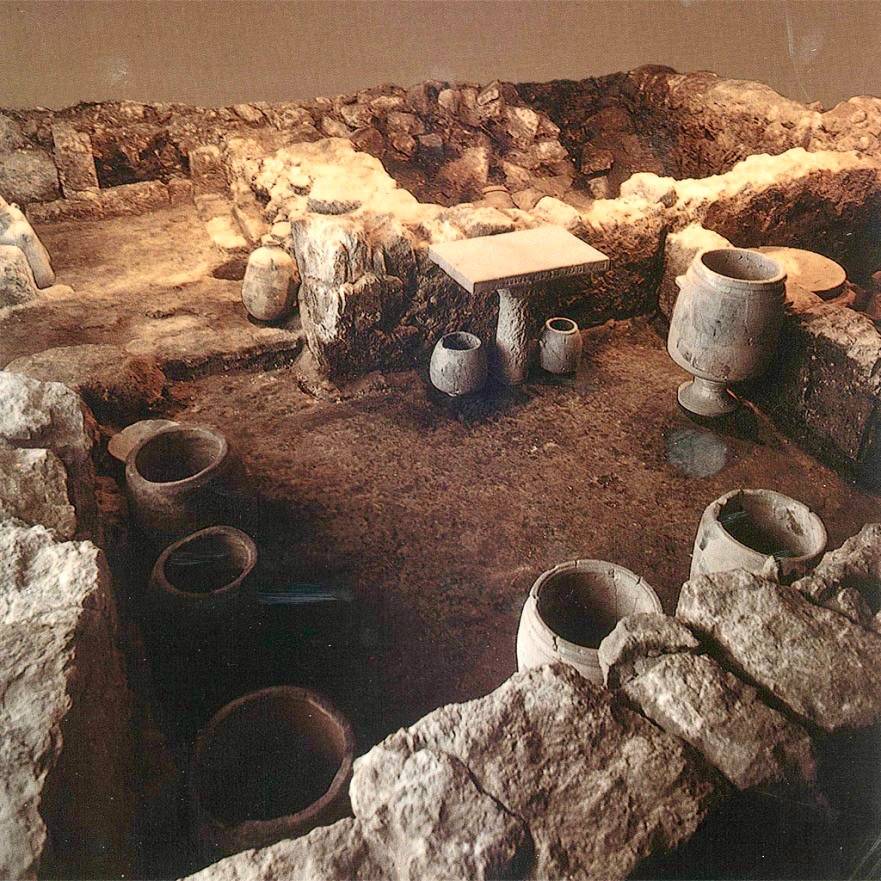
The Burnt House in Jerusalem. Note the six large stone jars!
While recognising the interest in symbolism shown in John’s Gospel, Ian Paul (drawing on the work of Richard Bauckham) highlights the historical aspects of this episode.
First, the jars, being made of stone, were not subject to the impurity laws outlined in Lev 11:32-35. This suggests that the incident took place in a priestly household.
Second, the jars were difficult to make, being constructed out of a single piece of stone. A quarry and workshop for making such articles has been found near Cana. Their construction required the use of a Roman lathe, of the kind used to make stone columns. This latter fact points to the period of the Roman occupation of Judea and Samaria.
Thirdly, although these jars were expensive, archaeological evidence indicates that they were used in the working parts of the house.
Fourthly, 1 Chron 24:7-18 sets out the requirements for the 24 priestly ‘courses’, each one of which was to serve for a period of two weeks. A number of lists have been discovered in synagogues from the NT period, and these lists include the names of the towns associated with each priestly course. Cana is listed as one of the towns in which priestly families lived. No towns founded after AD70 are mentioned in these lists.
Paul concludes:-
‘Put together with the role of stone jars, it looks quite likely (though of course not provable) that the wedding in Cana was taking place in the house of this priestly family, which accounts for the presence of jars themselves because of the family’s concern for ritual purity. And why, then, does John record that there were six? Because, as in the picture of the Burnt House above, that is how many there happened to be!’