The genealogical Adam and Eve
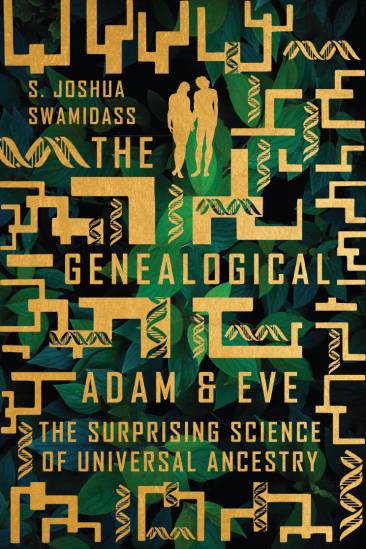
Very often it’s put to us as a stark choice: either you accept the biblical account of human origins, or you accept the scientific account. Either you believe that we are all direct descendants of Adam and Eve, or that we are all products of a long evolutionary process, stretching back a million years or more to a (non-human) common ancestor.
But can we have our cake and eat it? Can we hold both to the essential factual historicity of the accounts of creation in Genesis 1 and 2, and to the validity of evolutionary science?
S. Joshua Swamidass (a biologist and physician) thinks that the answer is ‘yes’, and he sets out his novel and interesting case in The Genealogical Adam and Eve: the Surprising Science of Human Ancestry (IVP, 2019).
‘For thousands of years, most readers of Genesis thought Adam and Eve were real people who (1) lived in the Middle East, just several thousand years ago; (2) were the ancestors of everyone; and (3) were created, with no parents, by a direct act of God’ (p5)
The teaching of Paul seems to confirm this belief. He appears to regard Adam as a universal ancestor, and so to rule out any reinterpretation of Genesis 1-3 along the lines of evolutionary creationism.
Yet, Genesis itself seems to allow for the existence of people ‘outside the Garden’ at the time of Adam and Eve. Where did Cain’s wife come from? Why was Cain afraid of being attacked by other people, if there were no other people around? Why (and how) would cities be built if there were no other people around to populate them? Who were the Nephilim, with whom the descendants of Adam and Eve interbred?
Science, of course, raises its own serious questions about the biblical account of origins. Current orthodoxy is that we humans descended, some millions of years ago, from Great Apes. We arose, not from a pair, but from a population, of ancestors.
Among Christians, various approaches have been made to resolving the tension. Briefly, these may be summarised under three headings: (a) ‘Bible trumps science’; (b) ‘Science trumps Bible’; (c) ‘We don’t know’.
Swamidass points to the surprising, yet entirely credible, thought that no two people, from anywhere on the globe, would need to go back countless generations before they began to discover common ancestors in their respective genealogies. Take the process back further, he claims, and you would arrive at a pair of ancestors that everyone now living would have in common.
This not-so-very ancient couple could, suggests Swamidass, be Adam and Eve. They were created by God in a special way and for a special purpose. They enjoyed a life of innocence and fulfilment in the Garden of Eden. But they rebelled, and were thrust out of the Garden.
Here is his proposal:
‘Entirely consistent with the genetic and archeological evidence, it is possible that Adam was created out of dust, and Eve out of his rib, less than ten thousand years ago. Leaving the Garden, their offspring would have blended with those outside it, biologically identical neighbors from the surrounding area. In a few thousand years, they would become genealogical ancestors of everyone.’ (p 10)
As summarised by Hans Madueme (in his somewhat critical review), six propositions emerge (pp 25-26):
- Adam and Eve lived recently in the Middle East, perhaps as recently as 6,000 years ago.
- Adam and Eve are genealogical ancestors of everyone alive today, although at some point in our past biological humans existed who did not descend from them.
- God directly created Adam and Eve without any ancestors.
- Adam and Eve’s descendants interbred with biological humans outside Eden.
- The direct creation of Adam and Eve is the only miracle allowed.
- The biological humans outside Eden share common ancestry with the great apes, and their population size was always much larger than a single couple.
The proposition that Adam and Eve were created de novo) is not, according to Swamidass, essential, and could be dropped if found to lack evidence.
The proposal concerns genealogical, not genetic, ancestry. The latter concerns the inheritance of patches of DNA, whereas the former has to do with lines of descent. Given that a child inherits 1/2 of one of its parent’s DNA, 1/4 of one of its grandparent’s DNA, and so on, there may comes a point where a given genetic ancestor has passed on no DNA at all to a distant descendant. But this makes no difference to the fact of genealogical descent from one to the other.
Because the so-called ‘Mitochondrial Eve’ and ‘Y-Chromosome Adam’ postulate genetic ancestry for the human race going back 200,000 years or more, they are not directly relevant to the present proposal. In fact, it is quite possible to say that the human population is descended genetically from the great apes and genealogically from much more recent ancestors.
A key point is that there are many universal genealogical ancestors. So it is by not absurd to say that one pair of these live in the Middle East a few thousand years, that they are named Adam and Eve in Scripture, and everyone living from around 1 AD onwards is descended from this pair. That sort of chronology is important because, by the time of Jesus and the apostles, the gospel of salvation is to be taken to everyone on the globe (Acts 1:8).
Since around the turn of the present Millenium, the idea of universal genealogical ancestry has become well-established in scientific circles. In The Ancestor’s Tale, Richard Dawkins writes;
‘If we go sufficiently far back, everybody’s ancestors are shared. All your ancestors are mine, whoever you are, and all mine are yours. Not just approximately but literally. This is one of those truths that turns out, on reflection, to need no new evidence.’
As noted above, Swamidass allows for the de novo creation of Adam and Eve. Their genomes may now be completely lost, but that would not affect their being our genealogical ancestors.
Why are Adam and Eve so important? They are important (according to Swamidass) because they are the first true humans, created in God’s image. And they are important because all humans – including ever person alive on the planet today, is descended from them. People who lived alongside, and subsequent to, Adam and Eve, were not human in this sense. They were humanoid, just as (further back in history) Neanderthals and other hominids were (although the differences in this case would have been spiritual rather than physical or psychological).
These other people (Swamidass allows) were the products of normal evolutionary processes, operating over long periods of time as conventional science teaches. After Adam and Eve were expelled from the Garden, their progeny intermarried with the population already outside the garden. Eventually, Adam and Eve became common ancestors of every person on the planet who thus inherited the consequences of their original rebellion against the God in whose image they had been created.
According to Swamidass, Genesis 1 could record the creation of people generally, while Genesis 2 could record the special creation of Adam and Eve who were the first humans to be made in the divine image, and who are the genealogical ancestors of every person who has lived over the last couple of thousand years. There is a parallel between the special creation of Adam and Eve and the Virgin Birth of Jesus, the ‘last Adam’.
Theologically, the proposal allows for a number of traditions to be held together:
- a high view of the inspiration and authority of Scripture, along with a (fairly) literal interpretative approach
- the special creation of Adam and Eve
- a recent Adam and Eve from the Middle East (the Persian Gulf Oasis seems to provide a close match to the Garden of Eden)
- universal ancestry (important for the theology of sin, and also as fundamental to the church’s resistance of racism)
Within this scheme, we do not have to view the Flood as having destroyed all but five of the entire population of the planet, but only those in the Garden.
Comment
It’s an ingenious proposal. Swamidass does not claim certainty for it, but only possibility. His intention is not to prove that he is correct, still less to claim that he has answers to all the questions that might be put to him. His aim, rather is to show that, with regard to origins, there is at least one way in which science and theology can live in peace with one another.
It has a certain scientific and theological plausibility. However, many questions remain. Leaving aside the issue of the miraculous creation of Adam and Eve (on which science is not qualified to adjudicate), there is a question about how they could have become the genealogical forebears of aboriginal humans who were cut off from the rest of the human race for many thousands of years. On the theological side, there is the question of what sense we can make of the idea that original sin and guilt are passed on from one generation to subsequent generations; but this is a challenge for more conventional explanations too.
Call me a heretic, but I’m open to a less literal reading of the early chapters of Genesis than Swamidass appears to be. The writer(s) of Genesis knew that people beget people. They quite reasonably surmised that if you track this process of begetting back into the distant past, you must end up with an original couple. We call them Adam and Eve. Those writers also knew that every single person is born in a state alienation from God. They quite reasonably surmised that this must go back to an original act of rebellion on the part of Adam and Eve. That is what we call ‘the Fall’ (Gen 3). Yes, I know that there are problems with this – the most obvious of which is that Jesus and his apostles appear to regard Adam as an historical figure, and not just an assumed figure.
So, I’m undecided. But I do share with Joshua Swamidass the confidence that when all the facts are in and properly understood, the truth of Scripture will be found to entirely compatible with that of science. But exactly how they intersect may not be fully known this side of glory.
In particular, he argues that his proposal is consistent with a range of theological opinions about Adam and Eve – even rather conservative ones – without having to say that ‘Genesis is true; therefore science must be wrong.’
As far as I can see, the biggest difficulty is in the idea of two humanities. Even if one agrees that everyone today is genealogically descended from Adam and Eve, and therefore inherit the divine image (and also a sinful nature), this seems to leave vast swathes of the world’s population, in former times, in a completely different position, and neither accountable to God nor having access to saving grace even though they were indistinguishable from the first group in every other way. Where else does Scripture make such a distinction between people who are the descendants of Adam and those who are not?
See also three reviews on the Biologos website.