Myths and stories
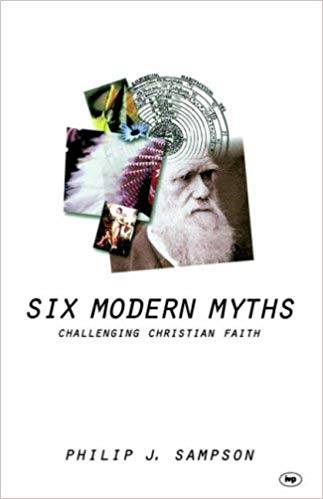
As Philip Sampson points out in his book Six Modern Myths Challenging Christian Faith, all societies have their stories and myths. The stories of ancient Greece, such as the story of Hercules, were myths or legends which were not intended to be taken literally. They paint pictures of heroes and villains, of good and evil, of creation and destruction, and all with the feel of a bygone age. The Bible has sometimes been read in this way. But such a view disregards the clear distinction between mythical and historical writing. The Bible is concerned with real people, real places and real events. Jesus was a carpenter from Nazareth, and Paul a tent-maker from Tarsus. See 2 Pet 1:16.
Just as the Bible cannot be regarded as mythical simply because it is ancient, so some stories cannot be thought of as historical merely because they are modern. Today, as in ancient Greece we have stories that tell us who we are and how we fit into the universe.
Take, for example, the story of Newton’s discovery of ‘gravity’ as he sat under the apple tree at Woolsthorpe Manor. To say that the story was probably made up by Newton in order to satisfy someone’s idle curiosity does not invalidate his scientific research, but it does give the story itself a different function.
Stories continue to serve important functions for our understanding of the world. As the Newton story shows, this applies even to the ways in which we pass on our understanding of science. Most people know more about black holes from watching Star Trek than from reading Stephen Hawking. We know that the earth obits the sun because we have heard of Galileo’s clash with the Inquisition, not because we have studied Kepler’s laws of planetary motion.
A story such as Newton and the apple functions as a myth which perpetuates the romantic picture of the scientific genius whose theories come in a flash of inspiration. Another story of Newton concerns his house-keeper arriving late one morning to find him still in his night-clothes, sitting on the edge of his bed, so engrossed in thought about the motion of the moon that he had forgotten to get dressed: this reinforces the myth of the ‘absent-minded professor’.
Myths sometimes distort (or even invent) ‘facts’ in order to make their point. History itself is distorted by being generally told by the victors and by paying attention to the deeds of kings and queens, prime ministers and presidents, while neglecting the concerns of ordinary people (including women). Some would go so far as to deny the possibility of any distinction between fact and fiction.
Disbelief in God is supported by appeals to tales of enlightenment. When C.S. Lewis has his Pilgrim advised by Mk Enlightenment that there is no God, the following explanation is offered: “Christopher Columbus, Galileo, the earth is round, invention of printing, gunpowder.” (The Pilgrim’s Regress)
The story is the medium, the myth is the message. The myth provides a framework for understanding certain beliefs and values.
Modern myths are not separate from the facts of history and science, but they select, and sometimes distort or even invent, facts in order to serve some need within the social group that propagates them.
One such myth contrasts the modern scientific world with the age of superstition and bigotry (often with the Church as the bastion of ignorance) which preceded it. This is illustrated by belief in a flat earth. It is said that in the Dark Ages people believed that the earth was flat and that sailors who ventured too near the edge would fall off. This was the official teaching of the Church and it inhibited voyages of discovery. The villains of the piece are the superstitious and ignorant priests. A courageous and rational hero in the form of Columbus can be found. He becomes an honoury member of the modern world. The story of confrontation between Columbus and the Church has been told and re-told, receiving encouragement from writers such as John Draper and Andrew White, but it is not true. All educated people of the time knew that the earth was round, and there was no confrontation between Columbus and the Church. The titles of Draper’s and White’s books perpetuate the myth of constant struggle between science and faith – History of the Conflict between Religion and Science, and A History of the Warfare of Science with Theology.
Another example of the myth of the conflict between science and religion is found in the ‘excommunication’ of Halley’s comet by Pope Callixtus III in 1456. This story is told by Draper, and re-told in a number of popular science books, although it is generally regarded by scholars as apocryphal. It originated in an unreliable 15th-century Lives of the Popes by Platina, and has been uncritically repeated until recently. Although it is true that many in medieval times regarded comets as evil omens, this was not particularly led by the church. Indeed, it was the Jesuit Horatio Grassi who correctly suggested that comets lie beyond the earth’s orbit (a belief opposed by Galileo, no less, who favoured the traditional Aristotelian account that comets were caused by exhalations from the earth into the atmosphere. Newton regarded comets in the light of divine providence, and betrays no sense of conflict between his own discoveries and belief in the deity.
White gave many misleading examples of the supposed conflict between science and religion, and did much to perpetuate the wisespread cultural myth that science is a rational, truth-seeking discipline and theology is not’.
We should notice the way in which such myths establish a language. ‘Religion’ becomes associated with ignorance, superstition, bigotry, and oppression, whereas ‘science’ connotes rationality, freedom, intelligence, open-mindedness and truth.
The myth contains a strong notion of ‘progress’. As society has freed itself from the shackles of religion, and embraced a scientific world-view it has to that extent experienced progress. We have Galileo to tell us our place in the heavens, Columbus to demonstrate that the earth is round, Darwin to explain our procreative behaviour. Who needs religion? Huxley, Sagan, and Dawkins have all been keen to bid it good riddance.
It is often assumed that the Enlightenment pointed the way to a rational foundation for the modern world. But there have always been those who doubted the adequacy of scientific enquiry to plumb the rich and complex depths of human existence. The Romantic movement, for example, rejected the cold heartlessness of rationalism. Newtonian reason thrives on quantitative measurement and cannot comprehend the world of feelings, values and experiences.
The myth of unimpeded scientific progress has been dealt severe blows by the facts of the case: 80 million killed in wars, environmental pollution, two thirds of the population starving while the rest become obese, daily destruction of plants, animals, and their habitats.
Myths determine what is included and what is excluded from the stories. The flat-earth myth would be weakened if it were told that most educated people of the medieval period knew that the earth is round. The myth of the warfare between science and religion would be less plausible if it were admitted that religious belief was intimately connected with the rise of modern science in the 17th century.
A ‘good’ story has a number of characteristics. It is presented in black-and-white terms and shuns half-tones. Characters are one-dimensional, and contrary evidence is suppressed. It has a strong plot, some central characters (including heroes and villains), a setting, and some props. The need for simple, straitforward contrasts lends itself to stereotyping and misrepresentation.
‘Perhaps because its stories pose as history or science, the modern mind is blind to the extent to which its viewpoint is one of faith. Modern stories, driven by thehir underlying myths, are carriers of values and beliefs. Their commitment is to what is left of the Enlightenment project, with its trust in progress and the universal human spirit.’
The Enlightenment project was itself based on faith. If, as Walsh and Middleton suggest, a faith commitment is the way we answer fundamental worldview questions, then the G.B. Shaw (as a believer in the Enlightenment) would offer the following answers:-
Who are we? Children of the Earth, sweet-minded, strong and beautiful.
Where are we? On an earth which is ours to conquer and whose resources are ours to exploit.
What’s wrong? We are chained by ignorance and the impostures of religion which torment us and cripple our lives.
What is the remedy? Education to banish ignorance and superstition, and to free the human spirit to lift its daring to the stars.
Similarly, Bertrand Russell regarded religion ‘as belonging to the infancy of human reason, and to a stage of development which we are now outgrowing.’
See Sampson, Six Modern Myths Challenging Christian Faith, 7-26