The Widow’s Offering
21:1 Jesus looked up and saw the rich putting their gifts into the offering box. 21:2 He also saw a poor widow put in two small copper coins. 21:3 He said, “I tell you the truth, this poor widow has put in more than all of them. 21:4 For they all offered their gifts out of their wealth. But she, out of her poverty, put in everything she had to live on.”
We can almost hear the difference between the loud resonance as the large sums of the rich are tossed into the chest, compared with the soft tinkling sound as this woman’s coins are offered. They have given much, but will remain rich; she has given what little she had, and becomes all the more destitute.
“She…put in everything” – She might easily have kept back one of the two coins for herself, but she did not.
The Signs of the End of the Age
21:5 Now while some were speaking about the temple, how it was adorned with beautiful stones and offerings, Jesus said, 21:6 “As for these things that you are gazing at, the days will come when not one stone will be left on another. All will be torn down!” 21:7 So they asked him, “Teacher, when will these things happen? And what will be the sign that these things are about to take place?” 21:8 He said, “Watch out that you are not misled. For many will come in my name, saying, ‘I am he,’ and, ‘The time is near.’ Do not follow them! 21:9 And when you hear of wars and rebellions, do not be afraid. For these things must happen first, but the end will not come at once.”
Lk 21:12–17 = Mt 10:17–22
Persecution of Disciples
21:10 Then he said to them, “Nation will rise up in arms against nation, and kingdom against kingdom. 21:11 There will be great earthquakes, and famines and plagues in various places, and there will be terrifying sights and great signs from heaven. 21:12 But before all this, they will seize you and persecute you, handing you over to the synagogues and prisons. You will be brought before kings and governors because of my name. 21:13 This will be a time for you to serve as witnesses. 21:14 Therefore be resolved not to rehearse ahead of time how to make your defense. 21:15 For I will give you the words along with the wisdom that none of your adversaries will be able to withstand or contradict. 21:16 You will be betrayed even by parents, brothers, relatives, and friends, and they will have some of you put to death. 21:17 You will be hated by everyone because of my name. 21:18 Yet not a hair of your head will perish. 21:19 By your endurance you will gain your lives.
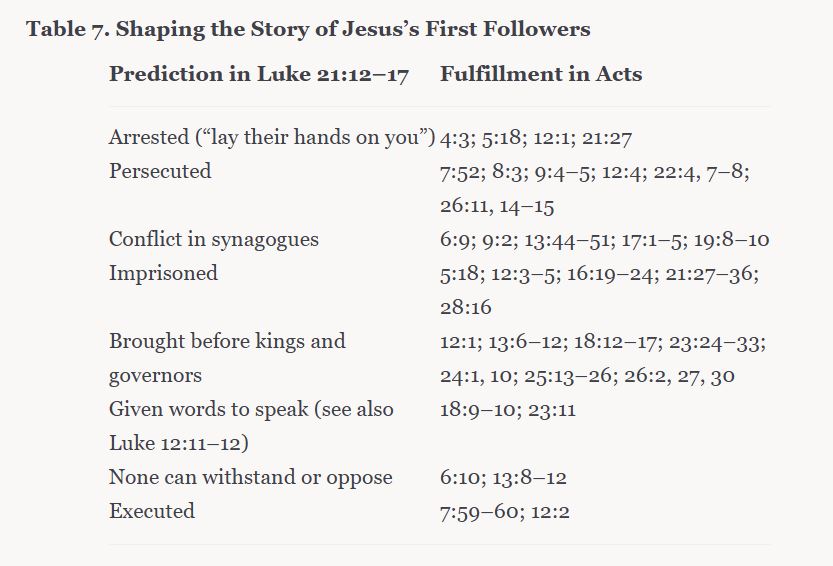
Parsons notes that the predictions of difficulties find their fulfilment in Acts:
“Not a hair on your head will perish” –
The Desolation of Jerusalem
21:20 “But when you see Jerusalem surrounded by armies, then know that its desolation has come near. 21:21 Then those who are in Judea must flee to the mountains. Those who are inside the city must depart. Those who are out in the country must not enter it, 21:22 because these are days of vengeance, to fulfill all that is written. 21:23 Woe to those who are pregnant and to those who are nursing their babies in those days! For there will be great distress on the earth and wrath against this people. 21:24 They will fall by the edge of the sword and be led away as captives among all nations. Jerusalem will be trampled down by the Gentiles until the times of the Gentiles are fulfilled.
Chapman notes a number of allusions to Isa 13 and the fall of Babylon:
Luke 21
… its desolation is near (20)
… the time of punishment… (22)
… wrath against this people (23)
They will fall by the sword (24)
Isaiah 13
… to make the land desolate (9)
… I will punish the world… (11)
… wrath and fierce anger (9)
… the wrath of the Lord… his burning anger (13)
… all who are caught will fall by the sword… (15)
“Wrath against this people” – This is the only place in the Synoptic Gospels where Jesus uses the word ‘wrath’ in relation to God. This is not to say, however, that there are not many occasions when he expresses God’s hostility to evil, without actually using the word ‘wrath’.
Jerusalem will be trampled down by the Gentiles until the times of the Gentiles are fulfilled – Unique to Luke. The precise meaning is difficult to determine. Morris suggests various alternatives:
- ‘the time for the Gentiles to execute God’s judgments, or
- to be supreme over Israel, or
- to exercise the privileges hitherto belonging to Israel, or
- to have the gospel preached to them.’
(Paragraphing and bulleting added)
Garland:
‘This phrase may apply to the period of mission to the Gentiles (Rom 11:25–27; Tob 14:6), the period of foreign domination (see Dan 2:21; 7:1–8:27; 9:24–27), or a synthesis of both ideas.’
According to the Lexham Bible Dictionary, this period:
‘likely extends from the destruction of Jerusalem in AD 70 to the end of history.’
Ryle, after considering various alternatives, concludes:
‘The “times of the Gentiles” I regard as the period between the first and second advents of Christ, during which the Gentile nations have a day of visitation and enjoy the privileges of the Gospel.—These times will come to an end at last, as the old Jewish dispensation did, because of the hardness and unbelief of the Gentile churches. They too, because they continue not in God’s goodness, will be cut off.—And when their time of visitation comes to an end, and they have been found as faithless and hardened as the Jews, then at last will the Jews be converted, and Jerusalem restored to its rightful possessors.’
Some read the text as predicting that Jerusalem would be ruled by non-Jews until the times of the Gentiles were complete, and then it would come under Jewish rule again. Such interpreters understand the recapture of the Old City of Jerusalem by the Israelis in 1967 as significant in this regard.
But, as Chapman points out (Whose Promised Land? 5th ed.) The word ‘until’ does not necessarily point to an event in the more distant future (see, e.g. Gen 28:15 – “I will not leave you until I have done what I have promised you”).
Better, argues Chapman, to read this passage with Nolland as referring to God’s judgment on Jerusalem, followed by judgment on the instruments of Israel’s judgment (see Isaiah 10:12–14; 33; 47; Jeremiah 50–51; Daniel 9:26–27 and compare Ezekiel 38; Habakkuk 1:11 – 2:3).
The Arrival of the Son of Man, 25-28
21:25 “And there will be signs in the sun and moon and stars, and on the earth nations will be in distress, anxious over the roaring of the sea and the surging waves. 21:26 People will be fainting from fear and from the expectation of what is coming on the world, for the powers of the heavens will be shaken. 21:27 Then they will see the Son of Man arriving in a cloud with power and great glory. 21:28 But when these things begin to happen, stand up and raise your heads, because your redemption is drawing near.”
Ian Paul notes that, whereas Matthew’s and Mark’s account are quite similar at this point, Luke’s is more distinctive:
Firstly, Luke places less stress on the cosmic and eschatology elements:
*The language of sun, moon and stars loses its particular details (darkening, not giving its light, and falling) which comes from the source in Is 13.10 and Is 34.4. Instead, Luke postpones this detail to Peter’s Pentecost speech, where he cites similar language from Joel 2.28–32.
*Matthew’s citation of Zech 12.10, and the language of ‘gathering the elect’ from both Matthew and Mark are omitted.
*Several parts of the Matthew/Mark account are relocated earlier in Luke: Matthew’s reference to the coming of the Son of Man as lightning and the parallel with the ‘days of Noah’ are found in Luke 17; and the later ‘Parable of the Talents’ (highly abbreviated in Mark) becomes the Parable of the Pounds in Luke 19. Some other sayings gathered into this section by Matthew are found in Luke 12. (This is similar to the way that Matthew has gathered teaching of Jesus into the Sermon on the Mount in Matt 5–7 which is found in other places in Mark and Luke.)
Secondly, Luke links these events more explicitly with the fall of Jerusalem:
*Luke replaces the rather oblique reference to Daniel in the phrase ‘desolating sacrilege’ (or ‘abomination of desolation’) in Matt 24.15 and Mark 13.14 with the much more mundane ‘When you see Jerusalem surrounded by armies…’ in Luke 21.20, just before the lectionary passage that we have (which shows why chunking the text into lectionary bites is not always very helpful).
*This connects the teaching here with the earlier, uniquely Lukan, passage Luke 19.39–44 where Jesus weeps over the city because ‘the days will come on you when your enemies will build an embankment against you and encircle you and hem you in on every side. They will dash you to the ground, you and the children within your walls. They will not leave one stone on another, because you did not recognize the time of God’s coming to you.’ Notice here the quite explicit references to the Roman siege of the city (‘build up an embankment’) and the anticipation of the question about stones that then comes in Luke 21.5 and parallels.
*The language of the ‘roaring of the sea and the waves’ draws on the apocalyptic imagery of the sea as the peoples of the world from which four beastly empires emerge in Dan 7 and the Roman Empire as the beast from the sea arises in Rev 13.1. In fact, there are numerous surprising links between Luke and Revelation, including Luke’s unique addition of ‘patient endurance’ in the parable of the soils at Luke 8.15 connecting with John’s participation in ‘suffering, kingdom and patient endurance’ in Rev 1.9. In our passage, the language of ‘falling by the sword and going to prison’ in Luke 21.24 connects with the language of sword and captivity in Rev 13.10, and the ‘trampling by the Gentiles’ in the same verse connects with the image of the temple being trampled in Rev 11.2. In both cases, there is a clear focus on contemporary cultural reality, rather than the distant future.
*Luke’s unique addition in Luke 21.28 and the further section of encouragement in Luke 21.34–36 connect the events quite specifically to the trials that Jesus’ own disciples will face.
Daniel 7:13f – “In my vision at night I looked, and there before me was one like a son of man, coming with the clouds of heaven. He approached the Ancient of Days and was led into his presence. He was given authority, glory and sovereign power; all peoples, nations and men of every language worshiped him. His dominion is an everlasting dominion that will not pass away, and his kingdom is one that will never be destroyed.
There can be little doubt that, when seen through the ‘lens’ of the teaching of the New Testament, this is applicable to Jesus Christ. He is the ‘Son of Man’ who ‘comes with the clouds of heaven’, is led into the presence of his heavenly Father, and is given an indestructible and universal kingdom.
But what about this ‘coming’? Is it a coming down from heaven (at his ‘parousia’) or a coming up to heaven (at his ascension)?
And what are we to make of the New Testament passages which quote or allude to this passage? –
Mt 16:27f “For the Son of Man will come with his angels in the glory of his Father, and then he will reward each person according to what he has done.I tell you the truth, there are some standing here who will not experience death before they see the Son of Man coming in his kingdom.”
Mt 24:30 “Then the sign of the Son of Man will appear in heaven, and all the tribes of the earth will mourn. They will see the Son of Man arriving on the clouds of heaven with power and great glory.”
Mt 26:64 “I tell you, from now on you will see the Son of Man sitting at the right hand of the Power and coming on the clouds of heaven.” (Mk 14:62)
Mk 13:26 “Then everyone will see the Son of Man arriving in the clouds with great power and glory.” (Lk 21:27)
Acts 7:56 “Look!” he said. “I see the heavens opened, and the Son of Man standing at the right hand of God!”
Rev 1:7 Look! He is returning with the clouds.
Rev 14:14 Then I looked, and a white cloud appeared, and seated on the cloud was one like a son of man! He had a golden crown on his head and a sharp sickle in his hand.
1. The Parousia?
Commenting on Dan 7:13, Nelson (UBCS) sees a clear application of this passage by and to Jesus. However, he thinks that it is applicable to his return:
‘Daniel 7 is of the utmost importance for understanding both the identity of Jesus and the plan of God for the end times. When the book was written, “son of man” was not a title, but rather the vision referred to a transcendent one who looked like a man. Originally it was probably understood to be an angel or archangel—Michael is the best candidate, since he figures prominently in the deliverance of the Jews (12:1). However, in the NT, Jesus uses “Son of Man” as a title for himself (for example, Matt. 8:20; 9:6; 11:19). Although he sometimes uses it to mean “man,” he identifies himself with the figure in Daniel’s vision at other times, predicting that he will return in power and glory riding on clouds (Matt. 19:28; 24:27, 30; 26:64). John also utilizes the imagery for Jesus in his apocalypse (Rev. 1:7, 13; 14:14). Daniel’s vision in chapter 7 gives us hope for the future. Jesus will return to raise from the dead those believers who have died (1 Cor. 15:22–26; 1 Thess. 4:14–17), to gather together his living followers, and to set up God’s kingdom in its fullness. The oppressive regimes of this world will disintegrate as they are replaced by the eternal, righteous, reign of God. This leads us to cry “Maranatha” (1 Cor. 16:22) and to pray “Your kingdom come … on earth as it is in heaven” (Matt 6:10). For those who are suffering persecution for the name of Jesus, Daniel 7 holds out the certain hope of the eventual triumph of God’s kingdom and with it the vindication of God’s people for their faithfulness. It calls them to endure and persevere through their present trials with an eye fixed on the horizon awaiting their great future.’
So also Miller (NAC):
‘The phrase “coming in clouds” is understood in Matt 24:30 as a reference to the return of Christ.’
Wallace (BST) is another who thinks that, for Jesus, this passage was about ‘his second coming and ultimate triumph.’
Referring more widely to the ‘son of man’ figure in later Jewish writings, Harper’s Bible Commentary states:
‘This preexistent heavenly figure of Jewish tradition may be the one of whom Jesus speaks in such passages as Matt. 10:23; 16:27–28; Mark 8:38; and 13:26, in which he seems to be referring to some heavenly figure who will come on clouds as the judge of the Last Day.’
See this by Michael Vlach.
2. The ascension?
Calvin was decidedly in favour of this interpretation. Bolt (The Cross from a Distance: the Atonement in Mark’s Gospel) provides quotations:
‘The great Reformation exegete, John Calvin, in his commentary on Daniel, also joined this stream of interpretation, claiming that these verses are ‘undoubtedly of Christ … He had been endued with heavenly power, and was seated at his Father’s right hand.’ Throughout his exposition, Calvin uses strong language that expresses his conviction: ‘This passage, then, without the slightest doubt, ought to be received of Christ’s ascension, after he had ceased being a mortal man’; 40, 44; ‘This, in my judgement, ought to be explained of Christ’s ascension; for he then commenced his reign, as we see in numberless passages of Scripture’ (cf. Rom. 6:10, John 16:7; 14:28); (p. 42); ‘He now arrives at the Ancient of days, that is, when he ascends to heaven, because his divine majesty was then revealed’ (p. 43); ‘He ascended to heaven, and a dominion was bestowed upon him’ (p. 44).’
A number of older commentators adopt this view:
‘This relates to his ascension, Acts 1:9–11, at which time, though King before, Matt. 2:2, yet now, and not before, he seems to receive his royal investiture for the protection of his church and the curbing of their enemies, which he says he had before, Matt. 28:18; 1 Cor. 15:25; chap. 2:44.’ (Poole)
Charnock writes that this is
‘not to be understood of his coming at the day of judgment, but his coming after his oblation. He comes not here to judge man, but to be judged by his Father; and upon being found to have performed the part of the Son of man, he hath a kingdom both extensive and everlasting bestowed upon him, which should not be destroyed by the subtleties or force of his enemies; a present only worthy of the Son of God. Again, he received not his power at the day of judgment, but upon his resurrection and ascension after his death; but this expresseth the first investiture of this power in him.’ (Works, Vol 5, p55)
John Flavel:
‘This vision of Daniel’s was accomplished in Christ’s ascension, when they, that is the angels, brought him to the Ancient of days, that is to God the Father, who, to express his welcome to Christ, gave him glory and a kingdom. And so it is, and ought to be expounded. The Father received him with open arms, rejoicing exceedingly to see him again in heaven; therefore God is said to “receive him up into glory,” 1 Tim. 3:16. For that which, with respect to Christ, is called ascension, is, with respect to the Father, called assumption. He went up, and the Father received him. Yes, received so as none ever was received before him, or shall be received after him.’ (The Fountain of Life)
Matthew Henry notes that:
‘Some refer this to his incarnation…I think it is rather to be referred to his ascension; when he returned to the Father the eye of his disciples followed him, till a cloud received him out of their sight, Acts 1:9. He made that cloud his chariot, wherein he rode triumphantly to the upper world. He comes swiftly, irresistibly, and comes in state, for he comes with the clouds of heaven.’
Ovey writes that Dan 7:13
‘arguably’ depicts ‘the transition from Jesus’ state of humiliation to his exaltation.’ (New Dictionary of Theology, art. ‘Ascension (and Heavenly Session of Christ)’.
Referring to Mk 14:62, Ian Paul writes,
‘This cannot refer to Jesus’ return to earth (‘second coming’) unless Jesus was deluded about how soon that would happen. But more importantly, it cannot mean this because it is an almost exact quotation from Daniel 7, and refers to Jesus’ (the Son of Man’s) ascending to the throne of God and fulfilling the destiny of Israel. That is why the High Priest considered it blasphemy: in effect, Jesus was crucified because he anticipated his Ascension!’
Commenting on Mt 26:64 – ‘This,’ writes Ian Paul,
‘cannot refer to Jesus’ return to earth (‘second coming’) unless Jesus was deluded about how soon that would happen. But more importantly, it cannot mean this because it is an almost exact quotation from Daniel 7, and refers to Jesus’ (the Son of Man’s) ascending to the throne of God and fulfilling the destiny of Israel. That is why the High Priest considered it blasphemy: in effect, Jesus was crucified because he anticipated his Ascension!’
‘This is associated not with anyone’s coming from heaven to earth, but rather the opposite—the exaltation of the Son of Man as he comes from the earth to the one seated on the heavenly throne. This is language both distinct from, and opposite to, Paul’s use of ‘coming on the clouds’ in 1 Thess 4.17. This would have been very obvious to Paul’s readers, since he uses quite different language for ‘coming’, the word parousia meaning ‘royal presence’.’
Focusing on Lk 21:25-28 (and the parallel accounts in Mt 24:29-35; Mk 13:24-31), Ian Paul notes that this passage is selected as an Advent reading for Year 3 of the Revised Common Lectionary. There is an assumption that this passage is all about Christ’s Second Coming.
Following G.B. Caird and R.T. France, Paul argues that this passage is actually about the Ascension and the subsequent spread of the gospel. The key elements in the argument are:-
- ‘the ‘technical’ language of parousia (used repeatedly by Paul in e.g. 1 Cor 15.23, 1 Thess 2.19) occurs in the second half of Matt 24 (Matt 24.37, 39) but is absent in the first half, except in Matt 24.27 when Jesus says all that is happening is not sign of his coming;
- ‘English translations confuse this, by using the same wording (‘coming’) to translate both this word and the quite different present participle erchomenos;
- ‘the language of the ‘coming of the Son of Man’ in Matt 24.30 is a direct allusion to Dan 7.13, which refers to the Son of Man coming from the earth to the throne of the Ancient of Days. Matthew conflates it with a reference to Zech 12.10, which talks of the Spirit being poured out on the House of David, and all the tribes of Israel seeing the one they have pierced—used in reference to Jesus’ crucifixion and then the events of Pentecost;
- ‘the main stumbling block for the ‘traditional’ reading comes in Matt 24.34–35 – “Amen I say to you: this generation will not pass away until all these things take place. Heaven and earth will pass away, but my words will never pass away.”‘ This seems to demonstrate that the events spoken of would take place within the next 30-40 years.
Paul comments that, in contrast to Matthew and Mark, Luke places these events much more clearly in the context of the destruction of Jerusalem.
Source: Parsons, cited by Paul.
Paul cites Mikeal Parsons to the effect that ‘in keeping with the consistent and distinctive emphasis in Luke on promise and fulfilment, this passage with its predictions of difficulties for the followers of Jesus is actually fulfilled in a range of elements of the narrative in Acts.
The implications for preaching from this passage are, according to Paul:-
First, we need to take this passage seriously in its historical context, noting first what it would have meant for Luke’s original audience, before seeking its meaning for us today.
Secondly, we need to note ‘the connections Luke makes between the events of the fall of Jerusalem, Pentecost, and the gentile mission.’
Thirdly, we need to understand that, for Luke, ‘the “end days” have already commenced with Jesus’ Ascension, the fall of Jerusalem, and Pentecost. God’s covenant grace has now been broken open to include gentiles within the “Israel of God”.’
Fourthly, ‘because of all this, the troubles that Jesus’ followers experienced throughout Acts are troubles that we ourselves might well encounter. Like them, we are to ‘hold our heads up’ and not be dismayed, since this Jesus is Lord, and he will return.’
Tim Chester writes:
‘Luke describes the ascension from below. This is the ground level view and we see one ordinary-looking person rise into the clouds. Daniel describes the ascension from above. He shows us what happens on the other side as Jesus moves through the clouds – not into earth’s upper atmosphere, but into heaven.’ (The Ascension)
3. Christ’s entire journey from resurrection, through ascension, to exaltation and return
It may be that the text in Daniel may be applied with sufficient fluidity as to understood in relation to any or all of these events. The ‘coming’ itself would refer primarily to the ascension, but this itself may be seen as completing what the resurrection began. The passage in Daniel can readily be understood to refer also to our Lord’s heavenly session (as he exercises his ‘glory, authority and sovereign power’). Nor should we, under this view, be surprised if the parousia is described in terms of his ‘coming with clouds’, given that, according to Acts 1:11 “This same Jesus who has been taken up from you into heaven will come back in the same way you saw him go into heaven” (emphasis added).
Among older commentaries, JFB state:
‘This investiture was at His ascension “with the clouds of heaven” (Acts 1:9; 2:33, 34; Ps. 2:6–9; Matt. 28:18, “Jesus (after His resurrection, and just before His ascension) spake, saying, All power is given unto me in heaven and in earth”); which is a pledge of His return “in like manner” “in the clouds” (Acts 1:11; Matt. 26:64), and “with clouds” (Rev. 1:9). The kingdom then was given to Him in title and invisible exercise; at His second coming it shall be in visible administration.’
Bolt’s view is that this passage in Daniel, so far as the references and allusions in Mark’s Gospel are concerned, is fulfilled ‘in the event of Christ’s resurrection, ascension and exaltation.’
Commenting on Mt 26:64, Hendriksen understands Jesus’ words here as spanning an extensive period:
‘Jesus is looking down history’s lane. He sees the miracles of Calvary, the resurrection, the ascension, the coronation at the Father’s right hand (“the right hand of the Power,” that is, “of the Almighty”), Pentecost, the glorious return on the clouds of heaven, the judgment day, all rolled into one, manifesting his power and glory.’
Goldingay’s interpretation probably belongs here:
‘The actual title “the Son of Man” is a literalistic rendering of the phrase in v 13, though such links between OT and NT are more formal than substantial. Yet Christ is indeed the one who was to come in human likeness from heaven, and the one still to come in human likeness on the clouds of heaven to receive a kingdom and to accept the honor of all nations. The rule of God on earth is implemented through one who is himself from heaven. Along with figures such as the prophet and priest, the angel is one of Jesus’ role models: he fulfills a place analogous to each of these… In the view of theologians such as John and Paul, he is so heavenly that he must share God’s own divinity: the similarity of judge and humanlike figure becomes a similarity of Father and Son… Thus the Christ event initiates the reign of God on earth that Dan 7 promises. It brings that unveiling of the mystery of God’s plan for the world (Eph 3:1–12) which is spoken of here as the opening of the books (v 10).’
Conclusion
I incline towards this last, the more ‘fluid’ interpretation. The New Testament quotations and allusions, which would seem confusing and even contradictory otherwise, then become more understandable. Among these, it is now one, and then another, aspect of our Lord’s glorification which is to the fore.
“Your redemption is drawing near” – In Lk 2:38 Anna speaks to all ‘who were looking forward to the redemption of Jerusalem’. And in Lk 24:21 the two disciples had been hoping for one ‘who was gong to redeemed Israel’. It follows that this redemption is accomplished in the person and work of Jesus.
The Parable of the Fig Tree, 29-33
21:29 Then he told them a parable: “Look at the fig tree and all the other trees. 21:30 When they sprout leaves, you see for yourselves and know that summer is now near. 21:31 So also you, when you see these things happening, know that the kingdom of God is near. 21:32 I tell you the truth, this generation will not pass away until all these things take place. 21:33 Heaven and earth will pass away, but my words will never pass away.
‘Jesus used a fig tree in his illustration because, whereas in Palestine most trees are evergreens, the fig tree loses its leaves in winter.’ (Brooks)
“This generation will not pass away until all these things take place” – ‘Jesus’ saying here is quite emphatic in form, including the emphatic form of the negative, mentioning ‘all’ these things clearly, and opening with the ‘Amen’ formula, characteristic of Matthew’s record of Jesus’ teaching, and suggesting recollection of Jesus’ actual words in Aramaic.’ (Ian Paul)
“Heaven and earth will pass away, but my words will never pass away” – ‘That Jesus here identifies his words, like God’s, as eternal bears witness to a high implicit Christology.’ (Strauss)
It is also notable that, in a passage which has occasioned so much discussion and debate, Jesus expresses here solemn certainty!
Be Ready!, 34-38
21:34 “But be on your guard so that your hearts are not weighed down with dissipation and drunkenness and the worries of this life, and that day close down upon you suddenly like a trap. 21:35 For it will overtake all who live on the face of the whole earth. 21:36 But stay alert at all times, praying that you may have strength to escape all these things that must happen, and to stand before the Son of Man.”
21:37 So every day Jesus was teaching in the temple courts, but at night he went and stayed on the Mount of Olives. 21:38 And all the people came to him early in the morning to listen to him in the temple courts.