Preaching Old Testament characters
Introduction
There are several reasons for exercising caution when planning to preach from an OT character:
- a tendency to read biblical characters as heroes
- a tendency to oversimplify biblical characters
- a tendency to treat biblical characters as moral examples (‘Dare to be a Daniel’)
- a tendency (in modern literature) to focus on the inner workings of people’s minds, which leads either to a frustration with biblical narratives or to a temptation to indulge in speculation of our own
A further challenge arises from our difficulty in separating out the narrator’s point of view and that of the character his/her self. The narrator may give us sparse details about a character’s mental state, attitude, motivation, and so on, prompting us to rush to fill in the gaps and to ask questions such as, ‘What would I have done, in the circumstances?’
Then there is the concern about the historical, cultural and social distance between biblical times and our own times.
On the tendency to treat OT characters as examples, Paul Kissling writes:
‘The OT’s narratives refuse to hide the weaknesses, failing, sins and foibles of its human characters because their character and example is not the focal point. In fact their weaknesses point to the remarkable fact that the Lord chooses to use the anyway.’
Principles and guidelines
Choose the right characters. Some characters are more rounded than others. But even relatively minor characters, such as Hagar, Dinah or Eve yield good sermon material if their stories are read closely and carefull.
Distinguish the voice of the narrator from that of the character. For example, the account of the death of Saul given by the Amalekite in 2 Sam 1:1-16 is at variance with that given in 1 Sam 30 by the narrator. This leads us to suspect that the Amalekite is lying.
Particular care should be taken when a character is the protagonist in the narrative. For example, because we often regard Jacob as a protagonist, we too readily assume that his prayer in Gen 32:9-12 is wholly sincere, when it may not be.
Sometimes, it can be helpful to place side by side the words of a character and the words of the narrator or another character. For example, compare what Joseph actually said (Gen 42:18b-20a) with what his brothers claim he said (Gen 42:33f).
Note the order of telling. Sometimes, key information is given at the outset. For example, Gen 22:1 informs us that the Lord never intended Abraham to sacrifice Isaac.
Observe the use of ambiguity as a narrative technique. Why was Jacob unable to see that he had been given Leah instead of Rachel? Was it wine? Was it eye disease? Was it too dark? The preacher can invite the hearers into the act of interpretation and to consider the alternatives for themselves. It allows both preacher and hearers to say, “I don’t know” – which can be a sign of mature thinking.
Pay attention to how characters are named and addressed. In the case of Dinah (Gen 34) the narrator and her brothers call her ‘Jacob’s daughter’ and ‘sister’ respectively. But Jacob himself seems unwilling to acknowledge her as his daughter, and never refers directly to her.
Look for parallel and opposite situations. Jacob twice hears bad news about one of his children. In the case of Dinah, he shows no emotion, whereas in the case of Joseph he is inconsolable.
Be alert to intertextuality, textual echoing and typology. Noah is a new Adam, as is Abraham. Joshua and Elijah are the Moses for their own generation. Elisha is the new Joshua. Ezra heads a new exodus, and is careful to leave at Passover; as a new Moses, he publicly proclaims the Torah.
Attend to the macro-narrative context. To miss the place of a character in the unfolding of the biblical story is to risk simplistic moralising. Abraham’s willingness to sacrifice Isaac becomes intelligible when we recall he earlier attempts to do God’s work for him. In Gen 22 he learns to rely completely on God to fulfil his own promises.
Watch how characters develop over time. Joshua goes from a character who needs divine encouragement to one who gives encouragement (Josh 1:5-9; 17:14-18; 18:3; 23:6). Abraham develops from a person too self-reliant to one who has learned to rely on the Lord.
Read over Israel’s shoulder. Following Rein Bos, we adopt a new fourfold meaning of Scripture: Sensus Israeliticus, Christological sense, Ecclesiological sense, Eschatological sense. In the first of these, we ask, for example, what the seemingly obscure custom of not eating the hip tendon would have meant in the light of Jacob’s experience and his status as the father of ‘the children of Israel’.
How can we structure sermons from OT characters?
The simplest approach is to follow the narrative structure of the story itself. Even with a well-known story, there will be a freshness as the process of tension and release is unfolded.
Show how the text fits into the larger narrative context. Don’t assume that your hearers will know even the bare outline of the OT story. Show, too, how it reaches its culmination in the NT story, and be prepared to include an appropriate NT reading alongside your OT reading. There is probably something wrong with a sermon from the OT that does not mentioned Jesus or the church.
Consider the place of first-person narrative sermons. Playing the role of an OT character can be overdone. It is likely to require more, not less, preparation. But it can bring the character alive in new ways. A certain degree of dramatic license will be required when filling in the details, and we must make sure that these do not detract from the text itself.
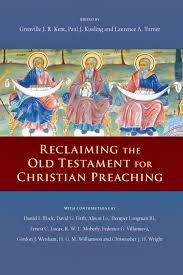
Based on Paul J. Kissling, ‘Preaching Narrative: Characters’, in Reclaiming the Old Testament for Christian Preaching, ed Grenville J.J. Kent et al, pp30-43.