Extra-terrestrial life: theological perspective
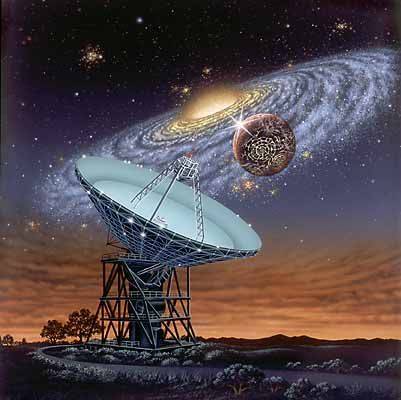
Earlier in the year, Professor Paul Davies was interviewed for the Guardian’s Science Weekly podcast.
Professor Davies is committed to the search for extra-terrestrial intelligence. He thinks, however that rather than earthlings receiving intelligible radio messages from aliens, still less being actually visited by beings from elsewhere in our galaxy, it is more likely that we will one day detect some kind of ‘beacon’, which we will infer could only have been caused by intelligent life. This, he says, will have less of a dramatic short-term effect, more of a long-term change in perspective in our thinking. It would be analogous, he says, to the discoveries of Copernicus, Galileo, Darwin, and Einstein.
Davies is perfectly open and honest about how likely or unlikely it is that life exists elsewhere in the cosmos. He says that we simply don’t know.
On the question of the religious implications of any such discovery, however, he is less guarded.
‘I think there is a real issue for religion…All the world’s great religions were formulated in a pre-scientific era, and they all place human beings in a very important role, even a central role. The fact that human would be seen as just one intelligent species among countless others in the universe…no existing religion could survive.That isn’t to say there would be no place for something like religion or spirituality…but the existing religions would be swept away, whatever the ministers of those religions might say. Christianity is especially vulnerable…because of the unique nature of the incarnation. Christian believe that Jesus Christ is God incarnate and came to earth to save mankind…Jesus didn’t come to save the dolphins or the chimpanzees, or the gorillas, or the neanderthals…but to save one particular species…it’s a species-specific religion.’
Extraordinarily, Professor Davies goes on to speculate that the human race will, within a couple of centuries, genetically modify its own genome in order to eliminate grossly inethical behaviour, such as mass murder. He supposes that other, extra-terrestrial life, if more advanced than us, will already have done so.
But I want to dwell on the specific question of whether the possibility of extra-terrestrial life should be regarded as a serious threat to Christian theology, as Davies supposes.
Writing in the New Dictionary of Christian Apologetics, C. C. Dicello notes that Christian thinkers have been considering the question of extra-terrestrial life since the Middle Ages. While Thomas Aquinas (1224-74) expressed doubt, Nicholas of Cusa (1401-64) suggested that God might have created life elsewhere. Giordano Bruno was burned at the state in 1600, possibly partly because of his belief in other worlds. The political and deistic writer Thomas Paine (1737-1809) thought that a plurality of worlds would undermine the Christian faith, whereas C.S. Lewis (1898-1963) provided a positive perspective through his fiction writing, placing Christianity within a large cosmic framework.
Richard Baxter wrote:
‘I know it is a thing uncertain and unrevealed to us whether all these globes be inhabited or not. But he that considereth, that there is scarce any uninhabitable place on earth, or in the water, or air, but men or beasts, or birds, or fishes, or flies, or worms, and moles, do take up almost all; will think it a probability so near a certainty as not to be much doubted of, that the vaster and more glorious parts of the creation are not uninhabited; but that they have inhabitants answerable to their magnitude and glory.’
Scripture, of course, is written for the inhabitants of the earth. Yet it nowhere denies the existence of other beings. Indeed, its teaching on angels opens up the possibility of other life-forms elsewhere in the universe.
According to Scripture, God is the maker and sustainer of the cosmos, Col 1:15-17. The stars and galaxies are his handiwork, Gen 1:1; Neh 9:6; Amos 5:8. If extra-terrestrial did exist, they would be creatures of the only true God, and accountable to him, Heb 4:13.
The Bible teaches that human beings are made in God’s image and are the apex of his creative activity, Gen 1:26-31, though now in a fallen state, Gen 3:6f; Rom 3:9-18. We simply cannot tell if other beings, if they exist at all, might be in a similar relationship with God.
In God’s own timing, Gal 4:4, he sent his own Son to take on human nature, Jn 1:14. Jesus came to rescue the world through his death, 1 Jn 4:10, and was raised from the dead in validation and vindication of his claims, Rom 1:4. Any extension of the incarnation and its redemptive outcomes to other beings in other parts of the universe, becomes merely speculative. Though this is conceivable, we should take care to safeguard belief in the uniqueness of Christ and the one-for-all nature of his atonement. We should not suppose that God has other plans for other parts of the cosmos, for Christ is himself the ‘image of the invisible God, the first over all creation’, Col 1:15.
A faithful theological approach must therefore take God’s word seriously, 2 Tim 2:15; treat his creation respectfully, Ps 8:3f, and honour his Son supremely, Rom 11:36.