Chrismation
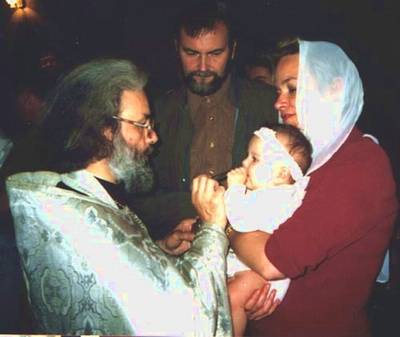
In the Eastern churches the sacrament of chrismation (Gr. chrismatis, ‘anointing’) is associated with that of baptism. It involves anointing with oil by the bishop or priest.
Timothy Ware (The Orthodox Church) says that chrismation is equivalent to Confirmation in the Western churches. Unlike Confirmation, however, it usually takes place immediately after Baptism:
The child, who has been incorporated into Christ at Baptism, now receives in Chrismation the gift of the Spirit, thereby becoming a laïkos (layperson), a full member of the people (laos) of God. Chrismation is an extension of Pentecost: the same Spirit who descended on the Apostles visibly in tongues of fire now descends on the newly baptized invisibly, but with no less reality and power. Through Chrismation every member of the Church becomes a prophet, and receives a share in the royal priesthood of Christ; all Christians alike, because they are chrismated, are called to act as conscious witnesses to the Truth. ‘You have an anointing (chrisma) from the Holy One, and know all things’ (1 John 2:20).
A child is brought to Communion as soon as possible after Christmation.
Chrismation is also used in the reconciliation of former apostates to the Church, and, sometimes, in the reception into Orthodoxy, of Christians from the Western churches.
According to the Orthodox Study Bible, chrismation corresponds to the gift of the Holy Spirit, a gift which is especially spotlighted on the Day of Pentecost (Acts 2:17, quoting Joel 3:1; see also Jer 38:31-34;). In Eze 36:25-27, water and Spirit are tied together in ‘a prophetic vision of baptism and chrismation’.
Jesus himself promised the gift of the Holy Spirit, Jn 7:37-39; 14:16. He promised that the Spirit would reveal the truth to the Church, Jn 16:13f, and that the Spirit would glorify him. In his last words before his Ascension, Jesus foretold the baptism with the Holy Spirit (Acts 1:5), a promise that was fulfilled ten days later on the Day of Pentecost.
On the Day of Pentecost itself, Peter answered a question about how salvation might be received by calling his hearers to ‘repent and be baptised’, and that they would receive the gift of the Holy Spirit (Acts 2:38). Here is a model for all time:
‘We repent (turn from our sins and toward Christ); we are baptized; we are given “the gift of the Holy Spirit,” chrismation. That practice has never changed.’
In Acts 8, we find baptism being followed by the sacrament of chrismation. So also in Acts 19, where certain disciples of John the Baptist, who had been baptised but had not been present on the Day of Pentecost, received the Holy Spirit through the hands of an apostle.
Baptism, then, speaks of our union with Christ, and chrismation of the gift of the Holy Spirit.