The Eucharist in Orthodox teaching
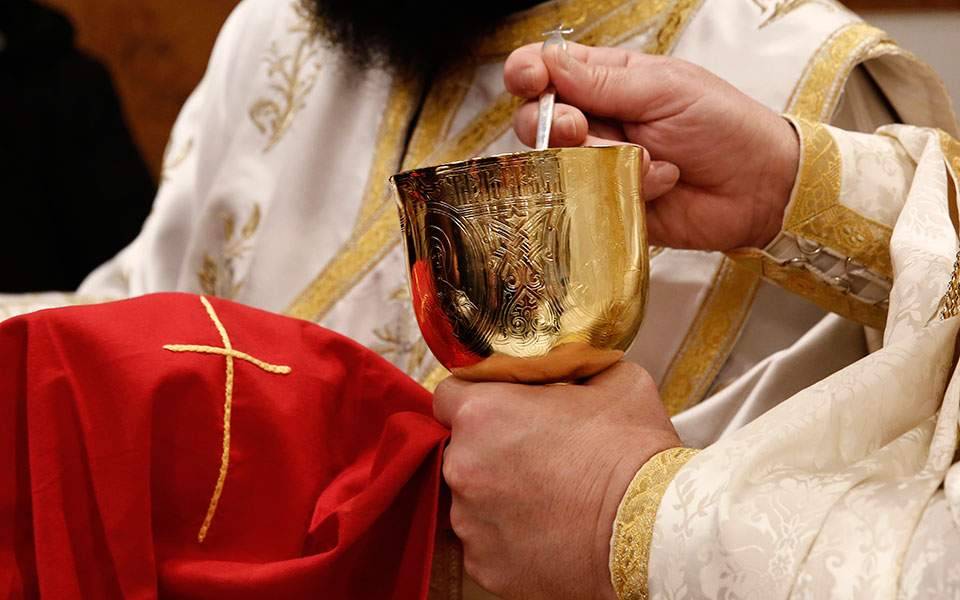
The Orthodox doctrine of the Eucharist differs somewhat from the Roman Catholic doctrine of the Mass, and even more from the Protestant doctrine of the Lord’s Supper/Eucharist/Holy Communion.
The Orthodox Study Bible outlines three interpretations of Christ’s Eucharistic words as they have been understood by the church down the ages:
(a) ‘For the first thousand years of Christian history, when the Church was visibly one and undivided, the holy gifts of the Body and Blood of Christ were received as just that: His Body and Blood. The Church confessed this was a mystery: The bread is truly His Body, that which is in the cup is truly His Blood, but one cannot say how they become so.’
(b) In the 11th and 12th centuries, the Roman Church defined the transformation of the elements as ‘transubstantiation’ – a change of substance from bread and wine to flesh and blood.
(c) The radical reformers took the view that the elements are nothing but bread and wine. ‘They only represent Christ’s Body and Blood; they have no spiritual reality.’ They are, in other words, mere symbols. This last point, according to the Orthodox Study Bible, helps explain why some Protestants receive communion only infrequently. But Timothy Ware (in The Orthodox Church) remarks that many Orthodox receive communion infrequently – perhaps only three or four times a year. But this would be for the opposite reason: they have been taught to approach only after lengthy and careful preparation.
As for the reference to ‘the radical reformers’: such a term would normally be used for those, such as the anabaptists, who were on the fringe of the Reformation movement. It is true that Zwingli taught that the Lord’s Supper was essentially a memorial. But the same cannot be said of Luther, Calvin and other main-stream Reformers. And to neglect to mention this is misleading.
Equally misleading is the assertion that, for Protestants, the bread and wine ‘have no spiritual reality’.
A defence of the Orthodox position is offered:
(a) Jesus said, “This is my body…this is my blood”. It is no reply to say that when he declared, “I am the door”, he did not mean he was a seven-foot plank of wood. The Church has never believed that; but it has always believed that the consecrated bread and wine are truly his Body and Blood.
(b) Those who receive Christ’s Body and Blood unworthily are said to bring condemnation upon themselves, and to suffer sickness and even death (1 Cor 11:30). A mere symbol, or reminder, could scarcely have that power!
(c) From earliest days, when the Church met weekly to break bread (Acts 20:7), the Church has recognised the supreme importance of the Eucharist.
Timothy Ware explains that in Orthodox teaching the Eucharist
‘is not a bare commemoration nor an imaginary representation of Christ’s sacrifice, but the true sacrifice itself; yet on the other hand it is not a new sacrifice, nor a repetition of the sacrifice on Calvary, since the Lamb was sacrificed ‘once only, for all time’. The events of Christ’s sacrifice – the Incarnation, the Last Supper, the Crucifixion, the Resurrection, the Ascension – are not repeated in the Eucharist, but they are made present.’
In Orthodox thinking, the Eucharist is closely tied in with Christ’s incarnation:
‘The Eucharist is fundamentally an incarnational mystery: it is grounded in the Son’s taking of human flesh and becoming a person of true human nature. As the Son united to himself the nature of man in his human birth, so the faithful Christian receives into himself or herself the true person of the Son in the Eucharistic gifts, sanctified to the Father by the Holy Spirit.’
(M.C. Steenberg, The Encyclopedia of Eastern Orthodox Christianity, art. ‘Eucharist’)