Jacob Meets Esau, 1-20
33:1 Jacob looked up and saw that Esau was coming along with four hundred men. So he divided the children among Leah, Rachel, and the two female servants. 33:2 He put the servants and their children in front, with Leah and her children behind them, and Rachel and Joseph behind them. 33:3 But Jacob himself went on ahead of them, and he bowed toward the ground seven times as he approached his brother. 33:4 But Esau ran to meet him, embraced him, hugged his neck, and kissed him. Then they both wept. 33:5 When Esau looked up and saw the women and the children, he asked, “Who are these people with you?” Jacob replied, “The children whom God has graciously given your servant.” 33:6 The female servants came forward with their children and bowed down. 33:7 Then Leah came forward with her children and they bowed down. Finally Joseph and Rachel came forward and bowed down.
It is possible that Jesus drew on this story in his portrayal of the father of the prodigal son in Lk. 15:20.
‘The meeting is a classic of reconciliation. The stream of gifts and the demure family processions, almost comically over-organised (as it turned out), give some idea of the load on Jacob’s conscience and the sheer grace of Esau’s reply.’ (Kidner)
Bowed … seven times – ‘The manner of doing this is by looking towards a superior and bowing with the upper part of the body brought parallel to the ground, then advancing a few steps and bowing again, and repeating his obeisance till, at the seventh time, the suppliant stands in the immediate presence of his superior.’ (JFB)
But Esau ran to meet him – ‘What a sudden and surprising change! Whether the sight of the princely present and the profound homage of Jacob had produced this effect, or it proceeded from the impulsive character of Esau, the cherished enmity of twenty years in a moment disappeared; the weapons of war were laid aside, and the warmest tokens of mutual affection reciprocated between the brothers. But doubtless, the efficient cause was the secret, subduing influence of grace (Pr 21:1), which converted Esau from an enemy into a friend.’ (JFB)
And kissed him – Peter Williams (The Surprising Genius of Jesus) notes that this verse would have been very well known to the scribes of Jesus’ day, because it is one of only fifteen places in the Hebrew Scriptures where dots are placed over each of the six letters of the word translated ‘and he kissed him’. (The meaning of these dots is uncertain: they may indicate textual uncertainty, but the point here is that every scribe who listened to Jesus’ story of the ‘Prodigal Son’ would have placed these dots over the word. Accordingly, the words in the parable…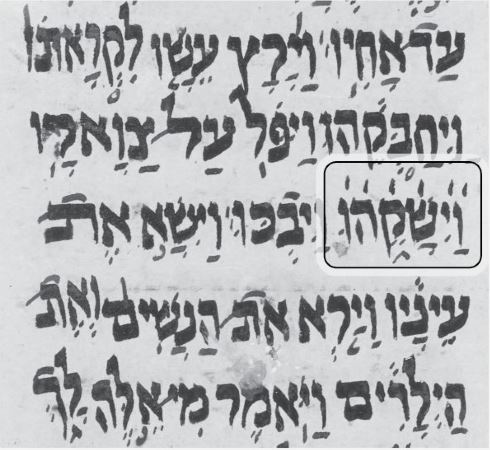
‘But while he was still far off, his father saw him and felt compassion, and ran and fell on his neck and kissed him.’ (Luke 15: 20)
…would have rung bells for them!
Williams notes the following commonalities between the story of Jacob and Esau and the Parable of the Prodigal Son:
(1) a man with two sons,
(2) a younger brother going into a far country,
(3) the younger brother herding animals in that far country,
(4) someone saying he is dying of hunger,
(5) a younger brother wearing the best robes given by a parent,
(6) an older brother coming in from a field,
(7) the use of the word “draw near” (Luke 15:25),
(8) an older brother being angry,
(9) concern about an older brother losing some inheritance to a younger one, and
(10) young goats as a meal.
v5 On children as a gift from God, see Ps 127:3.
33:8 Esau then asked, “What did you intend by sending all these herds to meet me?” Jacob replied, “To find favor in your sight, my lord.” 33:9 But Esau said, “I have plenty, my brother. Keep what belongs to you.” 33:10 “No, please take them,” Jacob said. “If I have found favor in your sight, accept my gift from my hand. Now that I have seen your face and you have accepted me, it is as if I have seen the face of God. 33:11 Please take my present that was brought to you, for God has been generous to me and I have all I need.” When Jacob urged him, he took it.
He took it – ‘In the East the acceptance by a superior is a proof of friendship, and by an enemy, of reconciliation. It was on both accounts Jacob was so anxious that his brother should receive the cattle; and in Esau’s acceptance he had the strongest proofs of a good feeling being established that Eastern notions admit of.’ (JFB)
33:12 Then Esau said, “Let’s be on our way! I will go in front of you.” 33:13 But Jacob said to him, “My lord knows that the children are young, and that I have to look after the sheep and cattle that are nursing their young. If they are driven too hard for even a single day, all the animals will die. 33:14 Let my lord go on ahead of his servant. I will travel more slowly, at the pace of the herds and the children, until I come to my lord at Seir.”
“Until I come to my lord at Seir” – But as soon as he was alone, Jacob turned north, to Succoth. Is there a sign here of his old deviousness? ‘Despite his total capitulation at Peniel Jacob kept his scheming ways, pretending one thing and intending another. He remained the same Jacob as Esau had know years earlier, giving his brother the slip under cover of following gently for the sake of the children and tender animals. Heartening it would be if defects of character were immediately removed by a conversion experience, evidence from Scripture and from life indicates otherwise.’ (Baldwin)
33:15 So Esau said, “Let me leave some of my men with you.” “Why do that?” Jacob replied. “My lord has already been kind enough to me.”
33:16 So that same day Esau made his way back to Seir. 33:17 But Jacob traveled to Succoth where he built himself a house and made shelters for his livestock. That is why the place was called Succoth.
The brothers part, not to meet again until they meet to bury their father at Hebron (Genesis 35:29).
Succoth = ‘shelters’.
33:18 After he left Paddan Aram, Jacob came safely to the city of Shechem in the land of Canaan, and he camped near the city. 33:19 Then he purchased the portion of the field where he had pitched his tent; he bought it from the sons of Hamor, Shechem’s father, for a hundred pieces of money. 33:20 There he set up an altar and called it “The God of Israel is God.”
v18 There is a break of several years between v17 and this verse.
‘Two generations on from Abraham all the covenanted purposes of God were vested in one man, Jacob, and his sons. Was it possible that from so small and unpromising a beginning the whole world could be significantly changed? In terms of human understanding the proposition was highly unlikely, but there was dynamisim in the word of the Lord, and it would not fail. Jesus saw his own ministry in a similar light; it was “like a grain of mustard seed, … the smallest of all the seeds on earth; yet when it is sown it grows up and becomes the greatest of all shrubs … ” (Mk 4:30-32). The quiet, hidden work of God’s Spirit goes on through the centuries, embracing succeeding generations, all of which belong in his world-wide outreach and are part of a greater whole, called by Jesus “the kingdom of God”. Statistics cannot estimate its size, nor reckon its worth.’ (Baldwin)