The Magi – the Damascus connection
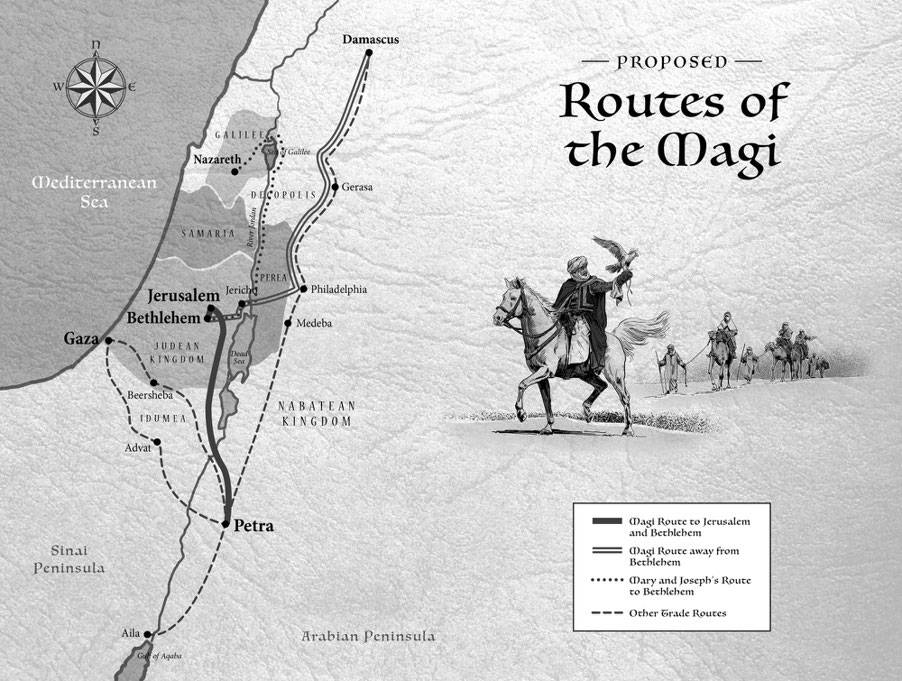
Dwight Longenecker, in his book Mystery of the Magi, proposes that the magi were courtiers from Nabatea (capital: Petra) in Arabia.
Their journey would have been undertaken on horseback and would have taken a few days.
We know from Matthew’s account that they returned by ‘another route’. This might have taken them to Damascus (which was at that time also part of Arabia, but later became part of the Roman empire).
If the magi sheltered in Damascus, they would have been ‘in their own country’ but sheltered both from Herod and from their own king, Aretas III. Some time later, they would have been able to return to Petra via the trade route that stretched southwards from Damascus.
The beginning of this route to Damascus receives support from the existence of a small monastery, dedicated to St. Theodosius, which. according to tradition, marks when the Magi stopped on their journey from Bethlehem.
Putting together fragments of evidence, it is possible that the magi came into contact with Essenes in Qumran, before heading north to shelter with Essenes near Damascus.
In Acts 9 we read that Saul was authorised by the Jewish leaders in Jerusalem to travel to Damascus to round up the Christian believers there. It was on his way there that he received his vision of the risen Christ and was converted. But why was it that there was an important group of believers there? Could it be that they were members of a community established by the Magi after their visit to Bethlehem, 30 years earlier?
After his conversion, Paul states (in Galatians) that he went to Arabia. Following Margaret Barker, Longenecker speculates that Paul may have gone to Nabatea in Arabia, and there taught by a school established by the Magi. We find in Paul’s theology the three strains that would have been found in the Nabateans: (a) Abrahamic Judaism (e.g Gal 4:25); (b) a knowledge of mystery religions (rejected by Paul, but still lending language and imagery to his thinking – see Eph 1:9)); and (c) Greek philosophy (cf. 1 Cor 1:22-25; Acts 17:22-34).
But if the Magi were Nabatean diplomats, why didn’t Matthew say so? Longenecker suggests three reasons.
(a) he didn’t need to; his audience of Jewish Christians in Judea would have understood clearly who the Magi were;
(b) Matthew’s sources may have handed the story down in such a spare form because both Herod and Aretas III were known to be vengeful and paranoic men; and
(c) Matthew may have wished to validate the benign Magian influence without lending credence to false magicians and gnostic sects by making too much of that influence.
All of this is admittedly speculative (more so than Longenecker’s theory that the Magi were courtiers from Nabatea). But it seems to make quite good sense of the available data.