Adelphopoiesis: ‘the making of brothers’
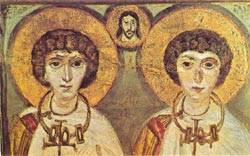
It is interesting that both human rights activist Peter Tatchell and politician Adrian Trett have asserted that in times past the Christian church has actively endorsed same-sex marriage. And in both cases they have appealed as their sole source of evidence to John Boswell’s book The marriage of likeness: same-sex unions in pre-modern Europe.
Boswell argued that the ancient rite of ‘adelphopoiesis’ should be regarded as equivalent to same-sex marriage. It would follow, then, that sections of the modern Christian church are denying its own history when it opposes same-sex marraige today.
Now, I have to confess that I have not read Boswell’s book. And probably no ‘general reader’ should be encouraged to do so since it is, by all accounts, full of references to sources that we would not be in a position to check and which frequently quote from original languages (including Greek) without transliteration. And the book’s central thesis is too disputable to be taken on trust.
And it is not just the arcane nature of the Boswell’s work that makes me regard Adrian Trett’s advice to his audience that ‘you all read it’ as a piece of misplaced opportunism. There are a number of reasons why we should not accept Boswell’s thesis merely on the say-so of a gay rights activist or a politician:-
-
The liturgy of ‘adelphopoiesis’ explicitly states that the union is a ‘spiritual’ and not a ‘carnal’ union.
-
The term ‘adelphopoiesis’ clearly indicates that the ritual had to do with bringing two men together as brothers, rather than as marriage partners. Far more likely, then, that it was linked to the idea of ‘blood brothers’, which was prevalent in other cultures. In fact, that’s precisely what the name (meaning ‘the making of brothers’) suggests.
-
Boswell’s book has found severe critics within the Catholic and Orthodox churches, who might be assumed to know their own ancient liturgies reasonably well. More significantly still, it has received strong criticism from within the academic community, where its central thesis has not found widespread support.
-
Finally, Boswell was both a committed Catholic and a homosexual (who sadly died from the complications of AIDS at the age of 47). This by no means proves that his work was biassed, but it needs to be shown that his work was not been unduly influenced by a need to reconcile his religious faith with his sexual orientation.
The fact that someone once wrote a book proposing some odd theory does not make that theory true. Theories need to be tried and tested. Boswell’s theory has not yet passed the test and, like an unproven drug, cannot be recommended for public consumption.