‘Why the Beloved Disciple Is Not John the Son of Zebedee’
I confess that I have, until now, accepted without question the ‘traditional’ attribution of the Fourth Gospel to John the son of Zebedee.
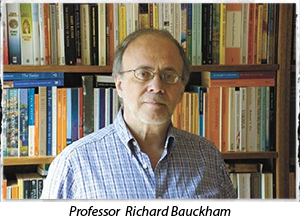
But I have been considering the view of Richard Bauckham, that the author and ‘Beloved Disciple’ of the Fourth Gospel is not John the Apostle, son of Zebedee. He is, rather, another John (later called ‘John the Elder’) who was a Jerusalem-based disciple (but not one of the Twelve).
I summarise Bauckham’s argument in Jesus and the Eyewitnesses (2nd ed.).
(1) Focus on Jerusalem and Judea rather than Galilee
Jesus’ ministry in Galilee had been well covered by Mark, and this was taken for granted by John, and not repeated. John was himself a Jerusalem resident and did not travel widely with Jesus.
(2) Different Disciples Are Prominent
Some members of the Twelve who are merely named in the Synoptics recieve more prominence in the Fourth Gospel. This is true of Philip, Thomas, Andrew, and the second Judas (not Iscariot). This is true also of other disciples who were not members of the Twelve: Nathanael, Nicodemus, Lazarus, Martha and Mary of Bethany. Conversely, the sons of Zebedee are hardly mentioned in the Fourth Gospel, whereas Philip, Thomas, Nathanael, Nicodemus and Lazarus are completely (or alomost completely absent from the Synoptics.
(3) The Twelve Are Not Prominent
In Mark and Matthew, the Twelve receive such prominence that a superficial reading might lead to the conclusion that they were the only disciples. In John, however, there is much less emphasis on the Twelve. It is clear that, in the Fourth Gospel, ‘his disciples’ has a wider reference than just to the Twelve (as in the case of Nathanael, Jn 21:2).
Whereas Mark 14:17-21 (followed by Matthew and Luke) seems to give the impression that only the Twelve were present at the Last Supper, the text nowhere states that it was only they who were present.
(4) Where Is James the Son of Zebedee?
Scholars who think that the Beloved Disciple was John the son of Zebedee remark that this explains why this John is otherwise unmentioned in the Fourth Gospel (apart from Jn 21:2). What they fail to recognise is that John’s brother James is also unmentioned (apart from ‘the sons of Zebedee’ in Jn 21:2). John and James are both frequently mentioned (often together) in the Synoptics, yet both recede into the background of the Fourth Gospel.
This leads to the conclusion that the Synoptics tells the story of Jesus from the perspective of the inner circle of disciples (Peter, James and John), whereas the Fourth Gospel tells the story from a different perspective. This would make sense of the author was not one of the sons of Zebedee.
(5) The Beloved Disciple as Eyewitness at the Cross
In the Synoptics, the principle witnesses at the time of the crucifixion were Peter, and then three named women. The Fourth Gospel, on the other hand, stresses the eyewitness testimony of the Beloved Disciple at this time. From the Synoptic perspective, it is highly unlikely that John the son of Zebedee would have been present at the cross: why would Mark have relied on the testimony of the women if one of the inner circle of the Twelve could have supplied it?
(6) Jesus’ Preferential Love for the Beloved Disciple
In the Synoptic Gospels, John the son of Zebedee (along with Peter and James) is a trusted disciple, and possibly marked out for future leadership. But there is no hint that Jesus was especially fond of John. Yet this is what stands out in the Fourth Gospel.
(7) The Distinctiveness of the Gospel of John
If we attribute the Fourth Gospel to John the son of Zebedee, it it difficult to explain why it is so different from the Synoptics. We would then have two Gospels – Mark’s and John’s – based on eyewitness testimony from the inner circle of disciples (Peter and John respectively), and yet profoundly different in so many ways. The differences are more understandable if one of them was written from a perspective outside the circle of the Twelve:
‘by a disciple who was not a Galilean fishermen but a resident in Jerusalem, an individual who may have brought to his reflection on Jesus a more educated urban cultural background, whose Gospel is so-to-speak not an official biography but the account of someone who believed his special closeness to Jesus both gave him distinctive insight into Jesus and the events of the Gospel and also required him to bear his distinctive witness to Jesus?’