Egypt in Israel
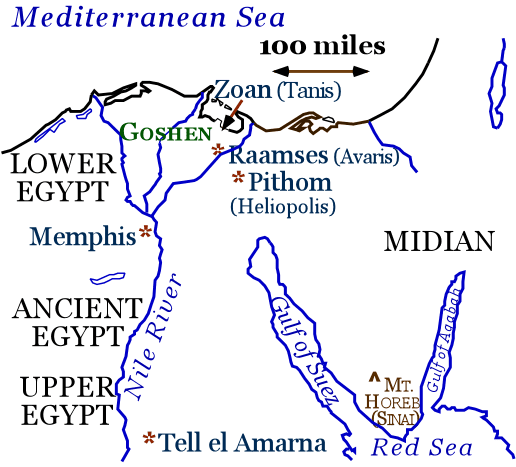
If firm evidence of Israel’s sojourn in Egypt is scant, then we might try looking in the opposite direction.
What signs are there that the Israelites, after their entry to the Promised Land, brought with them signs of their Egyptian past?
James Bejon argues that traces of Egypt’s influence can be found within the pages of the Hebrew Scriptures.
One notable example is the word for the Acacia tree (shittah). Of its 28 occurrences in the Bible, 26 are found in the Book of Exodus. The cognate shandat occurs frequently in Egyptian texts, and this word is likely to have passed across to Hebrew as a loan-word. Interestingly, the word shittah/sant occurs in a number of modern place names, almost all of which are found in or around Egypt. Conversely, in the Arabian Peninsula the alternative name for the Acacia tree (samar) is much more common.
A study of place names and personal names is also enlightening.
James Bejon discusses:
1. Ptah names
Ptah was an Egyptian deity.
(a) The place-name Maian-Me-Nephtoah in Josh 15.9, 18.15 probably reflects the Egyptian name Merneptah (‘Beloved of Ptah’), and should be translated ‘The Spring of Merneptah’.
(b) The personal name Tahrea/Tarea (1 Chr. 8.35, 9.41) was probably based on Ptah.
(c) One of Samuel’s ancestors was named Tohu (1 Sam 1:10, Nahath (1 Chron 6:26) or Toah (1 Chron 6:34). These names are probably different abbreviations of Ptḥ-nḫt (‘Ptah is strong’).
2. Horus names
The Israelites absorbed a number of names based on the important Egyptian deity Horus.
(a) In Ex 17, Moses does battle alongside the Israelite Hur (Horus).
(b) Num 13 records an Egypt-born patriarchal figure named Hori.
(c) In 1 Kings 4 Solomon appoints Ben-Hur over Ephraim.
(d) The name Har-nepher occurs in 1 Chron 7:36.
(e) Harhas (2 Kings 22:14) is another Horus name.
Bejon concludes:
‘The Hebrew Bible preserves Egyptian names with a remarkable degree of accuracy. It doesn’t simply reflect a vague awareness of a few Egyptian deity names; it reflects an awareness of how these names were pronounced, how they found their way into personal names, and how their pronunciation changed in light of the particular positions they assumed in personal names, all of which bears testimony to a sustained first-hand acquaintance with the Ancient Egyptian culture and language together with a reliably preserved text.’