Lloyd-Jones: cessationist, or continuationist?
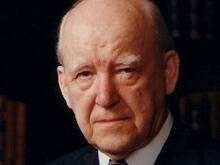
Even more than C.H. Spurgeon, Dr D.M. Loyd-Jones has divided his hearers and readers in respect of his views on the spiritual gifts.
In his book Strange Fire, John MacArthur offers a single quotation which demonstrates (presumably to MacArthur’s satisfaction) that Lloyd-Jones was a cessationist.
Actually, I’m going to present a rather more extended quotation than MacArthur offers:
‘A prophet was a person to whom truth was imparted by the Holy Spirit. . . . A revelation or message or some insight into truth came to them, and, filled with the Spirit, they were able to make utterances which were of benefit and profit to the Church. Surely it is clear that this again was temporary, and for this good reason, that in those early days of the Church there were no New Testament Scriptures, the Truth had not yet been expounded in written words.
‘Try to imagine our position if we did not possess these New Testament Epistles, but the Old Testament only. That was the position of the early Church. Truth was imparted to it primarily by the teaching and preaching of the apostles, but that was supplemented by the teaching of the prophets to whom truth was given and also the ability to speak it with clarity and power in the demonstration and authority of the Spirit.
‘But once these New Testament documents were written the office of a prophet was no longer necessary. Hence in the Pastoral Epistles which apply to a later stage in the history of the Church, when things had become more settled and fixed, there is no mention of the prophets. It is clear that even by then the office of the prophet was no longer necessary, and the call was for teachers and pastors and others to expound the Scriptures and to convey the knowledge of the truth.
‘Again, we must note that often in the history of the Church trouble has arisen because people thought that they were prophets in the New Testament sense, and that they had received special revelations of truth. The answer to that is that in view of the New Testament Scriptures there is no need of further truth. That is an absolute proposition. We have all truth in the New Testament, and we have no need of any further revelations. All has been given, everything that is necessary for us is available. Therefore if a man claims to have received a revelation of some fresh truth we should suspect him immediately. . . .
‘The answer to all this is that the need for prophets ends once we have the canon of the New Testament. We no longer need direct revelations of truth; the truth is in the Bible. We must never separate the Spirit and the Word. The Spirit speaks to us through the Word; so we should always doubt and query any supposed revelation that is not entirely consistent with the Word of God. Indeed the essence of wisdom is to reject altogether the term ‘revelation’ as far as we are concerned, and speak only of ‘illumination’. The revelation has been given once and for all, and what we need and what by the grace of God we can have, and do have, is illumination by the Spirit to understand the Word.’
(Source)
In his introductory article on Lloyd-Jones, Eryl Davies includes a small excerpt from the above-quoted sermon in support of his case that Lloyd-Jones was not a ‘charismatic’ (or, indeed, a Pentecostal).
Davies does think that there are some ‘weaknesses and ambiguities’ in Lloyd-Jones’ position. But the following, taken from Lloyd-Jones’ sermons on Romans 12, is hardly ‘ambiguous’:
‘I find it almost laughable that people should say that they do not see any evidence of the gifts today. It means, of course, that they are only thinking of speaking in tongues or of prophecy or of miracles … We are entitled, therefore, to argue that if some of these gifts have been in evidence throughout the history of the church and are still here, then why not all of them?
…
‘But perhaps the best way of reaching a definition is to ask; what is the difference between prophecy on the one hand and preaching and teaching on the other? Because there is a difference. And I would say that the difference is one word. Immediacy. And this means that a word is given to people and comes to them. Now preaching and teaching are not like that. A preacher and teacher is a man who takes time to study, he takes time to think, to prepare; he arranges his material and gives it order and system. A preacher and teacher should not enter into the pulpit without any preparation and trust to the inspiration of the moment.
‘What then is the gift of prophecy? Well I would define it as a direct inspiration of the Holy Spirit. What for? Its purpose is to give a word from God or the Word of God to the Church. Prophecy is the inspired delivery of warning, exhortation, instruction, judging and making manifest the secrets of the heart. Someone who makes a prophecy has been given this gift of passing on, as it were, a word from God to the church and to individuals in the church.’
(Source)
As is the case with Spurgeon, some writers have an awful habit of giving just one side of what is, in fact, a more complicated picture.
Lloyd-Jones argued that in revival a gift of prophecy (including an ability to foretell the future) was frequently given:
‘We must face these things because, it does seem to me, that we are in grave danger, with all our learning and knowledge, of quenching the Spirit. I am putting facts before you. You will find this phenomenon of prophecy, this ability to foretell the future, frequently present. It takes many forms. I knew a man whose minister had had this gift, again in the revival of 1904 and 1905. It disappeared completely afterwards, but while the revival lasted he was told beforehand of something that was going to happen in his Church, not once, but morning by morning. He would be awakened out of his sleep at half past two in the morning, and given direct and exact information of something that was going to happen during that day, and it did happen.’ (Revival)
Lloyd-Jones cites Peter’s quotation (in Acts 2) from the book of Joel and sees a fulfilment among the mill girls in Northern Ireland:
‘Poor girls who had been brought up in poverty and penury, who were ignorant and who had had practically no education, they suddenly began to prophesy. They displayed amazing knowledge and were able to speak in an unusual manner. Does it not rather look as if the prophet Joel had anticipated this, and prophesied that it was going to happen? Young men, young women, visions, dreams, prophecies, old men dreaming dreams: ‘That is what is happening,’ said Peter. ‘This is the pouring out of the Spirit of God.’ And the results are exactly as they were prophesied.’ (Revival)
That Lloyd-Jones was ambivalent towards the charismatic movement is evidenced in the chapter (‘Lloyd-Jones and the charismatic controversy’) by Atherstone, Jones and Kay in Engaging with Martyn Lloyd-Jones. Lloyd-Jones commitment to spiritual renewal meant that he was open to contemporary manifestations of prophecy and other charismata; however, his equally strong commitment to reformed theology led him to be critical of the doctrinal laxness and ecumenism he perceived within the charismatic movement. This ambiguity led to him encouraging people like Michael Harper, Peter Lews and Terry Virgo in private, while making somewhat scathing statements about the movement in public.