Experimental knowledge
No, this is not another post about science and faith, but a quotation from Puritan Thomas Brooks about the importance of what these days we might call ‘experiential’ knowledge of Christian truth:-
To be an evangelical is to seek to be true to Scripture because of the conviction that to be true to Scripture is to be true to Christ. A contemporary evangelical approach to Scripture has the possibility of combining appropriate pre-modern, modern and postmodern elements.
1. It will be pre-modern in the sense that it submits to the will of God as revealed in the text and thus puts the human will and its capacity for detached reason or local special pleading under that authority.…
Here are are three reasons, among many others that might be given:-
I believe in God, because otherwise, I would ultimately have no-one
In his book More Ready Than you Realize – Evangelism as Dance in the Postmodern Matrix (2002), Brian McLaren gives 8 factors that he sees as summarising post-modern evangelism:-
1. The Relational Factor – count conversations not conversions.
2. The Narrative Factor – listen to their story, share your story and share God’s story, not just propositions or formulas.
3. The Communal Factor – expect conversion to normally occur in the context of authentic Christian community, not just in the context of information.…
Recent publication of a book exploring Five Views on Biblical Inerrancy has got me thinking again about this topic.
Readers of Walking With Giants will know that I do not subscribe to a formal doctrine of inerrancy. I have outlined my reasons for this, and these include:-
Inerrancy is an inappropriate term. It is not appropriate for the very different kinds of literature we find in the Bible. It is easy to see what it would mean for a telephone directory to be regarded as ‘inerrant’, but not a psalm.…
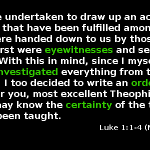
The New Testament writers assert on a number of occasions that the accounts of Jesus’ life and work were based on eyewitness testimony.
Perhaps the most famous of these assertions is the statement by Luke at the beginning of his gospel. Peter also insists that ‘we did not follow cleverly invented stories when we told you about the power and coming of our Lord Jesus Christ, but we were eye-witnesses of his majesty’ (2 Pet 1:16). …
It should be the daily goal of Christians to become more like Christ. It is a remarkable reflection of God’s common grace that even those without faith in Jesus Christ can demonstrate remarkably Christlike qualities.
But the popular mind in general, and the media in particular, have a regrettable tendency to single out a few remarkable lives and virtually deify them. Cases in point would be Ghandi, Mother Theresa, and Nelson Mandela. The tendency to place Mandela in the pantheon of virtue along with Jesus Christ was reflected in a question put by BBC presenter Justin Webb to Jimmy Carter. …
Contributors to Trevin Wax’s blog have recently been writing about some of the aspects of Christ’s atoning work:-
On the cross, Christ
No one image (let’s not call them theories, please!)…
Scholars such as Bart Ehrman (in his recent book How Jesus Became God) stress the differences between the ‘higher Christology’ of John’s Gospel (in which Jesus is represented as God incarnate) and the ‘lower Christology’ of the Synoptic Gospels (Matthew, Mark, and Luke, in which he is represented as exalted, but not pre-existent). For Ehrman, even the Synoptic view of Jesus did not arise until after his followers came to believe that he had been resurrected; and the Johanine view developed later still.…
Craig L. Blomberg, Can we still believe the Bible?. Reviewed (or, rather, noted, by Kevin James Bywater).
Blomberg is a thorough scholar and a clear writer. He has authored books on a range of topics, including the historical reliability of the Gospels. In this present volume, he deals with a range of possible objections to the trustworthiness of the Bible, including issues to do with the integrity of the text of the New Testament, the choice of books to include in the canon, the historical nature of biblical narratives, and the question of miracles.…