Be bold!
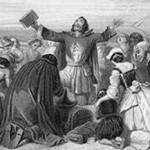
What I meant to do, when writing my previous post on William Gurnall, was to present this more extended quotation on boldness. It is vintage Gurnall, and a magnificant encouragement to Christians. So here it is:-
William Gurnall (1617-1679) was rector of Lavenham in Suffolk. Although a Puritan in doctrine, he remained loyal to the Church of England all his life. He is known for one book, The Christian in Complete Armour. This is a massive exposition of Ephesians 6:10-20, and is a classic on spiritual warfare. Massive it may be (almost 1200 pages) and yet, as someone once said, there is often more solid teaching in one line of Gurnall than in any number of pages of other Christian writers.…
Peter Adam is Principal of Ridley Theological College in Melbourne, Australia. In a recent lecture on John Calvin as a preacher, he sets out nine demanding engagements that Calvin sought to fulfil in his own preaching.
There are:-
1. Engaging with God. The preacher doesn’t just talk about God in some remote and objective way. No: the preacher expects God to be present with and in his Word by his Spirit.
2. Engaging with the 66 texts of the Bible. …
Calvin took the activities of Satan and his demons very seriously, without falling into the superstitions which sometimes appear in Luther’s writings. Calvin’s teaching was, above all else, scriptural, as the following extract shows.
J.I. Packer, who has done so much to revive interest in the Puritans, identifies the following characteristics of Puritan preaching:-
1. It was expository in its method. The preacher’s task was to extract meaning from the text, rather than to impose meaning on it. The preacher seeks the mind of God as revealed in Scripture, and then seeks to express it faithfully. In ‘opening’ a text, the Puritan preacher would explain it in context, extract from it one or more doctrinal observations, and then amplify, illustrate and confirm from other scriptures the truths thus derived.…
I’m sure that many of us will have read the famous ‘Narnia Chronicles’ of C.S. Lewis either when we were children, or, as I did, to our own children.
I can remember being intrigued by the fantastic world that Lewis dreamed up in those tales. I found it difficult to understand that even a mind as fertile as Lewis’ could have created such a world without some kind of underlying framework.
The stories work, of course, simply as stories. …
Timothy Dudley-Smith, in his fine biography of John Stott, draws some striking parallels between John Stott and Charles Simeon (1759-1836).
…‘Both were privileged sons of comparatively affluent parents, educated at public schools, undergraduates at Cambridge. They shared a transforming experience of conversion to Christ, early and and severe trials and testing, and virtually a lifetime’s ministry in a single church. Each cultivated habits well beyond the norm for early rising, disciplined prayer and the study of Scripture.
‘If you have not learned about sin,’ writes J.I. Packer, ‘you cannot understand yourself, or your fellowmen, or the world you live in, or the Christian faith.’
The Bible (apart from the first two chapters) is about God’s answer to sin.
It is not easy to have clear views about sin, because
The nature of sin. …
According to US Presiding Bishop Katharine Jefferts Schori, belief in personal salvation is a ‘heresy’. The grace of God, she is reported as saying, is given to the believing community, not to the individual Christian.
Of course, she may have been misreported. It wouldn’t be the first time that the religious press has made someone out to be less orthodox than they really are.
Or possibly she just expressed herself badly. Maybe she just meant to say that rampant individualism (a besetting problem in post-enlightenment liberalism as well as evangelicalism) is sub-biblical and sub-Christian. …
J.I. Packer explores this topic with cross-cultural evangelism in mind. Here’s a summary.
The content includes a diagnosis of the human condition, value-judgments on the life that is, and the life that might be, lived, and a call to respond in radical commitment. Now this content must be verbalised, and it must be preached (i.e. explained and applied). Such media as instrumental music, pictures, sculpture, or dance may reinforce the message, but only preaching can communicate it. …