

 Reload document
  Open in new tab
 Mt 26:1-16 – Judas’ story and Mary’s story – sermon notes
Text: Matthew 26:1-16
[Note: these are notes of a sermon preached in two parts, separated by a time of reflection and confession. As you will see, each half was delivered using a 1st-person perspective.]
Judas’ Story
I heard it with my very ears: “In two days’ time, I’m going to be handed over to be crucified.”
A criminal’s death. The cruelest and most degrading form of death.
He’d said such things before, of course: ‘[that] he must go to Jerusalem, and suffer many things at the hands of the elders, the chief priests and the teachers of the law, and that he must be killed and on the third day be raised to life.’…
A survey of heresies
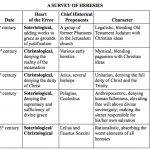
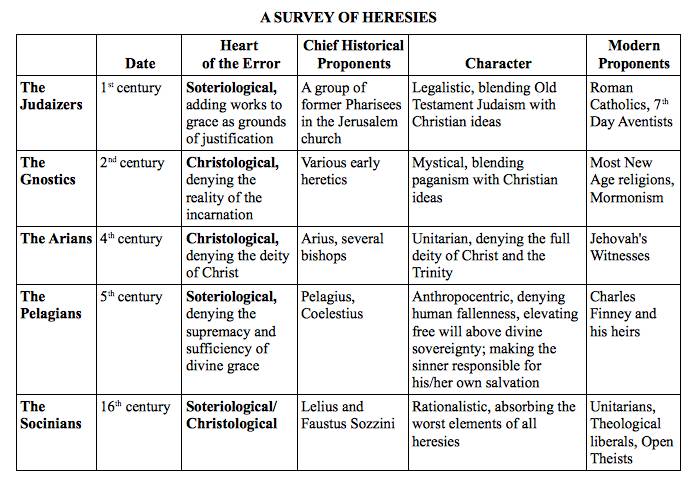
http://www.solasisters.com/2012/07/survey-of-heresies.html
Communion with the Triune God

John Owen ‘picked up on a theme found in Augustine, namely, communion as the “enjoyment,” or possession of and delighting in the triune God. In Augustine’s “On Christian Doctrine,” one chapter is titled, “The Trinity the true object of enjoyment.” There, Augustine wrote, “The true objects of enjoyment, then, are the Father and the Son and the Holy Spirit, who are at the same time the Trinity, one Being, supreme above all, and common to all who enjoy Him.”’…
Erastus of Corinth

‘During the eighteen months he was in Corinth (Acts 18:11) Paul evidently converted a man named Erastus, who provides an interesting cross-cultural link in the Corinthian church. One of the most imposing structures in Corinth was the fourteen-thousand-seat theater, located northwest of the forum and renovated about five years before Paul arrived. About this time (c. 50, during the reign of Claudius) a large stone plaza was also laid at the northeast corner of the theater area.…
Is religious belief culturally determined?

If you were born in the UK, then your religion (if any) would probably be Christian. If, however, you were born in Morocco, you would probably be a Muslim. This shows (so the argument goes) that religious belief is not something that determined by a calm consideration of the evidence, but rather by where, and by whom, you were raised.
There is, however, a rather glaring problem with this argument, in that it applies to the pluralist who thinks that all religions are equally valid (or equally invalid). …
Thoughts on thankfulness

The class was set a task to write a short paper on “Things I Am Most Thankful For.” One small boy put at the top of his list, “My glasses. They keep the boys from punching me and the girls from kissing me.”
‘As the Lord loves a cheerful giver, so likewise a cheerful thanksgiver.’ (John Boys)
‘The Christian is suspended between blessings received and blessings hoped for, so he should always give thanks.’ (M.R. Vincent)
Bible commentator Matthew Henry, after being robbed, wrote in his diary: ‘Let me be thankful.…
Incidental references to ‘spiritual gifts’ in Paul’s letters

It is sometimes thought that because the ‘charismata’ are directly discussed only infrequently in Paul’s writings, they were regarded by the apostle as the marks of an immature church, and needed to be discouraged or actually suppressed.
However, it is at least as plausible to argue that Paul took the exercise of spiritual gifts more or less for granted in the churches, and he felt the need to discuss them in detail only when there were problems (as at Corinth).…
The blind men and the elephant

A famous Indian fable tells of a number of a blind men who try to describe an elephant. One, touching its side, declares that it is ‘like a wall’. Another, feeling the tusk, think that it is ‘like a spear’. Yet another, encountering its trunk, says that it is ‘like a snake’. Other contenders are ‘like a fan’ (the ear), ‘like a rope’ (the tail) and so on.
The intended moral of the story is clear: no-one has a monopoly on the truth. …
John Stott on 1 Corinthians 1:1-9
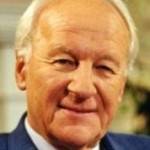
A summary of a sermon preached by John Stott at All Souls, Langham Place, in 1984. A recording of the sermon is available here.
Verses 1-3 – Introduction
It was a miracle that there could be a church in such a place as Corinth. It was notorious for sexual immorality, overseen by the Temple of Aphrodite. If a church can be planted in Corinth, it can be planted anywhere.
Paul had been called to be an apostle of Christ Jesus by the will of God. …