George Whitefield: slaveholder and evangelist
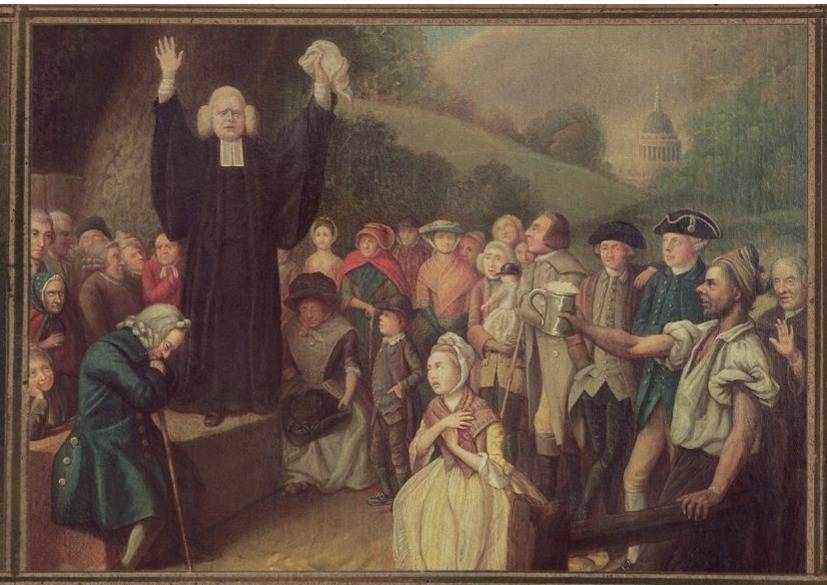
George Whitefield (1714 – 1700) was an outstanding evangelist. When, in 1740, he first traveled to North America he was appalled by the way slaves were treated:
‘Your dogs are caressed and fondled at your tables; but your slaves who are frequently styled dogs or beasts, have not an equal privilege. They are scarce permitted to pick up the crumbs which fall from their masters’ tables.… Although I pray God the slaves may never be permitted to get the upper hand, yet should such a thing be permitted by Providence, all good men must acknowledge the judgment would be just.’
He spoke about them, and to them, as human beings made by God and loved by God, and as fitting recipients of the gospel of God’s grace. For their part, many Afro-Americans held him in high esteem, and would finish their work early in order to come and hear him preach.
In 1740 he had founded an orphanage, called Bethesda, in Georgia. By 1747 both the colony and the orphanage were suffering economically. Whitefield ascribed this to the lack of slave labour (slavery was forbidden in Georgia at that time). He solution was to allow friends to purchase a plantation and slaves.
Writing in 1751 to a friend he explained his position:
‘As for the lawfulness of keeping slaves, I have no doubt, since I hear of some that were bought with Abraham’s money, and some that were born in his house. — And I cannot help thinking, that some of those servants mentioned by the Apostles in their epistles, were or had been slaves. It is plain, that the Gibeonites were doomed to perpetual slavery, and though liberty is a sweet thing to such as are born free, yet to those who never knew the sweets of it, slavery perhaps may not be so irksome. However this be, it is plain to a demonstration, that hot countries cannot be cultivated without negroes. What a flourishing country might Georgia have been, had the use of them been permitted years ago? How many white people have been destroyed for want of them, and how many thousands of pounds spent to no purpose at all? Had Mr Henry been in America, I believe he would have seen the lawfulness and necessity of having negroes there. And though it is true, that they are brought in a wrong way from their own country, and it is a trade not to be approved of, yet as it will be carried on whether we will or not; I should think myself highly favoured if I could purchase a good number of them, in order to make their lives comfortable, and lay a foundation for breeding up their posterity in the nurture and admonition of the Lord. You know, dear Sir, that I had no hand in bringing them into Georgia; though my judgement was for it, and so much money was yearly spent to no purpose, and I was strongly importuned thereto, yet I would not have a negro upon my plantation, till the use of them was publicly allowed in the colony. Now this is done, dear Sir, let us reason no more about it, but diligently improve the present opportunity for their instruction. The trustees favour it, and we may never have a like prospect. It rejoiced my soul, to hear that one of my poor negroes in Carolina was made a brother in Christ. How know we but we may have many such instances in Georgia ere it be long?’ (Source)
Thomas Kidd asks whether we are allowed to admire Whitefield for his suberb gifts, or shun his memory because of his failings. His answer is that instead of condemning him irredeemable, we should allow his faults to caution us.
Kidd comments:
‘Lest we wag our finger at figures like Whitefield, we should be reminded of the enormous difficulties of thinking outside of our cultural box. As much as I wish it were otherwise, if I had been born into a white southern slaveowning family in the Revolutionary era, I would almost certainly have died believing that slavery was a morally acceptable institution, too.’
Also see this, by Mark Galli,