Article X – On Free Will
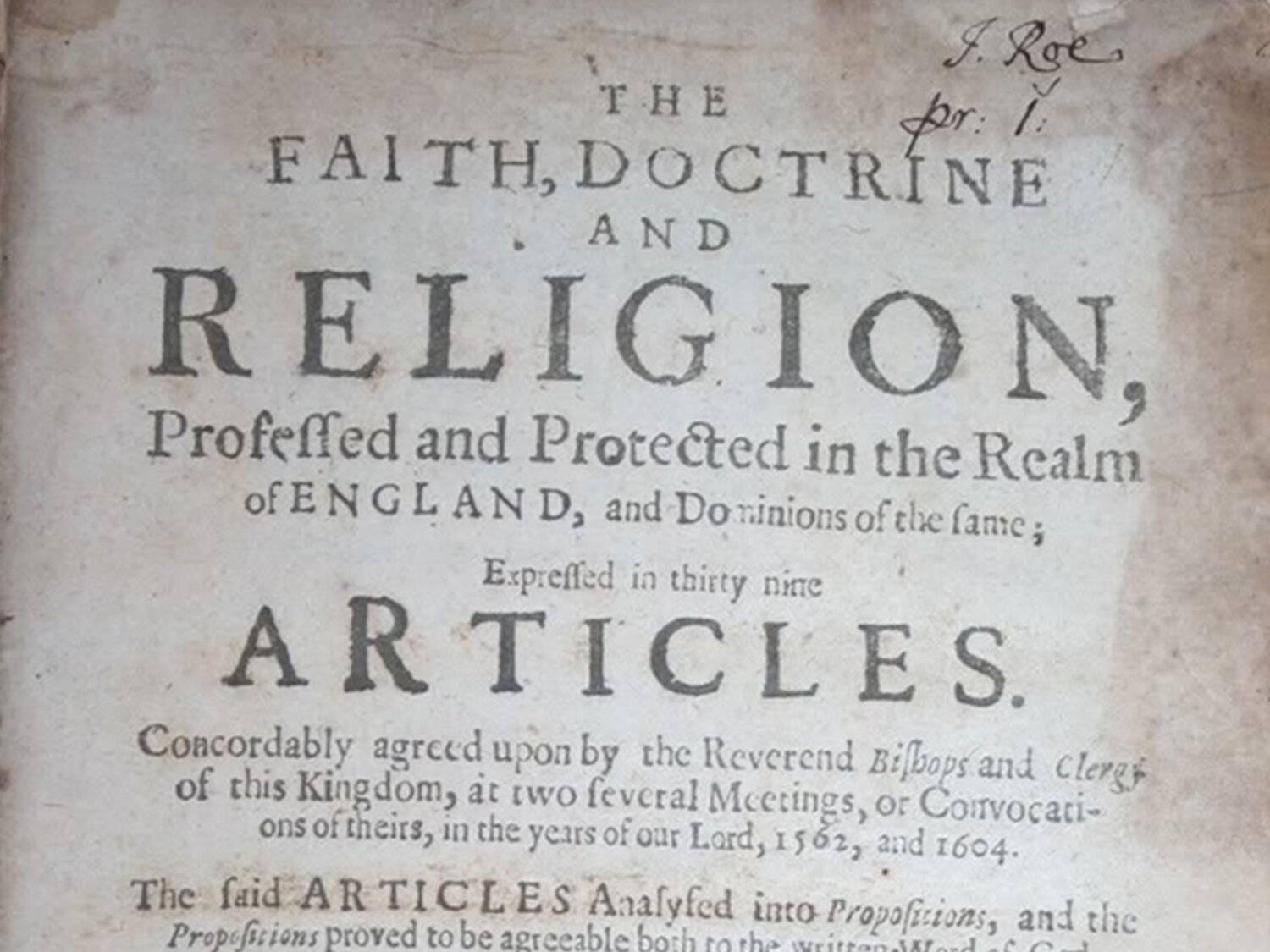
According to Article X of the Thirty-Nine Articles of the Church of England:
‘The condition of Man after the fall of Adam is such, that he cannot turn and prepare himself, by his own natural strength and good works, to faith, and calling upon God. Wherefore we have no power to do good works pleasant and acceptable to God, without the grace of God by Christ preventing us, that we may have a good will, and working with us, when we have that good will.’ (‘Of free will’ – The Thirty Nine Articles, X).
(The word ‘preventing’ is, of course, used in its older sense of ‘preceding’.).
Article X teaches that we are in bondage to sin and incapable of turning to God. The grace of God is required both in order for us to turn to him and in order for us to live lives that are pleasing to him. In order words, it includes both prevenient grace and accompanying grace; regenerating grace and sanctifying grace; grace in order to savingly choose Christ and grace in order to please God.
‘Article 10, ostensibly about human will, is thus in reality fundamentally about securing the sheer graciousness of divine grace in the economy of salvation. Given Article 10, I have nothing to boast in except Christ crucified.’ (Source)
It is the logical outworking of Article IX (Of Original Sin).
The issue is not that we have lost all power of choice. It is, rather, that:
‘Mankind was lacking, not in the capacity to make free decisions as such, but the capacity to make decisions which would affect in any way his moral standing under God’s judgement.’ (O’Donovan)
What is taught in Articles X is reflected throughout the Book of Common Prayer.
See, for example, the collect for the 9th Sunday after Trinity (BCP):
‘Grant to us, Lord, we beseech thee, the spirit to think and do always such things as be rightful; that we, who cannot do anything that is good without thee, may by thee be enabled to live according to thy will; through Jesus Christ our Lord. Amen.’
Griffith Thomas elaborates:
‘Our Prayer Book has many similar references to this need of Divine grace.
Thus, at Daily Prayer we ask: “O God, make clean our hearts within us.”
In the Collect for Easter Day: “As by Thy special grace pre-venting us … so by Thy continual help.”
The Collect for the Ninth Sunday after Trinity: “We, who cannot do anything that is good without Thee.”
Collect for the Fourteenth Sunday after Trinity: “Make us to love that which Thou dost command.”
Collect for the Fifteenth Sunday after Trinity: “The frailty of man without Thee cannot but fall.”
Collect for the Seventeenth Sunday after Trinity: “Thy grace may always pre-vent and follow us.”
Collect for the Nineteenth Sunday after Trinity: “Without Thee we are not able to please Thee.”
Collect after Communion Office: “Pre-vent us … with Thy most gracious favour, and further us with Thy continual help.”
The Homilies teach the same truth:
“It is the Holy Ghost, and no other thing, that doth quicken the minds of men, stirring up good and godly motions in their hearts, which are agreeable to the will and commandment of God, such as otherwise of their own crooked and perverse nature that they should never have.”
“As for the good works of the Spirit, the fruits of faith, charitable and godly motions, if he have any at all in him, they proceed only of the Holy Ghost, who is the only worker of our sanctification, and maketh us new men in Christ Jesus.”
“We are all become unclean, but we are not able to cleanse ourselves, nor to make one another of us clean. We are by nature the children of God’s wrath; but we are not able to make ourselves the children and inheritors of God’s glory. We are sheep that run astray, but we cannot of our own power come again to the sheepfold, so great is our imperfection and weakness.”
The Article is in two main parts.
(a) We are unable, by an unaided exercise of will, to savingly turn to God
Article X begins:
‘The condition of Man after the fall of Adam is such, that he cannot turn and prepare himself, by his own natural strength and good works, to faith, and calling upon God.’
Jn 8:31 ‘Then Jesus said to those Judeans who had believed him, “If you continue to follow my teaching, you are really my disciples 8:32 and you will know the truth, and the truth will set you free.” 8:33 “We are descendants of Abraham,” they replied, “and have never been anyone’s slaves! How can you say, ‘You will become free’?” 8:34 Jesus answered them, “I tell you the solemn truth, everyone who practices sin is a slave of sin. 8:35 The slave does not remain in the family forever, but the son remains forever. 8:36 So if the son sets you free, you will be really free.’
Romans 8:7–8. ‘The mind governed by the flesh is hostile to God; it does not submit to God’s law, nor can it do so. Those who are in the realm of the flesh cannot please God.’
Anselm: ‘You have not yet considered the greatness of the weight of sin.’
‘Scripture sets before us a man who is not only bound, captive, sick and dead, but who, through the operation of Satan, his lord, adds to his other miseries that of blindness, so that he believes himself to be free, happy, possessed of liberty and ability, whole and alive.’ (Luther, Bondage of the Will)
‘No man that seeth himself to be a sinner really, can count himself a small or little sinner. Nor can it ever be, till there be a little God to offend, a little guilt to contract, a little law to break, and a little wrath to incur. All which are impossible to be, blasphemy to wish, and madness to expect.’ (Robert Traill)
‘This crown of free will is fallen from our head.’ (Thomas Watson)
Rodgers remarks on the radical language that the Scriptures use about our inability:
1) We read that the imagination of man’s heart is evil continually.
2) We learn that we need God to give us a new heart, one of flesh and not of stone, one in which He will write His laws. We do not give ourselves a new heart nor write the Law of the Lord there.
3) We read that we are dead in our trespasses and sins, and dead people do not make themselves alive; they must be raised by another.
4) We hear that we need a new creation, and a new birth and we are not “self-creators” able to become a new creation. We are clearly beyond self-help.
Gerald Bray writes about the spiritual bondage that occurs consequent to the Fall:
‘When Adam and Eve disobeyed God they rejected his love and his providential care for them, preferring to go their own way—only to discover that they were trapped in a world ruled by Satan. This is bondage, and every human being is caught up in it because we have all inherited the consequences of our first parents’ sin. We are ‘free’ in the way that fish in an aquarium are free. We can move around within limits, but cannot escape from the confines in which we have been placed. The fish may not realise this, but the outside observer sees it all too clearly.’
There is only one way out, and that is the way of divine rescue:
‘There is only one escape from our prison, and that is divine rescue. God can lift us out of our limitations, but we cannot do anything to help ourselves. We may be capable of great achievements within the limitations placed on us—remember that it is not impossible for prisoners to get university degrees, for example, and some achieve amazing things. But however brilliant and gifted they may prove to be, they are still in prison and cannot get out unless they are released. This is the state of fallen man, apart from the grace of God and there is nothing we can do to change it.’
Rodgers:
‘The bondage of the will is found first and foremost in relation to God and other persons. This bondage is experienced as the fact that we cannot choose to love God with all of our heart, soul and mind and our neighbor as ourselves. At the deepest level of our heart or inner desire, we do not really want to love God or our neighbor that way and we cannot change this inclination and condition of our heart.’
Even the best and most loving of our thoughts and actions are tainted by sin. They are, at best, half-hearted.
The problem is not that we are not free to choose what we want: it is that we cannot consistently want what we ought to want.
Boice explains inability using an illustration:
‘In the animal world there are animals which eat nothing but meat: carnivores. There are other animals which eat nothing but grass or plants: herbivores. Imagine then that we have a lion, who is a carnivore, and place a beautiful bundle of hay or a trough of oats before him. He will not eat the hay or the oats. Why not? Is it because he is physically unable? No Physically, he could easily begin to munch on this food and swallow it. Then why does he not eat it? The answer is that it is not in his nature to do so. Moreover, if it were possible to ask the lion why he will not eat the herbivore’s meal and if he could answer, he would say, “I can’t eat this food; I hate it; I will eat nothing but meat.” We are speaking in a similar way when we say that the natural man cannot respond to or choose God in salvation. Physically he is able, but spiritually he is not. He cannot come because he will not come. He will not because he really hates God.’
Boice cites Arthur Pink in order to distinguish between natural and moral inability:
‘In 1 Kings 14:4. (“Now Ahijah could not see, for his eyes were dim because of his age”) and Jonah 1:13 (“The men rowed hard to bring the ship back to land, but they could not, for the sea grew more and more tempestuous”) it is natural inability that is in view. No guilt is attached to it. On the other hand, in Genesis 37:4 we read, “When his brothers saw that their father loved him [Joseph] more than all his brothers, they hated him and could not speak peaceably to him.” This is a spiritual or moral inability. For this they were guilty, which the passage indicates by explaining their inability to speak kindly to Joseph by their hatred of him.’
An alcoholic chooses to drink. But is that a free choice? No: alcohol has, for him, a power that is greater than his own will-power. And the key is to realise that he needs help from outside. So it is with the sinner: we are enslaved to sin until a stronger power releases us and rescues us. Then, and only then, are we released to love and serve God as we ought.
Bray illustrates this with reference to Alcoholics Anonymous. They are quite clear that they can do nothing to help a person until he or she recognises the problem and realises that they cannot do anything about it by themselves.
Letham:
‘Jonathan Edwards made a distinction between natural ability and moral ability. This is valid insofar as fallen humans still have a will and exercise it. The problem is not that they cannot believe but that they will not believe. It is an ethical problem rather than a physical or psychological one. They refuse to choose the good and have an inbuilt antipathy toward God. The will is there, but it requires a radical change altering its inclinations in order to respond positively to the gospel.’
‘All we like sheep…’
Jn 15:5 – ‘Apart from me you can do nothing.’
In truth, then, ‘we ourselves are the problem and not the answer.’ (Rodgers)
(b) Only God’s grace can set us free!
God’s grace frees the will so that we can receive new life (regeneration) and live a life that is pleasing to him (sanctification)
(i) Regenerating grace
A new heart and a new spirit required, Eze 18:31, to set us free from this bondage to sin.
Eze 36 ‘A new heart I will give you.’
‘Wherefore we have no power to do good works pleasant and acceptable to God, without the grace of God by Christ preventing us, that we may have a good will, and working with us, when we have that good will.’
John 6:44 “No one can come to me unless the Father who sent me draws him
John 15:16 “You did not choose me, but I chose you.”
Rodgers:
‘God’s remedy to the bondage of the will is prevenient grace, whereby the fallen human heart and the enslaved human will are set free to choose to turn to God in faith and obedience. It is prevenient because it is grace given prior to the act of faith that it enables. Accompanying grace follows: it is the continuing, inner, gracious work of God enabling the believing sinner to remain and grow in faith and obedience. Grace in both actions is the undeserved gift of God in Christ and is applied by the inner work of the Holy Spirit. Salvation, therefore, is entirely of God’s grace.’
Prevenient grace, writes Rodgers, is the grace which quickens the dead soul:
‘Left to our fallen nature, we would only resist all of His invitations to repent and believe. The things of the Spirit seem unreal or foolish, or impossible to fallen sinners. The “natural” man does not receive the things of the Spirit. But when God’s prevenient grace is at work in us, we are set free to respond. We stop resisting Him; we see the light; we recognize our need and we embrace His gracious Gospel. We believe and repent or, to put it differently, we are converted and we convert.’
(ii) Sanctifying grace
According to Rom 6:16-23, only a freed will heartily chooses righteousness. Only Christ can free a person to truly incline a person to live a life that is pleasing to God, Jn 8:34-36; Gal 5:1,13.
‘The act of belief…can occur only as God evokes it: no one can say ‘Jesus is Lord’, says Saint Paul, except through the Holy Spirit (1 Cor. 12. 3).’ (O’Donovan)
It is God’s grace that sets us free. Free to desire and to will what is right.
God’s grace is needed, to enable us to both commence, and to continue, the Christian life:
‘The only way that we can make any favourable impression on God is if we are set free to serve him as we ought to, and that is made possible by his free gift of salvation in and through Jesus Christ. We have not asked for this gift and have done nothing to deserve it—it is a gift, after all, and not a reward for services rendered. We are incapable of wanting it, or even of understanding what it is, until we receive it, which is why the article says that God’s grace in Christ ‘prevents’ us, ‘prevent’ being used here in the older sense of ‘precede’. When God gets to work in our lives he liberates our will and gives it a right understanding of what is good, as well as a desire to do it. Only when that happens is it possible to discover what true freedom is.’
Implications
Is this worth contending for at all?
In what senses may we speak of ‘free will’? Tom Woolford writes:
‘Apologetically, Article 10 should make us careful about how we talk about ‘free will’ in our defence of the Christian faith. We can and should talk about free will — even if we are impeccable Calvinists! — as part of our apologetic, provided we do so in a manner consonant with Articles 9 and 10. Why is there so much evil in our world? Men and women freely will it. For what are unbelievers judged and punished by a just and holy God? For what they have freely willed and done. When we sin, we sin freely and willingly. No-one else forces us to choose evil — not the Devil, not even Adam; and above all, not God. Our wills are by nature free, but free to will only as our nature directs: that is, to sin.’
Continuing:
‘But ‘free will’ must not feature in our answers to questions about faith and salvation. In answering the questions, ‘Why do you believe?’ or ‘Why are you saved?’, we must not reach within — to our ‘free will,’ our “natural strength and good works” — to answer. Article 10 forbids it, because Scripture forbids it (Ephesians 2:1-10). We must reach entirely outside ourselves, to the merit of Christ and the grace of God.’
The word ‘grace’:
‘expresses the Divine attitude to man as guilty and condemned. Grace means God’s favour and good will towards us (Luke 1:30). So the Mother of our Lord is described as “permanently favoured” (“graced,” Luke 1:28). This favour is manifested without any regard to merit; indeed, grace and merit are entire opposites. Grace is thus spontaneous (not prompted from outside); free (no conditions are required); generous (no stint is shown); and abiding (no cessation is experienced). It is also (as favour) opposed to “wrath,” which means judicial displeasure against sin.’
Furthermore, it expresses:
‘the Divine action to man as needy and helpless. Grace means not merely favour, but also help; not only benevolence, but also benefaction; not simply feeling, but also force; not solely good will, but also good work. It is Divine favour expressed in and proved by His gift; attitude shown by action. Thus from grace comes gift, which invariably implies a gift of or by grace (Rom. 5:15; 1 Cor. 4:6; Rom. 12:6).’
(Griffith Thomas)
Picture a man who gets into difficulties while swimming in the sea:
(a) manages to swim to the shore under his own steam
(b) calls for help, grabs the rope that is lowered to him, clambers onto the rescue boat.
(c) is plucked unconscioius out of the sea, resuscitated, brought safely back to land.
Hope. Even though I am dead in trespasses and sins, God is able to bring me back to life.
Humility. ‘I will not boast in anything.’
Gratitude. God loves those who, left alone, would not love him.
The lock is not forced. Grace is the key which unlocks the will.
Although not expressly stated in Article X, it is clear that the grace of God by Christ is given through the Holy Spirit.
‘The wonderful, albeit absentminded, “Rabbi” John Duncan (1796–1870), professor of Hebrew at New College, Edinburgh, once read out the words of Charles Wesley’s hymn “And Can It Be That I Should Gain”:
Long my imprisoned spirit lay
Fast bound in sin and nature’s night;
Thine eye diffused a quickening ray;
I woke, the dungeon flamed with light;
My chains fell off, my heart was free;
I rose, went forth, and followed Thee.
My chains fell off, my heart was free;
I rose, went forth, and followed Thee.
Duncan commented quizzically, “Where’s your Arminianism now, friend?”’
The end of pride. Griffith Thomas:
‘The Article is of particular value in opposition to the really shallow conception that “a man can reform himself at any time if he will only make up his mind.”‘
The essence of prayer
The life of praise.
How many hymns celebrate free will?
Toplady:
Not the labors of my hands
Can fulfill Thy law’s demands;
Could my zeal no respite know,
Could my tears forever flow,
All for sin could not atone;
Thou must save, and Thou alone.
Nothing in my hand I bring,
Simply to Thy cross I cling;
Naked, come to Thee for dress;
Helpless look to Thee for grace;
Foul, I to the Fountain fly;
Wash me, Savior, or I die.
‘Amazing grace’.
Boice:
‘A realization of God’s sovereignty inevitably deepens our veneration of the living and true God. Without an understanding and appreciation of these truths, it is questionable whether we know the God of the Old and New Testaments at all. For what is a God whose power is constantly being thwarted by the designs of people and Satan? What kind of a God is he whose sovereignty must be increasingly restricted lest he be imagined to be invading the citadel of our “free will”? Who can worship such a truncated and pitiable deity? Pink says, “A ‘god’ whose will is resisted, whose designs are frustrated, whose purpose is checkmated, possesses no title to Deity, and so far from being a fit object of worship, merits nought but contempt.” On the other hand, a God who truly rules his universe is a God to be joyfully sought after, worshiped and obeyed.’
Work as is everything depended on you. Pray as if everything depended on God.
‘Freely you have received, freely give’:
‘Since God’s grace is an attitude of unconditional favor to the undeserving, Spirit-filled believers ought to display a gracious attitude and kindly demeanor to others about them.’ (Demarest)