Article 10 (‘Free Will’) – sermon notes
…
…
A short bibliography focussing particularly on works dealing with the Thirty-Nine Articles of the Church of England (Article X of which is entitled, ‘Of Free Will’)
Boice, James Montgomery, Foundations of the Christian Faith, IVP, 1986.
Calvin, John, Institutes
Davie, Martin, Our Inheritance of Faith A Commentary on the Thirty Nine Articles, Gilead Books, 2013.
Demarest, Bruce, The Cross and Salvation
Edwards, Jonathan, On the Freedom of the Will
Gatiss, Lee, The Manifesto of the Reformation — Luther vs.…
‘Compatibilism’ refers to the view that divine sovereignty and human responsibility, being both taught in Scripture, must be compatible with each other, even if we cannot see exactly how.
A key conviction of semi-Pelagian and Arminian thinking is that the will must be free, otherwise we could not be held responsible for our actions:
…‘Unless man is really free, he cannot be justly held responsible for his actions, any more than for the date of his birth or the color of his eyes.
Do we have free will?
An answer to this question should not be attempted until we have defined the term.
J.I. Packer maintains that discussion of free will requires that certain distinctions be made:
1. If the phrase ‘free will’ be taken morally and psychologically, as meaning the power of unconstrained, spontaneous, voluntary, and therefore responsible, choice, the Bible everywhere assumes that all men, as such, possess it, unregenerate and regenerate alike.
2. If the phrase be taken metaphysically, as implying that men’s future actions are indeterminate and therefore in principle unpredictable, the Bible seems neither to assert nor to deny an indeterminacy of future action relative to the agent’s own moral or physical constitution, but it does seem to imply that no future event is indeterminate relative to God, for he foreknows and in some sense foreordains all things.…
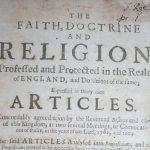
According to Article X of the Thirty-Nine Articles of the Church of England:
…‘The condition of Man after the fall of Adam is such, that he cannot turn and prepare himself, by his own natural strength and good works, to faith, and calling upon God. Wherefore we have no power to do good works pleasant and acceptable to God, without the grace of God by Christ preventing us, that we may have a good will, and working with us, when we have that good will.’
What different accounts has the Christian tradition given of the human ability to love, please and serve God?
(a) I am able to choose what is right without anyone’s help (Pelagianism)
‘My effort, from beginning to end.’
A simple moralism, pre-dating Pelagius, is in works such as the Shepherd of Hermas:
‘Believe in [God], therefore, and fear him, and fearing him, be self-controlled. Keep these things, and you will cast off all evil from yourself and will put on every virtue of righteousness and will live to God, if you keep this commandment’ (Cited by Peterson)
This view has come to be associated with the name of the British monk Pelagius, who died in 419. …