What happened to exhortation?
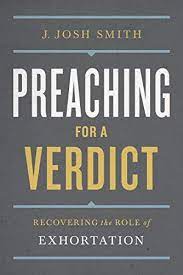
Preaching for a Verdict: Recovering the role of exhortation, by Josh Smith. B & H Academic, 2019.
Truly biblical preaching does not just involve explanation, illustration and application. It also seeks to persuade. It presses for a verdict. It involves exhortation.
Put another way, authentic preaching addresses the will, as well as the mind.
The recovery of exhortation is the burden of Josh Smith’s book. What follows is based on:
Chapter 1 – What happened to exhortation?
James 1:22 – ‘Be doers of the word, and not hearers only, deceiving yourselves.’ The assumption behind this call to action is that God’s word does indeed demand a response. This has implications for the one who proclaims the word, as well as for the one who hears it. The preacher’s responsibility does not end when he has accurately explained his text, or even when he has indicated its practical implications; he must exhort his hearers to put those implications into practice.
2 Timothy 4:2 – Paul writes, ‘preach the word…reprove, rebuke, and exhort.’
Titus 2:15 – Paul admonishes, ‘exhort and rebuke with all authority’.
2 Cor 5:20 – ‘God making his appeal through us. We implore you on behalf of Christ.’
Exhortation moves beyond suggested applications. It involves ‘pleading, persuading, and strongly urging the hearer to respond in obedience to the Word of God.’
Exhortation addresses the whole person – mind, emotions and will.
Exhortation was central to the preaching of the patriarchs, prophets, apostles, and Christ himself. They all looked, not merely to transmit information, but to urge for transformation.
Modern books on preaching scarcely mention the issue of exhortation at all. Among the few that do, Bryan Chapell conflates exhortation and application. Jay Adams does not use the word ‘exhortation’, but does affirm that application is incomplete if it does not include ‘exerting pressure’ on the hearers to implement the preached word. Dave Veerman agrees that ‘application persuades people to act.’ More fully, Wayne McDill says that
‘Application presents the implications of biblical truths for the contemporary audience. It is a call for action, for putting the principles of Scripture to work in our lives. It deals with attitudes, behaviors, speech, lifestyle, and personal identity. It appeals to conscience, to values, to convictions, to commitment to Christ.’
Hershael W. York and Scott A. Blue similarly combine application and exhortation:
‘Application in the expository sermon is the process whereby the expositor takes a biblical truth of the text and applies it to the lives of his audience, proclaiming why it is relevant for their lives, practically showing how it should affect their lives, and passionately encouraging them to make necessary changes in their lives in a manner congruent with the original intent of the author.’
John Piper is one of the few who (while not naming exhortation), does strongly assert the need to plead with people to respond:
‘When we preach, to be sure, it is God who effects the results for which we long. But that does not rule out earnest appeals for our people to respond.’
It seems, then, that the role of exhortation has been largely forgotten. Either it is not mentioned at all, or it is subsumed under the general heading of ‘application’, its distinctive nature and importance being therefore obscured.
It was not always so.
Augustine would quote to Ciceronian saying that the goals of rhetoric were to teach, delight, and persuade. Augustine wrote:
‘The hearers require to be roused rather than instructed, in order that they may be diligent to do what they already know, and to bring their feelings into harmony with the truths they admit, greater vigour of speech is needed. Here entreaties and reproaches, exhortations, and upbraidings, and all the other means of rousing the emotions are necessary.
‘The eloquent divine, then, when he is urging a practical truth, must not only teach so as to give instruction, and please so as to keep up the attention, but he must also sway the mind so as to subdue the will. For if a man be not moved by the force of the truth, though it is demonstrated to his own confession, and clothed in beauty of style, nothing remains but to subdue him by the power of eloquence.’
So also Luther, for whom (in the words of Hughes Oliphant Old):
‘to preach was to preach the Word of God, and that meant nothing less than to teach the Scriptures and exhort the congregation to live by them. It was as simple as that and yet as profound as that. . . . Preaching is a matter of reading the Bible, explaining its meaning for the life of the congregation, and urging God’s people to live by God’s Word.’
So, wrote Luther:
‘A preacher must be a logician and a rhetorician, that is, he must be able to teach, and to admonish; when he preaches touching an article, he must first, distinguish it. Second, he must define, describe, and show what it is. Thirdly, he must produce sentences out of the Scriptures, therewith to prove and strengthen it. Fourthly, he must, with examples, explain and declare it. Fifthly, he must adorn it with similitudes; and, lastly he must admonish and rouse up the lazy, earnestly reprove all the disobedient.’
Calvin, though a very different personality, was of the same mind. Steven Lawson writes:
‘Any perusal of Calvin’s sermons reveals that he passionately applied Scripture with loving exhortation. In his exposition, he regularly urged his listeners to live the reality of his text. Speaking from the pulpit, the Reformer was full of warm persuasion and fervent appeal. He preached with the intent of prompting, encouraging, and stimulating his congregation to follow the Word.’
Two centuries later, François Fénelon was, in the words of Steven Smith,
‘concerned with the whole idea of persuasion. For Fénelon, exposition melded with persuasion made the preacher eloquent. He was convinced that every form of art, and especially oratory, was inherently persuasive. The problem is that when you remove persuasion from exposition, you are left with a Bible lesson, not a sermon. When one removes exposition from persuasion, it leaves a persuasive message with no foundation in authority. In the end, it has no real bite, no staying power, and inherently no long-term effects because it is rooted in opinion and conjecture, not absolute truth.’
Of the Puritan preachers, William Bradshaw wrote:
‘They hould that the highest and supreme office and authoritie of the Pastor, is to preach the gospell solemnly and publickly to the Congregation, by interpreting the written word of God, and applying the same by exhortation and reproof unto them. They hould that this was the greatest work that Christ & his Apostles did.’
Richard Baxter held that:
‘The preacher’s aim should be first to convince the understanding and then to engage the hearer. Light first, then heat. Begin with a careful opening of the text, then proceed to the clearance of possible difficulties or objections; next to a statement of uses; and lastly to a fervent appeal for acceptance by conscience and heart.’
Take, as a specimen of Puritan exhortation, the close of a sermon on Ephesians 4:24 by Thomas Neast:
‘Consider, what it is I plead for. Why, all that I ask is love; and will you deny Christ that? I call thee to think well of Christ, to desire him, to take complacency in him, to breathe after union and eternal communion with him; and which of these dost thou think too much for such an object? Or where canst thou place them more fitly than upon him? What is he worthy of, if not of this? Did ever death content itself with such a recompense? Was ever any debt easier paid, any service so easily performed, as this—only to love? Hath God made Christ a King, Priest, and Prophet? And is that all which thou must do, to partake of his love in him, to love him in those relations, and wilt thou stick at this? Hast thou any other way to the bosom of God but by him? And yet, rather than thou wilt come thither by love, wilt thou damn thy soul by hating Christ? Is not the enjoyment of God worth the labour of love?’
It is interesting to note that Jonathan Edward’s strong emphasis on divine sovereignty did not lead to neglect of persuasion. Standing in the same doctrinal heritage was C.H. Spurgeon, who advocated (and practiced) a two-fold ministry fo ‘warning and invitation’: