A theological foundation for exhortation
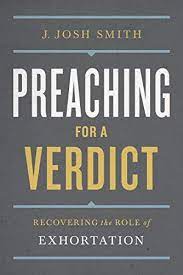
What follows is based on
Preaching for a Verdict: Recovering the role of exhortation, by Josh Smith. B & H Academic, 2019.
Chapter 2 – A theological foundation for exhortation
A. God has spoken
(i) God’s word is inspired. 2 Tim 3:16 – ‘All Scripture is breathed out by God.’
(ii) God’s word is authoritative, because the One who speaks it has all authority. All things were created by him and for him, Rev 4:12. All other authority is derived from his authority, Rom 13:1, and is ultimately subject to him, Eph 1:15-23.
Kuyper:
‘There is not a square inch in the whole domain of our human existence over which Christ, who is Sovereign over all, does not cry, ‘Mine!’.
The preacher speaks ‘with all authority’ Tit 2:15, because he speaks the very word of God.
(iii) God’s word is sufficient, Psa 19:7-9.
It is possible to believe in the inerrancy of Scripture without being committed to its sufficiency. But Scripture not only does not require correction; it does not require addition. It is sufficient for all the tasks and challenges of faith to which we are called. It is not only true, it is profitable (2 Tim 3:16f).
(iv) God’s word is powerful. As Chappell observes, it is by speaking that God
- creates, Gen 1:3; Psa 33:9;
- controls, Ps 147:15–18);
- persuades, Jer 23:28–29;
- performs his purposes, Isa 55:10–11;
- overrides human motives, Phil 1:18.
These truths reveal the necessity of exhortation, together with the authority of the one who exhorts.
Noel Weeks:
‘Since we have a Scripture which is sufficient to be an authority in all areas of life, let us proclaim with boldness that Christ is Lord of all and every area of man’s life must be yielded to Christ’s control.’
B. God has spoken for a purpose
(i) He has spoken for the purpose of self-revelation. There is no knowledge of God apart from his self-revelation. Preaching sets forth the word by which God reveals himself, 1 Cor 1:21; 2:14. In the OT, God does not so much reveal a picture of his visual appearance, but rather a verbal description of his character (see Ex 34:6f).
(ii) He has spoken for the purpose of relationship. He desires all people to know him (Jer 9:23f; Hab 2:14; 1 Tim 2:4). J.I. Packer:
‘God’s purpose in revelation is to make friends with us. It was to this end that He created us rational beings, bearing His image, able to think and hear and speak and love; He wanted there to be genuine personal affection and friendship, two-sided, between Himself and us—a relation, not like that between a man and his dog, but like that of a father to his child, or a husband to his wife.’
And, as Packer goes on to say, it is by speaking that friends get to know one another.
Iiii) He has spoken for the purpose of sanctification. He speaks, not only that we might know him, but that we might become like him. For this we were created, and for this we are destined, Rom 8:29. His word is a primary means by which this is accomplished, 2 Pet 1:3f. It not only teaches, rebukes and corrects, it also trains in righteousness, 2 Tim 3:16. Christ’s disciples are sanctified through the truth, Jn 17:17.
(iv) He has spoken for the purpose of response, James 1:22. We are not only to listen to the word, but to attend, assent to and apply it, Isa 66:5; Jer 22:29; Hos 4:1. Even where the word does not contain a specific command, a call for response is always implicit.
The foundational resonses are faith (Heb 11:6; James 2:14-16; Jonah 3:5; Rom 10:17; 1 Cor 1:17–25) and worship (Psa 43:3–4; 56:10; 119.
C. The preacher speaks for God
If God has spoken, and spoken for a purpose, then the preacher has one primary responsibility: to declare God’s words in order to accomplish God’s purposes.
God is mainly concerned, not with charisma or even ability, but faithfulness.
Moses and Samuel spoke ‘all the words’ that God had given them, Ex 19:7; 1 Sam 8:10. Ezekiel could only utter a ‘Thus says the Lord’ (Eze 3:26f). Jesus himself did not come with his own words, but those of his Father, Jn 14:24. His disciples are to preach, ‘teaching them to observe all that I have commanded you’ (Mt 28:20).
Remember: God not only has a message, he also has a motive. Whenever he speaks, he has a purpose. Exhortation is necessary, because God intends to accomplish something through the proclamation of his word.
James Stewart said that the goal of preaching is:
‘to quicken the conscience by the holiness of God, to purge the imagination by the beauty of God, to open the heart to the love of God, to devote the will to the purposes of God.
Cotton Mather:
‘The great design and intention of the office of a Christian preacher is to restore the throne and dominion of God in the souls of men.’
Steve Gaines:
‘If people leave a worship service saying, ‘What a preacher!’ ‘What a sermon!’ ‘What a choir!’ or ‘What a church!’ then we have failed. But if they leave a worship service saying, ‘Hallelujah, what a Savior!’ then we have succeeded!’
In 1 Cor 1:21 and Rom 10:14f, the apostle traces saving faith back to the preached word.
The Puritan Thomas Brooks insisted that true preaching is not just relaying knowledge, but also calling for a response:
‘First, because that is the only way to save and to win souls for Jesus Christ. . . .
Secondly,…because it is the choicest and chiefest way to ingratiate Christ with poor souls. . . .
Thirdly,… because the preaching up of Christ is the only way to preach down antichrists, or whatever else makes against Christ.
Fourthly,…because else they contract upon themselves the blood of soul. . ..
[Fifthly], because the preaching of Christ contributes most to their comfort here, and to their reward hereafter; therefore, they are to preach the Lord Christ to people.’