Boghossian vs McGrew: faith and evidence
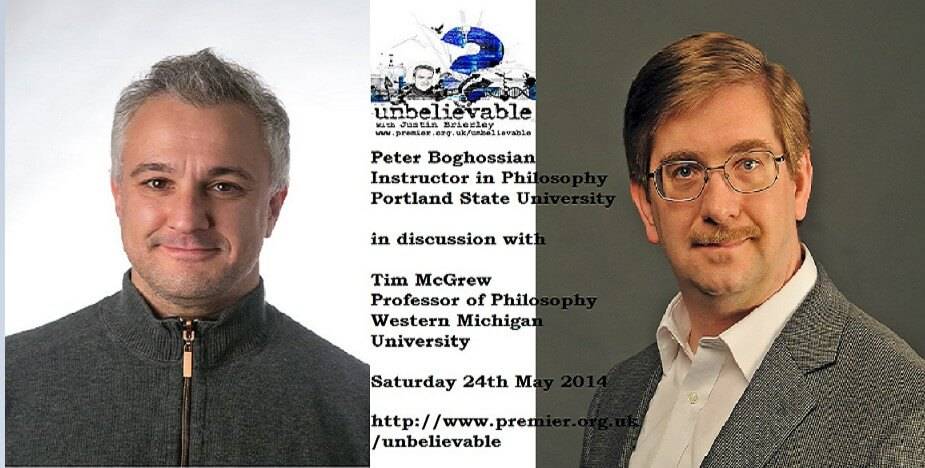
Peter Boghossian is a teacher of philosophy, an atheist, and author of a recent book, A Manual For Creating Atheists. Tim McGrew is also a philosophy professor, and a Christian. They met up recently on Premier Christian Radio’s Unbelievable show.
Let me begin by saying that I don’t particular appreciate the tone of Christian writer and apologist Randal Rauser’s response to this debate. There’s not much point in (rightly) commending McGrew for not resorting to ‘low blows or rhetorical cheap shots’ and then Rauser littering his own impression of Boghossian’s performance with expressions such as ‘ridiculous…complete buffoon…nonsense…nauseating’ and so on.
In terms of courtesy, Boghossian scores more highly that Rauser, but not higher than McGrew.
Mind you, I pretty much agree with Rauser regarding the substance of the debate. I have rarely heard a more confused, poorly-informed, ill-considered criticism of ‘faith’ than that offered by Boghossian. I have rarely heard a calmer or more carefully-argued rebuttal than McGrew’s.
The whole thing turned on Boghossian’s non-standard and thoroughly misleading definition(s) of ‘faith’. He thinks that for the vast majority of people (‘billions’), ‘faith’ is “belief without evidence”, or even, “pretending to know things you don’t know.” He also thinks that faith is ‘a virus of the mind’. It is ironic that he offers not a shred of real evidence to support these Dawkinsian definitions. If it were true that ‘faith’ amounts to ‘pretending to know things you don’t know’, then it might make some kind of sense to label it as clinical delusion, and to offer ‘treatment’ accordingly. In fact, what Boghossian mistakenly thinks is ‘faith’ is what most people would call ‘blind faith’.
I note in passing that a similarly erroneous definition of ‘faith’ was assumed by Steve Jones, geneticist and author of the book The Serpent’s Promise in his own contribution to a slightly more recent edition of Unbelievable. Jones said:-
There are large parts of Christianity that depend on faith alone – the afterlife, the resurrection, miracles of various kinds – and, almost by definition, science can say nothing about that.
Once again the assumption here is that ‘faith’ stands apart from anything that could reasonably be called ‘evidence’.
Anyway, McGrew begins his response with the Oxford English Dictionary (where faith is ‘complete trust or confidence in someone or something’). He explains that faith involves a positive evaluation of the trustworthiness of a person or object, such that a person is willing to venture an action, the outcome of which cannot be absolutely guaranteed. He offers the example of a sky-diver, who know that the statistical probability of death is very low, and who has good reason to believe that his instructor has packed his parachute safely. Even though the sky-diver cannot be absolutely certain of his safety, he is willing to venture on the sky-dive on the basis of the available evidence.
The point, then, is this: the person who has faith believes he has good evidence and good reasons for that faith. That evidence may in fact be weak, but that does not change the nature of faith itself.
Boghossian seemed quite unaware of such a definition of faith, and in fact struggled to understand it, so that McGrew had to repeat and clarify what was already a perfectly good explanation.
With such a fundamental disagreement over the definition of faith, the discussion was never going to get very far. Boghossian pleaded that he needed more time to articulate his thoughts, but I cannot see how, given more time, he could have avoided digging an ever-deeper hole for himself.
Although not covered in the debate (where both men seemed to want to stick with monolithic, if widely different, definitions of faith), I would want to add that the word itself does – both in biblical theology and in general discourse – carry a range of meanings. For example, the New Testament writers refer from time to time to ‘the faith’ as well as to ‘faith’. And the Oxford English Dictionary offers as a secondary definition: ‘Strong belief in the doctrines of a religion, based on spiritual conviction rather than proof.’ Even here, though ‘based on spiritual conviction rather than proof’ is a very long way from ‘belief without evidence’, and light-years from ‘pretending to know things you don’t know’.
Towards to close, Boghossian claimed:-
“I think anybody who sincerely listened to this conversation knows exactly that I’m correct and that this is how the overwhelming majority of people have it.”
Sounds rather like a ‘no true Scotsman’ appeal (i.e. if you don’t agree with him, you were not sincerely listening).
They agreed in the end that Premier should run a poll on Christians’ and non-Christians’ perceptions of faith. The results are most enlightening, and show that believers and non-believers are, with regard to matters of faith, talking completely different languages:-

It’s all a bit reminiscent of Humpty Dumpty:-
“When I use the word ‘faith’,’ Humpty Dumpty said in rather a scornful tone, ‘it means just what I choose it to mean — neither more nor less.’
’The question is,’ said Alice, ‘whether you can make words mean so many different things.’
’The question is,’ said Humpty Dumpty, ‘which is to be master — that’s all.”
(With apologies to Lewis Carroll, Through the Looking Glass)
See also:-