The Goldilocks Effect
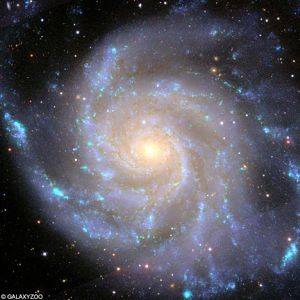
How can humans – tiny specks of transient life that we are – have any significance in a universe so big and so old?
But if the universe were not so vast and so ancient, we would not be here. It has taken 10 billion years for the elements of life to build up in stars.
Many of the ‘constants of nature’, such as the gravitational constant, appear to be extremely finely tuned. Minuscule changes to any of these constants would mean that life could never have developed. Professor Paul Davies says that if the Big Bang explosion differed in strength by just one part in 10 followed by 60 noughts the universe as we know it could not exist.
Such fine-tuning underlies the Anthropic Cosmological Principle, or ‘Goldilocks Effect’. The universe is neither too hot nor too cold; it is ‘just right’.
If carbon-based life were found only on planet earth, the entire universe would still be needed for its existence. That’s about 20 galaxies, or 2, 000 billion stars for every man, woman and child on Earth!
This may not prove that the universe was designed with us in mind, but it is certainly consistent with a purposeful God.
Various alternative explanations have been offered for the fine-tuning of the universe as evidenced in these remarkable cosmic coincidences. One line of thought is that a ‘grand theory of everything’ will be formulated that will explain why the various physical constants must be so. Another is to postulate a multiverse – a collection of an almost infinite number of parallel universes, each with different physical constants, of which our just happens to be the one that is just right for carbon-based life. But this seems to offend against Occam’s Razor (the principle that says that when formulating a hypothesis assumptions and entities should be kept as few as possible).
It is at least plausible to suggest that the cosmos is just so because an intelligent Creator made it so.
Based on Poole, User’s Guide to Science and Belief, 67-69.