‘Unapologetic’
Scintillatingly good, embarrasingly bad.
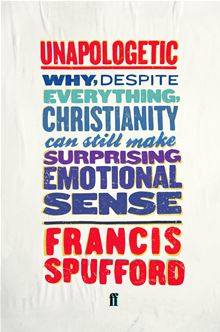
This recent (2012) book by Francis Spufford seeks to introduce the Christian faith from a fresh angle.
It’s certainly different. Spufford says that he’s not opposed to evidential apologetics, but thinks that there’s plenty of that kind of material around. But, on the other hand, he claims that no-one can know whether Christianity is true or not. Shades of ‘a leap in the dark’. What he has attempted, then, is to show ‘why, despite everything, Christianity can still make surprising emotional sense’
As anyone who has read it will tell you, it’s wonderfully, sometimes hilariously, written. In not claiming to speak for the Church of England (of which he is a communicant member) and in not writing for a conventional ‘Christian’ publisher (it’s published by Faber & Faber) the author has felt free to write in his own way, and to tell us what’s on his mind without worrying too much about who might be looking over his shoulder. I suppose it’s this attitude of ‘I’m speaking for myself, not on behalf of Christians generally’ that accounts, in part, for the occasional swearing.
Again, as many readers will tell you, Spufford finds a refreshing way to get us to face up to the universality of sin (which he re-names HPtFtU [don’t ask]). Also, like others, I would pick out the chapter on the life of Jesus as having an extraordinary power to see its subject in a fresh way.
He fires deliciously barbed arrows at the John-and-Yoko ‘Imagine’ brand of utopianism (‘the My Little Pony of philosophical statements’). He makes us giggle at the hopeless atheist bus slogan. He correctly diagnoses the problem of those who denounce Christianity as the great source of all evil (‘I mainly think: read more history, mate’).
It’s not a ‘safe’ book, in any sense. It is ‘unsafe’, because it will make Christians and non-Christians question some of their favourite prejudices and assumptions.
But it is, unfortunately, also ‘unsafe’ because it has some glaring errors and omissions.
Spufford has already admitted that he made a big mistake with the ‘Lewis Trilemma’. (Good for him, I suppose. But you need to be a bit more careful before you go into print. It should be left to us bloggers to say things we don’t really mean, to misrepresent other people’s opinions, and to forget to check up on our facts.)
There are a few interesting memory lapses. For instances, he attributes the description of God as ‘the ground of being’ to St. Paul, whereas I think you’ll find it was Paul Tillich (although I will admit that Paul did quote something similar at one point).
The section where the author talks about his personal experience of God is just very weak. Which is odd, given what he’s trying to achieve in this book. His God seems very distant.
The chapter on Jesus is, as I’ve said, highly original and deeply insightful. But his attempts to fuse the human and the divine aspects in Jesus were, to me, emotionally unconvincing. His Jesus dies, very definitely, but it is difficult to discern much atonement in this death. His Jesus rises, less definitely, and again we can’t quite see why or to what intent.
Where this book comes spectacularly off the rails is in its treatment of heaven and hell. Spufford has little interest in heaven, he tells us, because he’s much more concerned about the present life. And what’s more, he announces with a fanfare, hell doesn’t exist at all. Almost all Christians gave up believing in hell years ago. It’s official. Trouble is, there is no argument here, only assertion. No consideration of scriptural teaching, and no sense that Christianity does not make emotional sense if you try to magic away its convictions about ultimate hope and ultimate justice.
On personal ethics (particularly personal sexual ethics) Spufford thinks that the Bible is more or less silent, and Christians should therefore mind their own business about what consenting adults do in private. Well, maybe Christians do sometimes think and behave like prudish curtain-twitchers. But Spufford will have to do better than his own brand of naive secular liberalism. As someone once said: “Blessed are the pure in heart”.
Read with discretion by someone who already has a better idea than the author of the doctrinal shape of the Christian faith, this book will serve as a welcome blast of fresh air. But others should seek a more reliable guide.