Where was Sodom? And how was it destroyed?
[This is an extended and updated version of an article first posted in 2021.]
Sodom was one of the five ‘cities of the plain’ – the others being Gomorrah, Admah, Zoar and Zeboiim. Most of the biblical geographical details occurs in Gen 13:10–11. Gen 19:18–20; 19:1–13 records how they were destroyed by a conflagration because of their extreme sinfulness.
The names of Sodom and Gomorrah resonate throught Scripture as bywords for sin and its punishment (Deut 29:23; 32:32; Is 1:9–10; 13:19; Jer 23:14; 49:18; 50:40; Lam 4:6; Ezek 16:46–49, 53–56; Amos 4:11; Zeph 2:9; Mt 10:15; 11:23–24; Lk 10:12; 17:29; 2 Pet 2:6; Jude 7; Rev 11:8).
But where, exactly, were these cities? And how, exactly, were they destroyed (supposing that some kind of ‘scientific’ explanation can be given for what is presented as an act of divine punishment)?
According to the Archaeological Encyclopedia of the Holy Land, ‘all efforts to locate the site of Sodom have been fruitless.’ Areas both north and south of the Dead sea have been proposed, but without conviction.
Assuming that the biblical account of Sodom and Gomorrah have at least some basis in reality, I would like to consider two contenders for their location and devastation.
1. Fireball hypothesis – north of the Dead Sea. During the pioneering years of exploration in the 19th century, a site North of the Dead Sea was looked for. This was based on an examination of the biblical data – mainly Gen 13:1–12. They. For example, Abraham could see the destruction of Sodom from near Bethel (Gen 19:28), and this would only have been possible given a Northern location.
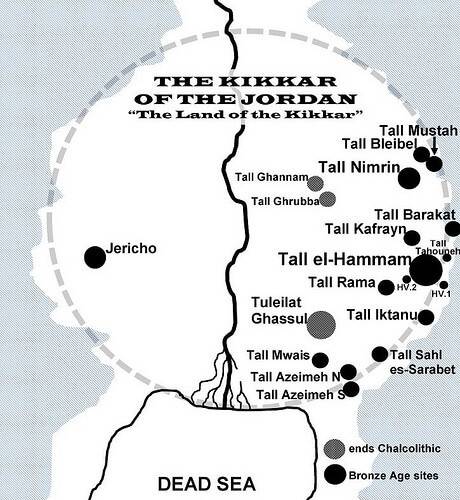
Since 2005 it has been possible to excavate the ‘Kikkar’ – Jordan ‘Disk’, which has been identified as the ‘well-watered plain’ of the biblical texts. These excavations have uncovered evidence of a thriving Bronze Age civilisation in the area. Steven Collins has been site director at the site of the largest city on the eastern side of Kikkar – Tall al-Ḥammām – since 2005.
Collins and Latayne C. Scott have published evidence for a site to the north of the Dead Sea (Discovering the City of Sodom, Howard Books, 2013). They claim that Tall (or Tel) el-Hammam fits the bill in a number of ways:
- According to Gen 13:10, Sodom was visible from Bethel and Ai (located in the ‘plain’ of the Jordan. When Sodom was destroyed, its smoke could be seen by Abraham from this vantage point, Gen 19:28. This rules out a site at the south of the Dead Sea, but is consistent with Collins’ and Scott’s proposal.
- The 8-year excavation has uncovered an impressive city with huge fortified walls, over 100 feet in places. An imposing gateway matches what is mentioned in Gen 19:1.
- Charred walls and a thick blanket of ash confirm that the city was destroyed by fire. The site was not occupied again for several centuries.
- Scorched pottery has been found which shows, on one side, the effects of intense heat followed by rapid cooling. Such effects have been found in material blasted by meteorite impact or thermonuclear explosion. This is consistent with the description in Gen 19:24-28.
According to the web site of the Tall el-Hammam Excavation Project,
‘it’s remarkable that Tall el-Hammam and its neighbors (noteably Tall Nimrin, likely center of the city-state to Hammam’s immediate north) suffered a civilization-ending calamity, uniquely their own, toward the end of the Middle Bronze Age. While cities to the west (Jerusalem, Bethel, Hebron), north (Deir ‘Alla, Pella, Beth Shan), and east (Rabbath-Ammon, Tall al-Umayri, Nebo) continued in the Late Bronze Age, the cities, towns, and villages of the eastern Jordan Disk did not.’
Researchers from seven different universities have been studying this sudden, local devastation event, and publications are pending. Collins thinks that the cause could be an aerially-exploding meteorite: this would leave no crater, but would cause intense local destruction. This would be consistent with the biblical account of fire and brimstone.
As reported in Christianity Today (Sep 24, 2021) a team of scientists have concluded that:
‘A fireball exploded over the northern shore of the Dead Sea around 1650 BC, according to the findings of a multidiscipline team of 21 scientists. The explosion laid waste to the entire lower Jordan River Valley, sowing Dead Sea saltiness that ruined agriculture for several hundred years.’
This centred on Tall el-Hammam, east of Jordan. However, doubt remains as to whether this site should be associated with the biblical Sodom (which many scholars place nearer to the south end of the Dead Sea), and about the proposed date of the event (with many scholars thinking that Israel was still in Egypt at that time, with the Exodus 200 years away).
In 2021, Bunch et al published a paper in Nature entitled ‘A Tunguska sized airburst destroyed Tall el-Hammam a Middle Bronze Age city in the Jordan Valley near the Dead Sea’. However, the paper has since been withdrawn by the publishers, due to methodological concerns.
2. Landslide hypothesis – south of the Dead Sea
Following Albright and Wright, most scholars during the 20th century favoured a site near the South-eastern end of the Dead Sea. The most prominent of the archaeological sites in this area are Bab edh-Dhra and Numeira. Excavations of the former have revealed a huge fortificaation wall, mud-brick houses, a Canaanite temple, and a cemetery where thousands of individuals had been buried. Very striking was the presence of a layer of ash, several feet thick, along with indications that the burning of buildings took place from the roofs downwards. It is thought by some that Bab edh-Dhra represents the site of Sodom, and Numeira the site of Gomorrah. These, along with other sites in the area, were all destroyed or abandoned at the same time, and in the same way. The thick layers of ash had left the soil with the consistency of spongy charcoal, and therefore unsuitable for future settlements. (See the discussion in Kaiser, The Old Testament Documents: Are They Reliable and Relevant?, ch. 6). It is possible, however, that these sites may be too early to belong to the period of Abraham and Lot.
Albright, while adhering to a Southern theory, postulated that Sodom and the cities of the plain must be under the southern waters of the Dead Sea. The area must once have been a fertile plain, but the cities sank into the waters as a result of an earthquake.
According to the Lexham Bible Dictionary (art. ‘Gomorrah’), a southern location is supported by reference to Philo, Josephus and Strabo. Philo describes an abundant area at the south end of the Dead Sea that has smoking bitumen pits. Joseph places Sodom near to the shore of the Dead Sea. He too describes black clouds of bitumen. Strabo identifies Sodom as the leading city of a group of 13 (presumably including Gomorrah). He describes the destruction of Sodom as a result of earthquakes and fire.
Graham Harris (in a 1995 paper, a 2001 BBC documentary, and more recently in Destruction of Sodom: A Scientific Commentary) has presented a detailed version of this hypothesis. A useful synopsis of the TV programme can be found here.
His argument includes the following aspects:
- Sodom and Gomorrah were situated on the shores of the Dead Sea. Although the land here was not fertile, these cities were able to prosper by trading in bitumen, which can float in blocks on the surface of the water. Bitumen from Egypt has been found to match closely that found near or on the Dead Sea. (Bitumen was used in the embalming process. Indeed, the word ‘moumiah’, from which we get our word ‘mummy’, means ‘bitumen’).
- Climate conditions may have been more favourable in the Early Bronze Age. Jonathan Tubb has excavated Tell es-Sa’idiyeh, north of the Dead Sea, and found evidence of an Olive Oil factory. This evidence strongly suggests the presence of one or more thriving cities in the area.
- The Dead Sea area is prone to earthquakes. Evidence of one such earthquake exists in the form of the remains of the crushed bodies of three men. These have been discovered at the early Bronze Age site of Numeira near the Dead Sea.
- A large fault line indicates the occurrence of a magnitude 6 earthquake. Such an earthquake would have been powerful enough to destroy early Bronze age buildings. But what happened to the ruins resulting from this earthquake? The soil around the Dead Sea is extremely loose, snd, close to the shore, would contain a lot of water. Under the pressure of an earthquake, such soil can undergo liquefaction. This could lead to a huge landslide, causing an entire city to slide into the sea.
- Drilling into the area around the Dead Sea has been found to release large quantities of methane. These, if ignited, could account for the ‘fire’ that is described in Gen 19:24. (The fire and stench could also be explained by burning bitumen).
Conclusion
Both the ‘fireball’ and the ‘landslide’ hypotheses, whle plausible, rely on rather a large amount of guesswork.
I feel unable to decide at the present time.
Bibliography
In addition to the works mentioned:
See this article by Steven Collins, with a reply from Bryant G. Wood.
Steven Collins has written a long article on ‘Tall-el Hammam’ in the Lexham Bible Dictionary.
See this article and this short article by Chris Sinkinson.
See also this article in Popular Archaeology.
For more details, see the website of the Tall el-Hammam Excavation Project.
For criticism of this proposal, see here.
See this article.
G. M. Harris and A. P. Beardow (1995) The destruction of Sodom and Gomorrah: a geotechnical perspective. Quarterly Journal of Engineering Geology and Hydrogeology. Volume 28, Pages 349 – 362