The Bible and science

Attempts at harmonisation
The earth is a sphere, floating free in space. Matter consists of microscopic particles. There are mountains on the ocean floor. Light can be divided into separate colours. There are an incalculable number of stars. The continents originated as one large land mass. The universe contains black holes and dark matter.
These just some of the anticipations of the findings of modern science that are said to be found in the Bible.
Here’s a web site that lists 101 of them.
And here’s an attempt to debunk the claims.
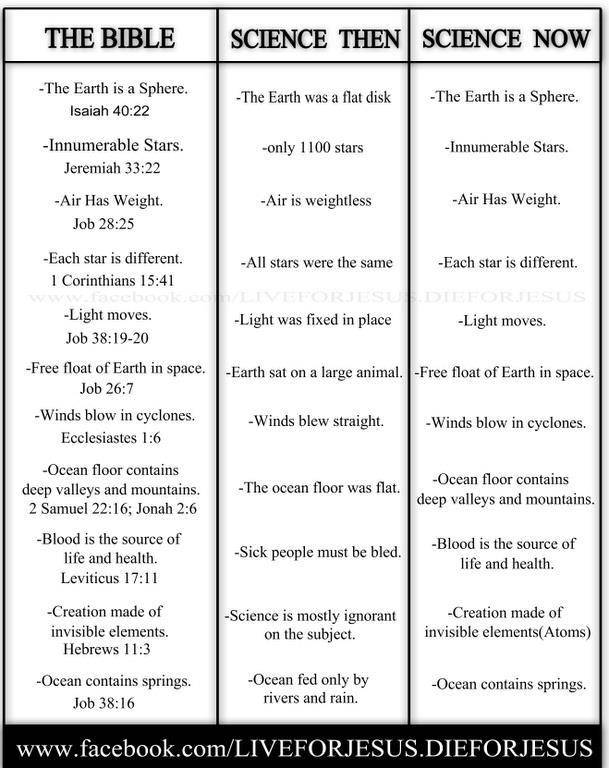
http://www.patheos.com/blogs/exploringourmatrix/2012/12/the-bible-and-science.html
Some popular writers think they have found many anticipations of modern science in the Bible. Harry Rimmer, for example, wrote that ‘it is possible for the careful student of science and Scripture to discover literally scores of such anticipations’. See also Gaussen, Divine Inspiration of the Bible, 261ff.
Examples:-
1. Modern undulatory theory of matter, Gen 1:2.
2. Wireless telegraphy, Job 38:35.
3. Parallax, Jas 1:17.
4. Nuclear physics, Heb 1:3; 11:3.
5. Motor-cars, Nah 2:3-4; aeroplanes, Isa 31:5; submarines, Rev 9:1-11; radio, Eccl 10:20; television, Rev 11:3-12.
6. Modern geological theory, Job 14:17-19.
7. Spherical earth, Job 22:14; Prov 8:27; Isa 40:22. See also Mar 13:35-37.
8. Earth suspended in space, Job 26:7.
9. Atmospheric pressure, and the weight of air, Job 28:25.
10. Water cycle, Job 36:27f.
11. Modern meteorology; water cycle, Eccl 1:6-7.
A number of these (along with some less contentious examples) are included in the Baker Encyclopedia of Christian Apologetics (Norman Geisler), in the article ‘Science and the Bible’. Answers in Genesis takes a similar approach, as does J. Warner Wallace. Here’s another list.
Nathan Busenitz (Reasons We Believe: 50 Lines of Evidence that Confirm the Christian Faith):
‘Though it is not a science textbook, the Bible harmonizes with the facts of science when it speaks to such issues, including the great number of stars in our universe (Jeremiah 33:22), the uniqueness of those stars (Isaiah 40:26; 1 Corinthians 15:41), the suspension of earth in space (Job 26:7), different species of plants and animals (Genesis 1:11–12, 20–22), the importance of blood to life (Leviticus 17:11), and certain medical precautions such as lip covering (Leviticus 13:45), quarantine (Leviticus 13:45–46; 14:8–9), and disinfection (Leviticus 15:13, 25–27).’
Quite so. But it is doubtful that any of these texts provide any scientific insight that was not available to the uninspired men and women of their day.
There is an illuminating discussion in Bernard Ramm’s seminal work, The Christian View of Science and Scripture (pp86-95).
The attempt to harmonise the teachings of the Bible with the findings of modern science has been continued by Hugh Ross, an influential Christian apologist in the area of cosmology. In his recent book, Why the Universe is the way it is, he answers questions about why the universe so vast, old, lonely, dark and so on. The answer, basically, is that only a universe with these characteristics could conceivably have given rise to intelligent life. There is some fascinating cosmological data here, some of which I was familiar with, but others of which were new to me. It’s interesting stuff.
What I find less impressive, however, are some of Ross’ attempts to link these scientific data directly to the teaching of the Bible. For example, various biblical writers, in Ross’ view, ‘declare that the universe is expanding and has continuously expanded from its beginning.’ He cites a number of biblical passages in support of this view. Each of these speaks of God having ‘stretched out the heavens’. In some of these passages, this act of ‘stretching out’ is described in a little more detail:-
Ps 104:2 He wraps himself in light as with a garment; he stretches out the heavens like a tent.
Isa 40:22 He sits enthroned above the circle of the earth, and its people are like grasshoppers. He stretches out the heavens like a canopy, and spreads them out like a tent to live in.
These passages speak eloquently of the power and majesty of our Creator-God. But the imagery is, quite plainly, of the stretching of a canopy, or of a tent. It is the stretching of the ‘canvas’ of the sky over the earth. It is entirely gratuitous to suggest that such passages teach the continuous expansion of the universe. The Bible is not a book full of scientific facts just waiting for modern science to catch up with it.
I’m afraid that such interpretations of Scripture as these (without any hint that there might be any other way to read these texts than his own), twist the word of God from its true intention, and threaten to bring the Christian apologetic enterprise into disrepute.
To claim that the Scriptural record is consistent with the findings of modern science is to admit (usually tacitly) the extent to which Scripture would have made no sense at all to its original writers and hearers/readers.
A better way
I think that many of the attempts to harmonise the Bible with modern science are rather artificial and exegetically unsound.
Writing in The Fundamentals (V1, ch. 11), James Orr stated:
‘The Bible was never given us in order to anticipate or forestall the discoveries of modern twentieth century science. The Bible, as every sensible interpreter of Scripture has always held, takes the world as it is, not as it is seen through the eyes of twentieth century specialists, but as it lies spread out before the eyes of original men, and uses the popular every-day language appropriate to this standpoint.’
What follows is my summary of some of the main points made in a lecture by John Bloom and podcasted by the American Scientific Affiliation.
The question before us is this: Does the Bible contain any teaching about the natural world that would accord with modern scientific discoveries and that is distinct from the views of the world that were prevalent at the time? In a word, is there any science in the Bible other than what was common to the ancient world?
For over a century, liberal theology has been answering such questions in the negative. Evangelicals have tended to adopt some form of ‘concordism’. More recently, however, evangelical scholars such as John Walton (The Lost World of Genesis One) have expressed the view that God did not reveal to the Israelites any science beyond that of their own and surrounding cultures.
But there a several ways in which the scientific teaching of the Old Testament does transcend that of the prevailing cultures:-
1. Monotheism and the stability of nature. The polytheism of the ancient world undermined belief in the inherent stability of nature, because personality conflicts between the various gods could cause chaos. In contrast, the workings of the world are seen as fixed and unchanging in the Bible. See, for example, Gen 8:22; Jer 33:20-22.
It was this very stability in nature that led Newton, Kepler, Galileo to seach for meaning and patterns in the natural world. Thus modern science was born. They looked for laws, because they believe in a Law-giver.
2. Breeding techniques. Gen 30 has the account of animal breeding involving Jacob and Laban. To begin with the breeding strategy follows the methods of the day. But the dream that God gives the Jacob accords with modern genetics, and corrects the folk science of the day.
3. The depersonalisation of nature. The peoples of the ANE viewed heavenly objects as gods, and therefore were in fear of astronomical omens such as eclipses and the varying phases of the moon. But in Jer 10:2 we see that the Bible dispenses with this ‘science’ of the day with one simple command – ignore it. The objects in the sky are not beings to be feared. Such a depersonalisation of nature occurs as early as Genesis 1, where the sun and the moon are described, but not named, because their names were associated with Canaanite gods. This biblical view of natural objects and things, not persons, is also foundational to the rise of modern science.
4. Divination forbidden. Various forms of divination were common in the ANE – the mind of the gods was discerned through the pattern of smoke rising, the flight of a flock of birds, an abnormal birth, or the appearance of the internal organs of a slaughtered animal. In Eze 21:21f we find Neduchadnezzar using such methods to determine his military strategy. But such practices were forbidden to Israel. The use by the High Priest of the Urim and Thumin was very limited, in contrast to the omen-reading industry of surrounding cultures.
5. Medical laws. The OT has extensive teaching on quarantine, the handling and disposal of dead bodies, the distinction between clean and unclean, sanitation practices, sexual purity and so on. These contrast dramatically with practices that were prevalaent in other ANE cultures. For example, the Bible knows nothing of amulets to ward off diseases, of using incantations to drive evil spirits away, or applying animal dung to heal wounds.
Conclusion
If we place too much stress on a concordism between the beliefs of Israel and the other cultures of the ANE, we will miss the distinctive features of the former, and miss the modest, but very real, concordism that exists between the Bible and modern science.
How much concordism between the teachings of the OT and those of modern science should we expect to find? We should certainly not suppose that Gen 10:25 teaches a theory of plate tectonics. Nor should we worry too much about harmonising modern science with the language of appearance that we find in many biblical descriptions of nature. Metaphor was as common then as it is today. We should not assume that the ancient Israelites assumed that the pillars of the earth were literal columns.
God corrects the scientific understanding of biblical characters and informs the biblical authors when an incorrect understanding of nature would obscure his actions or mislead his people. This fits with the accuracy of medically-related texts, the ban on divination, and the depersonification and fixed behaviour of natural objects.
In pursuing this mild concordism, we are simply accepting that we are willing to use the findings of science, as well as those of linguistics, history, and archeaology, to help us in our understanding of Scripture.
Some uncertainty will remain as to the thoughts and intentions of the biblical writers vis-a-vis literal and phenomenological descriptions of the natural world. When the biblical writer speaks of ‘the four corners of the earth’ was he speaking literally, or phenomologically? But there is no real reason to assume that the biblical writer thought that the earth was square, any more than modern talk of the four points of the compass implies such a belief.
Some would argue against a moderate concordism that we can go no further than what an author’s words would have meant to his original audience. But this has problems, for it is very difficult to reconstruct the beliefs of the original audience. We cannot assume, for example that other creation myths would have formed the background understanding for the Genesis accounts: there is no reason think that the average Israelite would have been aware of these, or could have understood the languages they were written in.
Others would appeal to the author’s original intent, and to the limitations of his own knowledge and understanding. But this would exclude God from his own process of revelation.
There is much description of the natural world in the Bible (and in the ANE) which does not depend on any scientific theory, ancient or modern. The sky is blue, whether one believes that this is so because the sky is made from lapis lasuli, or because this has something to do with oxygen molecules, or whether one has any explanation at all.