Ash: How to pray the psalms in Christ
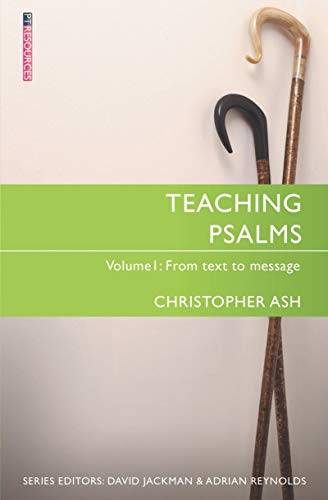
Christopher Ash, in Teaching Psalms, Vol 1, has developed a case for interpreting and preaching the Psalms in a rigorously Christ-centred way.
He espouses the view that all the psalms are ‘about, for, or to the Anointed King (Messiah).’
My initial reaction to this proposal was twofold:
(a) Yes, I want to exalt Christ in every possible way, and therefore to celebrate an approach that is thoroughly Christ-centred.
(b) But I suspected that Ash’s approach is actually quite restricted, in inhibiting a Trinitarian reading of the Psalms and in (potentially) leading to a neglect of their original meaning. Moreover, I feared that preaching based in this approach might become unduly formulaic and predictable, and inhibited in its attempt to be application-led (where appropriate).
With these initial thoughts in mind, I have returned to Ash’s rather extended discussion, to see what sense I can make of it.
Chapter 1. We must pray the psalms
Ash sets the scene by developing the following (non-controversial) assertions:
(a) We need to be taught to pray.
(b) The Psalms teach us to pray.
(c) The Psalms train us to respond to the riches of Bible truth
(d) The Psalms shape us as we learn to pray in all of human life.
(e) The Psalms reshape our disordered affections into God’s good order.
(f) The Psalms can sweeten sour emotions.
(g) The Psalms correct idiosyncratic or individualistic piety.
(h) The Psalms arouse us to warmth in our relationship with God.
Chapter 2. We can’t pray the Psalms
It is easy enough, claims Ash, to cherry-pick our favourite verses and pray them. But to attempt to pray the entire Psalter presents a mountain of problems. There are many bits that do not fit our own experience.
The difficulties include:
(a) The experience of intense suffering, as in Psa 88:3,5,8,15.
(b) Implications of global significance, as in Psa 118:10f.
(c) Claims to extraordinary innocence, as in Psa 17:3,5.
(d) Praying for God’s judgment on the wicked, as in Psa 139:19-22.
(e) The strange mixture of singulars and plurals, as in Psa 145:5.
In such ways (writes Ash) the prayers of the Psalms are not our prayers, and they cannot be. They are Christ’s.
Chapter 3. How to pray the Psalms in Christ
According to Ash, five considerations lead us to understand that Christ is at the heart of the Psalms. They sing of him. They are sung by him.
(a) We pray the Psalms in Christ because of the role of David the anointed King.
Surely, the entire Psalter is intimately connected with David (even though he did not personally pen all of the psalms). We must not neglect their original setting and meaning. But their Davidic connection leaves an unresolved tension which points forward to Christ.
Consider the first two, introductory, Psalms. They establish two foundational themes: God’s law and God’s king. What Psa 1 says about the blessedness of keeping God’s law seems to be contradicted by, say, Psa 119:85f (those who keep God’s law suffer). And what Psa 2 says about the final triumph of God’s king seems to be undermined by Psa 89:39 (the Davidic king is no more): the promise is never fulfilled in Old Testament history.
We must regard Psalms 1 and 2, then, as essentially and ultimately Messianic. And his reign (and not David’s will fulfil the global expectations of the Psalter (see 2 (b) above).
Psalms 1 and 2 are themselves intimately connected with each other: it is precisely the man who delights in the law of the Lord who will goven the world.
(b) We pray the Psalms in Christ because of the full humanity of Jesus the King.
It is only as we take seriously the real humanity of Jesus that we can begin to understand what it meant for him to sing and pray the psalms. But sing and pray them he did, both in his daily devotions and Sabbath by Sabbath in the synagogue. As a fully human being, growing from infancy to adulthood, he had to learn to pray the psalms, and to learn from them.
(c) We pray the Psalms in Christ because of the New Testament testimony about the Psalms and Christ.
We do not have to guess at he connection: it is made clear within the pages of Scripture itself:
Psa 22:1 and Mt 27:46
Psa 31:5 and Lk 23:46
Psa 6:3 and Jn 12:27
Psa 16:8-11 and Acts 2:25-32
Psa 18:49 and Rom 15:9
Psa 22:22 and Heb 2:12
Psa 40:6-8 and Heb 10:5-7
Psa 69:9 and Jn 2:17
Psa 69:21 and Jn 19:28f
(d) We pray the Psalms in Christ because of the work of the Spirit of Christ in inspiring the Psalms.
David was a ‘prophet’ (Acts 2:30), the Spirit who came upon him (1 Sam 16:13-23) was not only the Spirit of God, but also the Spirit of Christ. And, as a prophet, he spoke of the Christ who was to come (1 Pet 1:10-12). So, while the psalms arise out of David’s own experience, they also point to ‘great David’s greater Son’.
It was not only David himself, but his guilds of song-writers, who has the ministry of ‘prophesying’ (1 Chron 25:1-3; note the reference in Mt 13:35 to the Asaphite author of Psa 78 as ‘the prophet’).
(e) We pray the Psalms in Christ because of the nature of prayer.
All acceptable prayer and praise is offered ‘in the name of Jesus Christ’. The psalms are no exception. By ourselves, both we and our prayers are unworthy. God only hears and answers the prayers of the righteous: but there is only one who is truly righteous – Christ. In Jesus, and because of his cross-work, we have a mediator (1 Tim 2:5). Thus, we may come to God ‘in his name’ (Jn 14:13f; 15:16; 16:23f). Even those who prayed before the coming of Jesus were heard because of their trust in the One who was to come. Because of the cross, we have Jesus’ Spirit to enable us to pray (Eph 2:18).
In all these ways, then, we pray the Psalms ‘in Christ’
To read the Psalms as being primarily about Christ, and not about us and our private spirituality, may feel like a major loss. But we are ‘in Christ’. The same Spirit who sustained him now sustains us. Just as Moses (Ex 15:1), Joshua (Josh 10:12), Deborah and Barak (Judg 5:1), David (2 Sam 22/Psa 18) and Solomon (1 Kings 8) led the people in praise and prayer, so Jesus is the song-leader, and we are members of his choir.
Our approach to the Psalms, then, is both Christological (Jesus is the great Singer) and Ecclesiological (the church sings them in Christ).
What about the psalms of penitence and confession?
How can Psa 51 (and others like it) be put in the mouth of the sinless Jesus?
One answer would be to say that they can not, and so are excluded from our Christocentric reading of the Psalms.
But a better response would be to remind ourselves that Jesus ‘became sin’ for us (2 Cor 5:21; cf. Isa 53:12). As our Mediator, he took personal responsibility for our sins.
Some benefits of singing the Psalms in Christ
(a) We can join in expressions of great suffering, in Christ
(b) We can share in the cosmic significance of Christ. His victory ir our victory. His resurrection is the guarantee of our own. His exaltation is the pledge that we will reign with him (2 Tim 2:12; cf. 1 Cor 6:2).
(c) We can enjoy our imputed righteousness, in Christ
(d) We can even pray for God’s judgment, in Christ. It is a great comfort to know that those who are in Christ can leave the business of judgment to his, and our, righteous Father.
(e) We can make sense of the singulars and plurals of the Psalms, in Christ. The singulars foreshadow the prayers and praises of Christ, and the plurals form the basis for our corporate worship. (No individualism here!).
Chapter 4. Examples of praying the Psalms in Christ
Ash discusses three psalms (Psa 3; 16; 63), comparing and contrasting what it would mean to read each of them as
(a) A Psalm ….. for me
(b) A Psalm of David ….. for me
(c) A Psalm of David, fulfilled in Christ, to be sung by all the church in Christ
Only the third approach, claims Ash, does full justice to the content, meaning and scope of each of these psalms.
Chapter 5. Drawing the lines to Christ
There are some mistakes to be avoided here.
In Psa 23, for example, we should not jump to the conclusion that because Jesus is the Good Shepherd in Jn 10, therefore he is ‘the Lord’ who is ‘my Shepherd’ in the psalm. There is nothing in the psalm itself to suggest this. The singer of the psalm is king David, who points to his own ‘greater Son’, Jesus. The ‘Lord’ who is his ‘Shepherd’ is God the Father, who leads the King through the valley of the shadow of death to the victory feast in the very sight of his enemies. We ourselves sing the psalm ‘in Christ’ as we share in his sufferings and his triumph.
Or take Psa 99. This psalm sings the praises of God in heaven. It is tempting to draw a straight line to Jesus, and assume that the psalm is about his kingship. But there is nothing in the psalm itself to warrant this. But it is a good rule to look for the Messianic fulfilment of the Psalms in terms of Jesus’ humanity, rather than his deity. The only human figures in Psa 99 are Moses, Aaron and Samuel. Each of these had a priestly role as a mediator between people and God. They point to the need for a successor who can be a perfect mediator between God and people. In this way, the psalm drives a straight course to Christ.
Different voices in the Psalms
Not all the psalms are songs of Jesus.
Timothy Dudley-Smith says that hymns and songs can be celebratory, declatory, didactice, hortatory, meditative, or petitionary.
Michael Lefebre writes that the Psalms are conversations. The king is always at the centre. But in some psalms, the king speaks to the people. In others, the king leads the people in addressing God. In yet others, the people sing to the king, or to God about the king, or to one another before the king.
Here, then, is an outline of the different voices we hear in the Psalsm.
(a) The King speaks to God the Father. This is the pattern in most of the Davidic psalms (e.g. Psa 3). We join in by praying this psalm in Jesus’ name.
(b) The King leads the people in speaking to God the Father. Psa 68, for example, is sung in the plural voice. Here David prefigures Jesus leading his church in prayer and praise. Even where there is no mention of the king (as in Psa 126) we may think of other leaders (a governor like Nehemiah, a prophet like Zechariah, or a priest and prophet like Ezekiel) as foreshadowing our great Prophet, Priest and King.
(c) God the Father speaks to his Son, the King. See Psa 2:7-9 (echoed at Jesus’ baptism and transfiguration); Psa 102:25-27 (quoted in Heb 1:10-12) and Psa 110 (cf. Mt 22:41-45).
(d) God the Father speaks through his Son to his people or to the nations. This may be by way of personal testimony, as in Psa 37:5f and Psa 73. Or, it may be through direct appeal, as in Psa 130:7. This voice is heard in Psa 1; 4; 32; 37; 78 and many others.
(e) The people of God speak about their King. See 1 Sam 2:1-10; Psa 20; 45; 72.
(f) The people of God speak to the nations. See, e.g., Psa 66:8. We must heed this voice, and also join the choir in making the appeal.
(g) The people of God speak to one another, as in Psa 121.
In conclusion, the various voices heard in the Psalms may be vertical (up to God, or down from God), or they may be horizontal (where the people of God speak about their King, or address the world, or indeed encourage one another. But, always, we heard the voice of the King, or about the King, or to the King.