Jonah as allegory
The book of Jonah is sometimes regarded as an allegory, in which:
‘Jonah represents disobedient Israel; the sea represents the Gentiles; the great fish is Babylon; and the three days in the fish’s belly symbolizes the Babylonian captivity of the Jews.’ (Ryrie, who does not think that the book is an allegory)
Most conservative scholars rejectthis interpretation on the grounds that the book is historical, and not fictional, in nature:
According to 2 Kings 14:25, Jonah was a real prophet.
Crucially, Jesus appears to have accepted the historical nature of Jonah without demur: he referred to Jonah’s experience in the belly of the fish as parallel with his own approaching entombment for three days. Moroever, he cited the repentance of the Ninevites as a rebuke to his own generation, speaking of both the physical miracle of Jonah’s preservation and the moral miracle of Nineveh’s repentance.
It is further argued that Jonah is not an allegory in the technical sense. For example, the figures in an allegory are patently symbolic and fictional, and this must be immediately to the audience. This, it is claimed, is not the case with Jonah.
Conservative scholars, then, generally understand the book to be a historical narrative adapted to teach theological lessons.
However, I would like to summarise James Bejon’s case for considering Jonah as allegory.
‘The life of a prophet,’ writes Bejon, ‘frequently pictures his message’. So it was with Hosea’s marriage to a prostitute (picturing his people’s relaitonship with their God), Ezekiel leaving Jerusalem (to picture the exile), and Jesus riding into Jerusalem on a donkey (picturing the arrival of God’s king).
A leading feature of the book of Jonah is it focus on the Gentile nations. It is significant that Jonah spends a lot of time at sea, since the sea often depicts ‘the nations’ in the writings of the prophets (see Isa 11.9, 23.11, 43.16, Dan 7.2, Joel 2.20, Hab 1.14ff., 2.14, 3.8)
It is reasonable, then, to understand Jonah’s life as a picture of Israel’s existence in the Gentile world.
Jonah is disobedient. Commanded by God to go in one direction, he travels in the opposite direction. This pictures Judah’s descent into exile (Jon 1:3-5). The waves become more tumultuous, just as the nations do when God stirs them up against his people (Isa 5.30, 10.26, 17.12–13, 51.14–15, Jer 6.23, Ezek 26.3, Dan 7.3). Jonah/Judah is picked up and tossed in exile (Jon 1:11f).
There are various lexical connections between Jonah and Jeremiah. These are underlined in Jer 51, where Nebuchadnezzar is portrayed as a ‘sea creature’ who ‘swallows’ the people of Israel.
Jonah’s descent into the sea correlates with Judah’s descent into exile, as described in Leviticus 26 –
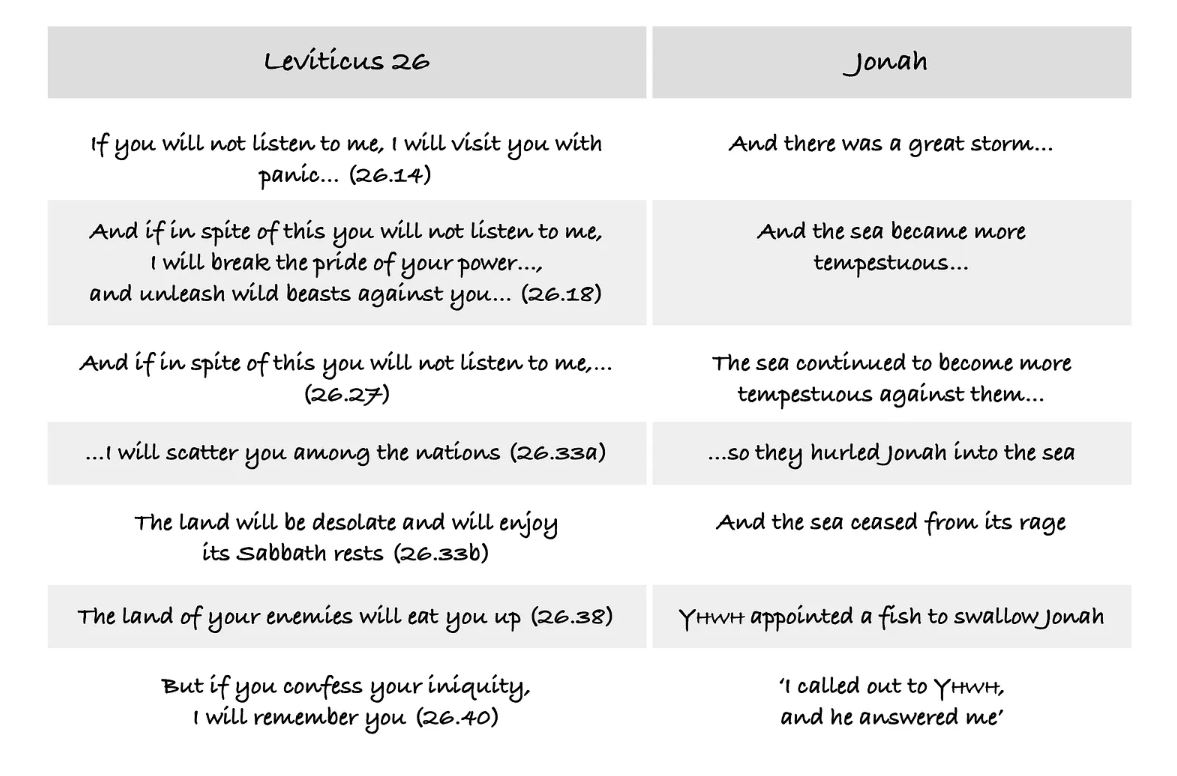
In chapters 3-4, Jonah is given a second chance. Again, God commissions Jonah to take his word to the Ninevites. This time, Jonah obeys. They Ninivits respond in repentance and faith (Jon 3:5-10). This anticipates Judah’s second ‘exile’ from Jerusalem, a time when the early church is scattered among the Gentile nations, taking the gospel with them (Acts 8-10).
All this resonates with Scripture’s other great sea-story, that of the flood:-
‘Noah sends out a dove (a yonah). The first time it’s sent out, the dove encounters a world engulfed in water (the world of Daniel’s colossus). Just as the dove finds no place of rest for her foot (Gen. 8.9), so Israel finds no place of rest among the nations (Deut. 28.65)…, and so the dove (Jonah-Judah) returns to square one. Seven days later, however, the dove is sent out for a second time. The dove’s seven days correspond to Jonah’s references to a three day stay in the belly of the fish, three-day journey to get to Nineveh (or to walk around it), and one-day journey into Nineveh (Jon. 1.17, 3.4). And, happily, the second time the dove-Jonah is sent out, it’s not simply confronted by a world under judgment; it returns with signs of new life in its mouth, just as Jonah-Peter returns with a story about new life in his mouth (which he reports to the Jerusalem council).’
Returning to Peter’s journey to Caesarea:
‘For one thing, Peter and Jonah’s story are set against similar backdrops. In Acts 9.30, Paul is forced to flee to Tarsus (Tarshish!). Afterwards, we find Peter in Joppa, where he’s said to be ‘by the sea’. And, just as Jonah’s story involves three occurrences of the verb ‘descend’, so too does Peter’s (cp. the use of katabaino in Acts 10.11, 20, 21).’
There are more echoes:
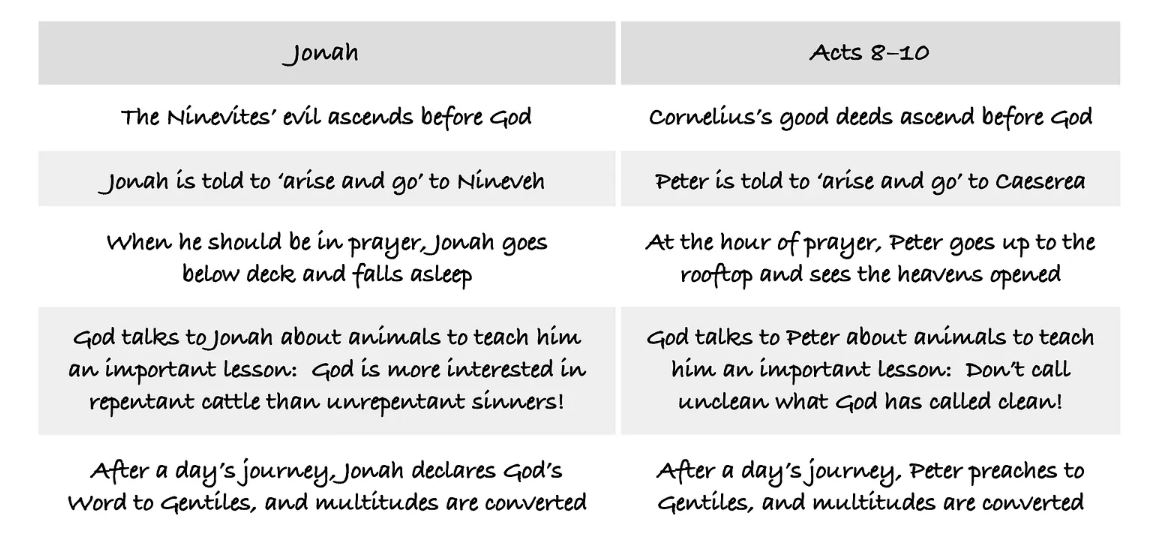
Hence:
‘Just as Jonah became a light to Assyria only on the far side of his death and resurrection, so Judah becomes a light to the Gentiles only on the far side of Jesus’ death and resurrection, which brings new life to the world at large (Isa. 53–56, Ezek. 37).’
The book of Jonah ends with the parable of the plant. Note the exaggerated descriptions, suggestive of deeper realities:
‘The shade that the plant affords Jonah is said to ‘deliver him from evil’; the plant is said to be ‘smitten/slain’ by a worm; and, as a result of his exposure to the east wind, Jonah says he wants to end his life.’
Bejon proposes that:
‘the last appointed entity in Jonah’s second panel (the wind) [depicts] the last appointed entity in the first panel (Babylon).’
Indeed, Eze 17 represents Babylon as an ‘East wind’.
The sheltering plant, then, could be Assyria, which Eze 31 depicts as a tree in whose shade Israel has enjoyed protection. Just as Jonah was grateful for the plant’s existence, and wished it had been ‘spared’, so Assyria, though a hostile nations itself, had sheltered Judah from other hostile forces:
‘Indeed, as soon as Assyria disappeared (like the plant), Babylon came (like the east wind). ‘
And:
‘Many of the Judeans who endured the Babylonian invasion in 587 BC might, therefore, have wished that God had spared Assyria in order to shelter them from Babylon.’
But we may not second-guess whom the Lord chooses to spare and whom he chooses to destroy.
To summarise. In the book of Jonah:
‘God hurls a wind down to the earth in such a way as to stir up a previously undisturbed sea, so as to lead its sailors to hurl/cast lots and subsequently hurl Jonah overboard, just in time to be swallowed by a fish and spewed out on the dry land three days later, all of which happens in such a way as to foreshadow Israel’s long history, which is ultimately to be lived out by God’s own Son in his (Jonah-like) death, resurrection, and acceptance among the Gentiles. How can you second-guess the actions of a God like that?’