Is the Good Samaritan an allegory?
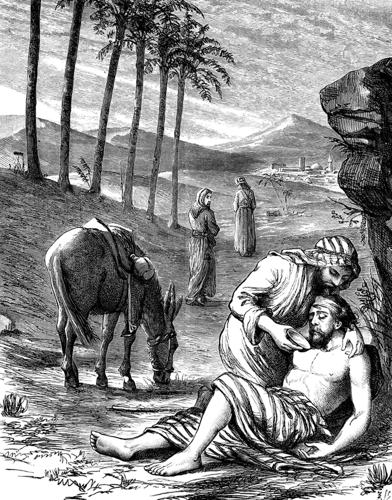
Lk 10:25 Now an expert in religious law stood up to test Jesus, saying, “Teacher, what must I do to inherit eternal life?” 10:26 He said to him, “What is written in the law? How do you understand it?” 10:27 The expert answered, “Love the Lord your God with all your heart, with all your soul, with all your strength, and with all your mind, and love your neighbor as yourself.” 10:28 Jesus said to him, “You have answered correctly; do this, and you will live.”
10:29 But the expert, wanting to justify himself, said to Jesus, “And who is my neighbor?” 10:30 Jesus replied, “A man was going down from Jerusalem to Jericho, and fell into the hands of robbers, who stripped him, beat him up, and went off, leaving him half dead. 10:31 Now by chance a priest was going down that road, but when he saw the injured man he passed by on the other side. 10:32 So too a Levite, when he came up to the place and saw him, passed by on the other side. 10:33 But a Samaritan who was traveling came to where the injured man was, and when he saw him, he felt compassion for him. 10:34 He went up to him and bandaged his wounds, pouring oil and wine on them. Then he put him on his own animal, brought him to an inn, and took care of him. 10:35 The next day he took out two silver coins and gave them to the innkeeper, saying, ‘Take care of him, and whatever else you spend, I will repay you when I come back this way.’ 10:36 Which of these three do you think became a neighbor to the man who fell into the hands of the robbers?” 10:37 The expert in religious law said, “The one who showed mercy to him.” So Jesus said to him, “Go and do the same.”
An allegorical interpretation, in which each element in the story stands for some ‘spiritual’ reality, was first proposed by Origen:
‘The man who was going down is Adam. Jerusalem is paradise, and Jericho is the world. The robbers are hostile powers. The priest is the Law, the Levite is the prophets, and the Samaritan is Christ. The wounds are disobedience, the beast is the Lord’s body, the [inn], which accepts all who wish to enter, is the Church. … The manager of the [inn] is the head of the Church, to whom its care has been entrusted. And the fact that the Samaritan promises he will return represents the Savior’s second coming.’ (Homily 34.3)
Such a reading was adopted by most teachers in the early church, including Irenaeus, Clement, Chrysostom and Ambrose.
Fee & Stuart show how such a ‘great and brilliant’ scholar as Augustine could fall into entirely unwarranted allegorisation:-
A man was going down from Jerusalem to Jericho = Adam
Jerusalem = the heavenly city of peace, from which Adam fell
Jericho = the moon, and thereby signifies Adam’s mortality
robbers = the devil and his angels
stripped him = of his immortality
beat him = by persuading him to sin
leaving him half dead = as a man he lives, but he died spiritually; therefore he is half dead
the priest and Levite = the priesthood and ministry of the Old Testament
the Samaritan = is said to mean Guardian; therefore Christ himself is meant
bandaged his wounds = binding the restraint of sin
oil = comfort of good hope
wine = exhortation to work with a fervent spirit
donkey (“beast”) = the flesh of Christ’s incarnation
inn = the church
the next day = after the resurrection
two silver coins = promise of this life and the life to come
innkeeper = Paul
Fee & Stuart comment:
‘As novel and interesting as all of this may be, one can be absolutely certain that it is not what Jesus intended. After all, the context clearly calls for an understanding of human relationships (Who is my neighbor?), not divine to human; and there is no reason to think that Jesus would predict the church and Paul in this obtuse fashion!’ (How To Read The Bible For All Its Worth, 4th ed., p155)
Luther, who generally avoided allegorical interpretations, did see this parable as an allegory.
Matthew Henry, while acknowledging that an allegorical interpretation is not intended, nevertheless finds such an interpretation irresistible:
‘This parable is applicable to another purpose than that for which it was intended; and does excellently set forth the kindness and love of God our Saviour towards sinful miserable man. We were like this poor distressed traveller. Satan, our enemy, had robbed us, stripped us, wounded us; such is the mischief that sin had done us. We were by nature more than half dead, twice dead, in trespasses and sins; utterly unable to help ourselves, for we were without strength. The law of Moses, like the priest and Levite, the ministers of the law, looks upon us, but has no compassion on us, gives us no relief, passes by on the other side, as having neither pity nor power to help us; but then comes the blessed Jesus, that good Samaritan (and they said of him, by way of reproach, he is a Samaritan), he has compassion on us, he binds up our bleeding wounds (Ps. 147:3; Isa. 61:1), pours in, not oil and wine, but that which is infinitely more precious, his own blood. He takes care of us, and bids us put all the expenses of our cure upon his account; and all this though he was none of us, till he was pleased by his voluntary condescension to make himself so, but infinitely above us. This magnifies the riches of his love, and obliges us all to say, “How much are we indebted, and what shall we render?”’
Trench, in his ‘Notes on the Parables‘ offers the following mystical interpretation of this parable:-
The traveller represents human nature. He has forsaken Jerusalem (holiness) in favour of profanity (Jericho). He falls into the hands of Satan, who with his evil angels strips him of the robe of his original righteousness, leaving him (spiritually) for dead. The law and sacrifices ‘passed him by’, being unable to restore him. The ‘Great Physician’ came, and applied the anointing of the Holy Spirit (oil), the blood of passion (wine) and the sacraments (binding up the wounds). The inn represents the church. The leaving of the Samaritan represents the departure (ascension) of Christ. The two coins represent all gifts and graces, left by Christ as a provision of grace until his return.
There is, of course, something attractive and apparently spiritual about such a scheme of interpretation. But that is not what Jesus meant when he told the parable. The meaning is fixed by the question which prompted it (‘Who is my neighbour’ – focusing on human relationships), and by the command given by Christ at the close (‘Go and do likewise’ – showing that the compassion of the Samaritan is meant to illustrate how we should behave as followers of Christ).
An allegorical interpretation of this parable, then, diverts attention away from the moral imperative that is at the heart of it.
Edwards cites Bovon as suggesting that:
‘The parable of the Good Samaritan essentially illustrates the second commandment, the love of neighbor (so 10:27; Lev 19:18), whereas the following story of Mary and Martha illustrates the first commandment, the love of God (10:27; Deut 6:5).’