BBC’s ‘The Ark’ – better than the cute animals version
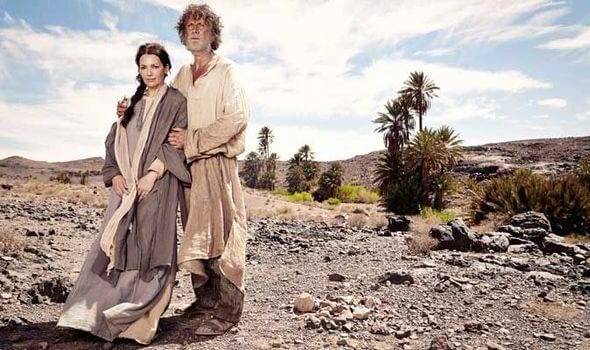
Last night, the BBC screened its 90-minute drama ‘The Ark’.
It was a re-telling, by Tony Jordan, of the celebrated biblical story of Noah (variations of which circulated in other ancient cultures).
Those who confuse the ‘traditional’ children’s version of this story with the biblical version complain that we don’t get to see the animals go into the ark. I was surprised to see Bishop Michael Nazir-Ali being (mis?)quoted as seemingly objecting to the animals being ‘banned’ from the ark in this film.
Actually, in this version, the animals are not quite forgotten (they are glimpsed coming over the horizon as the storm clouds gather). Nor is God’s judgement ignored. But the emphasis falls on the relationship between faithful Noah and his doubting family.
One strength is that the film tells its story without a scrap of cynicism. Noah’s family might have their doubts about him, and the inhabitants of The City might have ridiculed him, but we were not encouraged to do either. He is presented as a man who has loved and supported his family through thick and thin. It is this love and support (rather than his or their faith in God) that eventually wins them round and gets them helping him with the ark-building.
Some additions were made to the biblical story. Noah was given a fourth son, Kenan, who was sufficiently attracted by the bright lights of The City (and the pretty young woman he met there) that he ‘missed the boat’, as it were. And, in contrast to the biblical account, which tells us that only Noah and his family were saved, a crowd of others turn up in time to sail.
In ‘psychological’ terms, the whole story has been given a modern twist. Noah’s wife (‘Emmie’) is a strong, independent woman, who (eventually) supports her husband because she chooses to and because she loves him. The sons represent various forms of unbelief – including agnosticism (“Isn’t it OK just to say ‘I don’t know’?”) and pre-occupation with the ‘worldly pleasures’ offered by The City. Like their mother, they eventually come over the Noah’s side, not because they believe in God, but because he does. ‘Scientific’ objections to belief in God are allowed to creep in (including the common, if childish, “Who designed the Designer?”).
Although financial corruption, violence, and ‘child seduction’ are hinted at, the ‘wickedness’ of The City is presented, mainly as a love of partying. That’s rather weak.
Whereas in the biblical account, God speaks directly to Noah, in the film God’s message to Noah is given to him by an angel. Apart from this angel’s sudden appearance and disappearance, there is nothing in what he says or does that would explain why Noah found his message so convincing. Bear in mind that biblical angels usually cause great alarm, and begin their messages with, “Do not be afraid.” Mind you, I don’t know how this film could have done this better, given that a voice thundering from heaven would probably have just turned it into a cliché.
This film struck me as the honest work of a sympathetic agnostic, who is more home with the psychological aspects of faith (its horizontal dimension, if you like) than to its spiritual aspects (its vertical dimension).
Not great, then, but at least a grown-up version of the story of Noah, and better than those children’s versions whose one abiding image is of the cute animals going up the ramp into the ark.