Teraphim
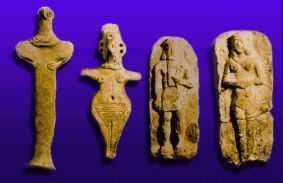
Stephen L. Cook notes that the word ‘teraphim’ occurs 15 times in the Hebrew scriptures.
The usual translation – ‘household gods’ – is, he suggests, somewhat misleading.
Cook thinks that they were effigies of deceased ancestors that were believed to live on in a different form, watching over a person’s household, Exod 21:6; 1 Sam 28:13; Isa 8:19.
In Gen 31:30 Laban searches for his stolen teraphim, calling them his elohim (a term that can apply to supernatural beings other than major deities, cf. Psa 8:5).
In 1 Sam 19:11–17 David’s wife Michal puts one in David’s bed, to make it appear that he was there, sleeping. This suggests that teraphim were human-shaped figurines, as is fitting if they represented deceased ancestors. However, in Gen 31 the teraphim fit into a saddle-bag, suggesting that these were much smaller.
Teraphim might be placed in a domestic shrine (Judges 17:5), or near to the door of a house (Ex 21:6), or by a meal place (1 Sam 20:6). At other times, they might be stored away.
Teraphim were used for divination, Judges 17:5; 18:5; Zech 10:2. Their use was a form of necromancy (procuring knowledge by consulting the dead).
According to Cook, the use of teraphim as a means of venerating ancestors was accepted in the OT, (Ex 21:6; 1 Sam 19:13; 28:13; Isa 8:18). But their use in divination was targeted in King Josiah’s reforms (2 Kings 23:24; cf. Deut 18:11).
[N.B. It is not obvious to me that Ex 21:6, 1 Sam 20:6 or Isa 8:19 refer to teraphim.]