Much ado about ‘The Nativity’
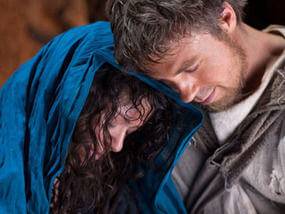
The Daily Express has melodramatically announced that there is ‘fury over BBC’s nativity insult’:-
The BBC has angered Christians with a TV drama in which the Virgin Mary is branded a prostitute and sex cheat.
Already, there is a danger of too little light being obscured by too much smoke. The Express only cites one angry Christian – Stephen Green, of Christian Voice. And I think his criticism is misplaced.
I’ve seen the first three episodes of this drama (the fourth and last is to be broadcast tomorrow). It is quite clear that those who are branding Mary a prostitute are (within the story as re-told by Tony Jordan) her fellow-Jews. This is quite plausible, given the indication within the Gospels that Mary was at risk of ‘public disgrace’ (Mt 1:19), and that Joseph was ‘afraid’ to take Mary home as his wife (Mt 1:20), until reassured by the angel.
In fact, a strength of this presentation is the way in which it imagines what the very human reactions of the players in the drama might have been. OK, so much of it is guess-work, but it reminds us that the shepherds, for instance, were real people with real lives, and with real hopes and fears (there is a sub-plot in which a shepherd is ill-treated because he is trying to support his sick wife and her baby, and cannot pay his taxes).
So I don’t agree that the series is ‘ridiculing’ the Christian faith, as Stephen Green asserts.
But I do have some gripes. Most of them are relatively minor:-
I’m puzzled about why Joseph is made out to be such an incompetent house-builder (at first, at least), since he was a carpenter by trade (and the word for ‘carpenter’ can equally mean ‘builder’). But he gets a good solid house built in the end.
And I’m slightly irritated that non-biblical legend has crept into the account of the Magi. Matthew’s Gospel no-where says that there were three of them, or that their names were Gaspar, Melchior and Balthasa. But that’s what tradition says, and that’s what Tony Jordan gives us.
I suppose we may have to put up with Mary giving birth in a stable. Never mind.
But I do think there is a more serious problem. Although we do have some divine intervention (Mary is pregnant, yet a virgin; the angel Gabriel does make a low-key appearance; the Magi have discerned a portentious alignment of stars and planets), the story is in other ways simply too human. I think it’s OK to represent Mary and Joseph as fearful and uncertain, but we see too little faith and joy in Mary. There is no reference to the Magnificat: “My soul glorifies the Lord and my spirit rejoices in God my Saviour” (Lk 1:46f). Mary must have been a young woman of remarkable godliness, but we see too little of that here.
Unfortunately, Tony Jordan hasn’t got a very good grip on the history and theology of the biblical narrative. He says that he believes in the ‘immaculate conception’, but doesn’t seem to realise that this expression refers to the Roman Catholic invention regarding Mary’s own conception, and not that of her divine son. Moreover, he thinks that those who wrote the gospels did so 200 years after the events they refer to. Try telling that to Luke, who goes out of his way to tell us how carefully he researched his account, using eye-witness testimony and other reliable sources (Lk 1:1-4).
The comment of Tatiana Maslany, who plays Mary, is rather pathetic:-
If you took the names Mary and Joseph out, it could be a story about any two people in love. It isn’t so much about the belief in God, but the belief in enduring love, in love that can hold people together even in the most difficult circumstances.
No, that’s wrong. It’s much more than that.
So, what does a spokesman for the Church of England think?-
Tony Jordan’s adaptation presents a gritty interpretation of the events of the first Christmas. We hope it will bring home the story of Jesus being born in a humble stable to many new viewers.
Born in a stable? Where does it say that in the gospels? Please, in tomorrow’s episode, don’t have Jesus born in a stable. I know it’s not a big deal, but don’t let it be a stable. (You might care to read my commentary on the relevant passage – Lk 2:7 – below).