Icons
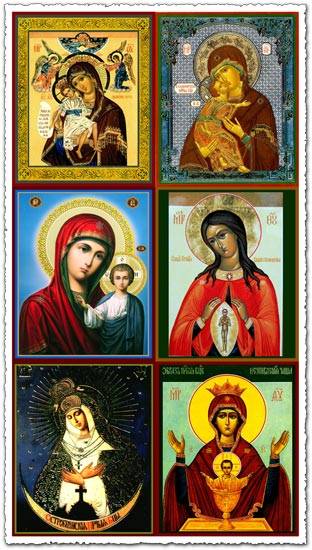
I want to try to understand something of the nature and significance of icons in Eastern Orthodoxy.
A. I begin this discussion with some key facts based on the relevant entry in the Dictionary of the Christian Church (F.L. Cross & E.A. Livingstone, eds. 3rd Edition, 1997)
- Icons are pictures, representing the Lord, the Virgin Mary, or another saint, which have been used and venerated in the Eastern Church since around the 5th century.
- They ‘venerated’ (not worshipped), with all the marks of such veneration common in the East – kisses, prostrations, incense, etc.
- It is believed that the saints exercise their beneficent powers through icons. Accordingly, icons are present at all important events of human life. They are held to be powerful channels of Divine grace, and offer remedies against illness and drive away demons.
- Many miracles have been claimed in association with icons. Especially important is the icon of Christ of Edessa, believed and that of the Theotokos in the monastery of the Abramites at Constantinople. Both these icons are believed to have been many ‘not with human hands’.
- The most famous icon is probably that of the Trinity by Rublev, in the Tretiakov Gallery in Moscow.
B. Summarising now an article on ‘Images and Imagery) in The Orthodox Study Bible.
It is often supposed that the Second Commandment forbids icons. But this cannot be so, because Moses himself was instructed to make two gold cherubim for the Ark of the Covenant (Ex 25:17-21). King Solomon’s temple was replete with artistic representations, and the entire venture received the blessing of the Lord (1 Kings 7-9). A further, striking, example of an image made at God’s command was the bronze serpent (Num 21:4-9; cf. Jn 3:14f). Later, when this same image was worshipped by the Israelites, Hezekiah destroyed it (2 Kings 18:3f). It follows that it is not the making of an image which is sinful, but its improper use; its idolatrous worship.
Prior to the incarnation, it was impossible to make an image of the invisible and infinite God. But, when God the Son assumed a tangible and visible form, it was natural for the Church to create images of him (and of his Mother, and of the saints and angels). According to tradition St. Luke made at least three images of Christ and his Mother. Every image, or ‘icon’ of Christ proclaims anew the incarnation of God.
At the Seventh Ecumenical Council, at Nicea in 787, the ‘heresy’ of iconoclasm was condemned. The Church distinguished sharply between worship, which is reserved for God alone, and the veneration given to icons. Furthermore this council declared that ‘the honor given to the image passes on to that which the image represents.’
C. Turning next to Timothy Ware (The Orthodox Church), who a helpful (and, obviously, sympathetic) discussion of ‘the holy icons’.
At the end of a 120-year controversy over the use of icons, final ‘victory’ came in 843, and this is celebrated in a special service on ‘Orthodox Sunday’, the first Sunday in Lent.
Ware notes that the use of icons constitutes a distinctive feature of Orthodoxy:
‘An Orthodox church today is filled with them: dividing the sanctuary from the body of the building there is a solid screen, the iconostasis, entirely covered with icons, while other icons are placed in special shrines around the church; and perhaps the walls are covered with icons in fresco or mosaic. An Orthodox prostrates himself before these icons, he kisses them and burns candles in front of them; they are censed by the priest and carried in procession.’
Ware insists that an icon is ‘not an idol, but a symbol’. Veneration is directed, not at the picture, but at the one depicted.
Icons convey the Church’s teaching. A believer may never open a book of theology, but upon entry to an Orthodox place of worship he sees upon the walls all the mysteries of faith.
But, if we grant that icons are not idols, and that they have instructional value, are they necessary? Iconodules insists that
‘the Incarnation has made a representational religious art possible: God can be depicted because He became human and took flesh.’
In the words of John of Damascus:
‘Of old God the incorporeal and uncircumscribed was not depicted at all. But now that God has appeared in the flesh and lived among humans, I make an image of the God who can be seen. I do not worship matter but I worship the Creator of matter, who for my sake became material and deigned, to dwell in matter, who through matter effected my salvation. I will not cease from worshipping the matter through which my salvation has been effected.’
The iconoclasts fell, as the Puritans did later, into a kind of Dualism; a belief that what is spiritual must be non-material. But to live and worship as if all matter were defiled is to deny the Incarnation. It is to forget that both the soul and the body are to be saved. If human flesh has become a vehicle of the Holy Spirit, then so, in a different, can wood and paint.
A further argument in support of icons states that Christian image have, in fact, been utilised by the church from the very beginning:
‘Christian images have been used since the church’s very inception—the cross, the church seen as an ark, Christ depicted as a lamb, and so on. Theologically the church’s teaching on images is grounded in the doctrine of the incarnation. God himself gave us an icon of himself in Christ and thereby, at least in principle, sanctioned the use of such imaging.’ (Edward Rommen, in Three Views on Eastern Orthodoxy and Evangelicalism)