Purgatory
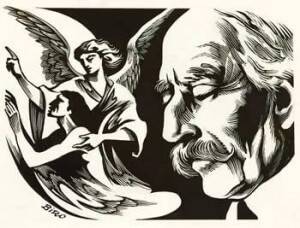
Elgar’s ‘The Dream of Gerontius’ is a wonderful piece of music. For me, however, its story-line requires a considerable suspension of belief. Based on John Henry (Cardinal) Newman’s poem of the same name, it describes the journey of a Christian soul from his death-bed to Purgatory.
The Roman Catholic doctrine of Purgatory took shape in the Middle Ages. The Council of Trent (1545-1563) pronounced as ‘anathema’ those who rejected it. The doctrine states that the intermediate state for Christian believers consists not of unmixed rest, but rather of punishment for post-baptismal sins. The soul is thus ‘purged’, and made ready for its final state of eternal blessedness. The length of time required would vary according to the number and seriousness of the sins committed. It could be reduced by the church’s prayers and masses. Outright absolution could even be granted by the Pope, exercising Peter’s power of the keys.
The soul, having been purified in Purgatory, would be received into heaven, to share with the saints and angels the vision of God. This would happen before the general resurrection on the last day.
To some extent, the doctrine of Purgatory may be regarded as a post hoc explanation of the efficacy of prayers for the dead, which had become widespread since quite early times.
In more recent times, in the light of evolutionary thinking, the doctrine of purgatory has been modified to focus more on the post-mortem development of the soul, as opposed to its punishment.
There is no scriptural warrant for the doctrine of purgatory. Pope Gregory (6th-century) read Mt 12:32 as implying that sins could be forgiven not only in the present world but also in the next. There is one text from the Apocrypha – 2 Macc 12:43-45 – that might offer support.
In fact, the doctrine of purgatory is in flat contradiction to the clear teaching of Scripture concerning Christ’s completed work of redemption. As Paul writes in Rom 8:1, ‘There is now no condemnation to those who are Christ Jesus.’
To give the church below this kind of influence over the fate of souls already dead leads almost inevitably to superstitious and corrupt practices. And so it was that not only masses for the dead proliferated, as did the granting of indulgences to reduce the extent or intensity of Purgatory both for the living and the dead.
The Eastern Church has never accepted the Roman doctrine of Purgatory, preferring rather to think of the state of the Church, both on Earth and in Heaven, as one of continuous ascent, aided by the prayers of the faithful.
Martin Luther campaigned first against the abuse of indulgences, and then against the doctrine of Purgatory itself. He judged it to lack Scriptural warrant and to violate the principle of justification by faith alone. The other Reformers followed suit, and ensured that prayers for the dead were removed from their liturgies.
Paul McPartlan, in The Oxford Companion to Christian Thought (art. ‘Purgatory’)
S.M. Smith, in Evangelical Dictionary of Theology, 2nd ed. (art. ‘Intermediate State’)