Unhappy birthday
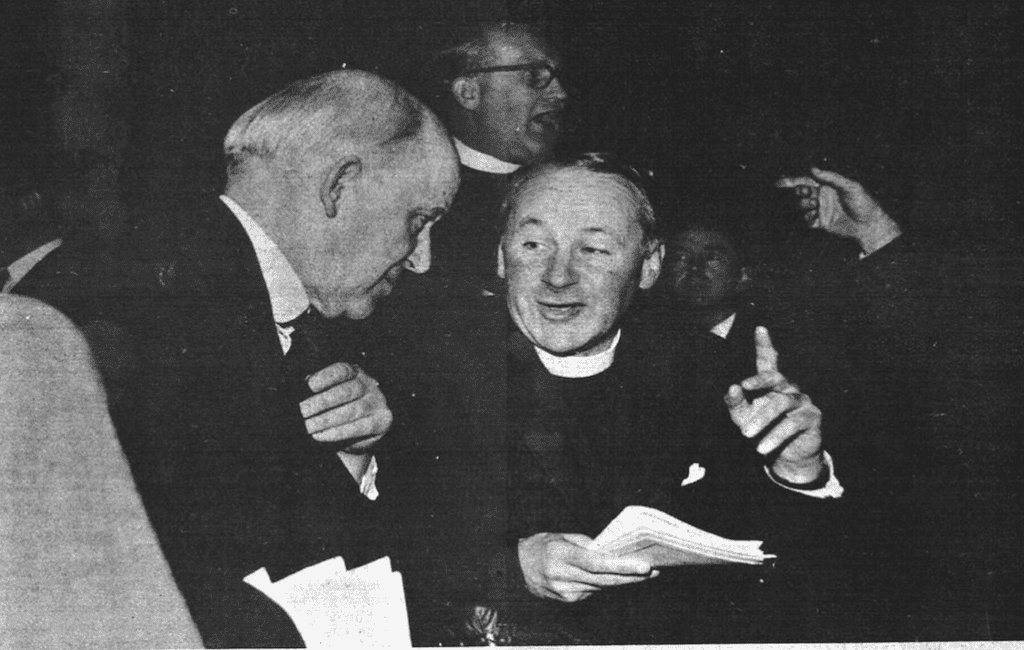
I am reminded by this post by Justin Taylor that it is 50 years ago today – Tuesday, October 18, 1966 – that an event took place that shook British evangelicalism to the core. The after-shocks can still be felt today.
That event was a meeting of the National Assembly of Evangelicals, held at Westminster Central Hall, London. At that meeting, Martyn Lloyd-Jones was understood by many to be appealing for evangelicals to secede from doctrinally mixed denominations, and should come together in a ‘fellowship, or an association, of evangelical churches’.
John Stott, who was chairing the meeting, felt obliged to sound a note of warning (lest ministers should go straight home and write their letters of resignation).
That day in 1966 signalised a parting of the ways for Anglican and Free Church evangelicals. For the former, according to Andrew Atherstone, formulated their arguments for remaining as follows:-
(1) Historically, they argued that the constitutional basis of the Church of England was Protestant and Reformed, seen in the Reformation formularies like the Thirty-Nine Articles of Religion and the Book of Common Prayer. So evangelicals held the legal “title deeds” to the Church of England, and the liberals and catholics should get out, not them.
(2) Biblically, they argued that many New Testament churches were doctrinally confused or morally compromised, like the church in Corinth which was muddled about the resurrection, or the church in Sardis which numbered only “a few” godly people (Revelation 3:4). But believers in those churches are told to hold fast to the gospel, and to fight against false teachers, not to leave the church and set up a new one.
(3) Pragmatically, Stott and his friends argued that the Church of England provided many gospel opportunities for evangelicals, and that it would be a dereliction of duty to hand over their pulpits to unbelieving clergy. What then would become of their congregations?
Critics of Stott and his followers would suggest that they have compromised too much by remaining within Anglicanism, and have weakened the cause of gospel ministry and gospel fellowship. A number of independent churches have found suitable fellowship and mutual support in the Fellowship of Independent Evangelical Churches (FIEC).
Relationships between Anglican Free Church evangelicals suffered a further damaging blow with J.I. Packer’s involvement in the 1970 report Growing Into Union (co-authored with fellow Anglican evangelical Colin Buchanan and two Anglo-Catholics). This led to Lloyd-Jones discontinuing the Puritan Studies Conference that he and Packer had established back in the 1950s, and contributed to a further polarisation of the two ‘sides’.
Evangelical opinion (including mine, for what it’s worth) has tended to side with Stott over Lloyd-Jones in this matter.
Although we are still living with the effects of these events, there has, on the whole, been some warming of relationships and some practical steps towards rebuilding fellowship and shared witness. Atherstone points, for example, to the existence of regional Gospel Partnerships as one positive sign.
See also this article