‘Gentle Jesus, meek and mild’
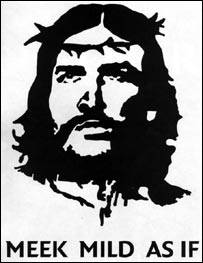
Gentle Jesus, meek and mild,
Look upon a little child,
Pity my simplicity,
Suffer me to come to Thee.
Of all the images of Jesus that are on offer, that of ‘Gentle Jesus, meek and mild’ is perhaps the most embarrassing for Christians, and the most offensive to non-believers.
What self-respecting person would want to follow, serve, die for, a saviour who was merely ‘gentle, meek and mild’?
Of course, we could just say that the writer of the hymn, Charles Wesley, had an off-day when he penned that number and quietly forget about it.
Or, we could react against the image and set about promoting precisely the opposite one. This was done a few years ago when a poster depicted Jesus as a rough, revolutionary Che Guevara figure, and carried the slogan, “meek? mild? as if!”
But perhaps there’s a bit more to it than that.
Have you noticed the following words in ‘Hark! the herald-angels sing’ – also by Charles Wesley:-
Mild He lays His glory by
That doesn’t quite sound like the insipid feebleness that we associate with the word ‘mild’, does it?
Many years ago, I noticed an article by Eric Sharp in the Evangelical Quarterly (Jul-Sep 1981). It was entitled, “‘Gentle Jesus, Meek and Mild’ – Variations on a Nursery Theme for Congregation and Critic”. In this article, the writer argued that the meaning of the word ‘mild’ has changed somewhat over the years, and that what Wesley meant when he wrote it is rather different from what we mean when we read it.
In Charles Wesley: A reader, John Tyson refers to Sharp’s article and summarises as follows:-
Today, the effect of words like ‘Gentle’ ‘meek’ and ‘mild’ cause one to think of someone or something ‘insipid’, but in their biblical application and eighteenth-century currency they presented a far different picture: ‘they are strong, positive, and above all biblical’. ‘Gentle’ in Wesley’s day characterised a person of culture and breeding – a gentleman. ‘Mild’ was Charles’ way of discussing the motives behind Christ’s incarnation, a term suggesting a kenotic Christology and the love of a self-emptying God. ‘Meek’ referred to Jesus’ acceptance of the necessity of his own suffering; it is the language of the way of the Cross, for Christ and for Christians.