Misused privileges
- By the Gadarenes, Mk 5:17
- By the Nazarenes, Mk 6:4,5
- By the People of Northern Galilee, Lk 10:14
- By the People of Jerusalem, Lk 19:42
- By Israel in different periods, Jn 15:22; Heb 3:17
(Source unknown)…
(Source unknown)…
A century ago, many Old Testament scholars had arrived at the view that the patriarchs (Abraham, Isaac, Jacob and their families) were fictional characters, or, at least, were based on vague historical reminiscences.
It must be acknowledged that, to this day, so-called ‘main-stream’ OT scholarship takes a more sceptical view than that summarised above. Ronald Helden, for example, states:-
…‘We do not know whether Abraham actually existed. But even if he did, many (or most) of the details in the Abraham stories are legendary and not historical.’
Peter Mead recently offered a set of helpful hints. Preachers of all ages will, I think, find them thought-provoking. I have cast them somewhat into my own words:-
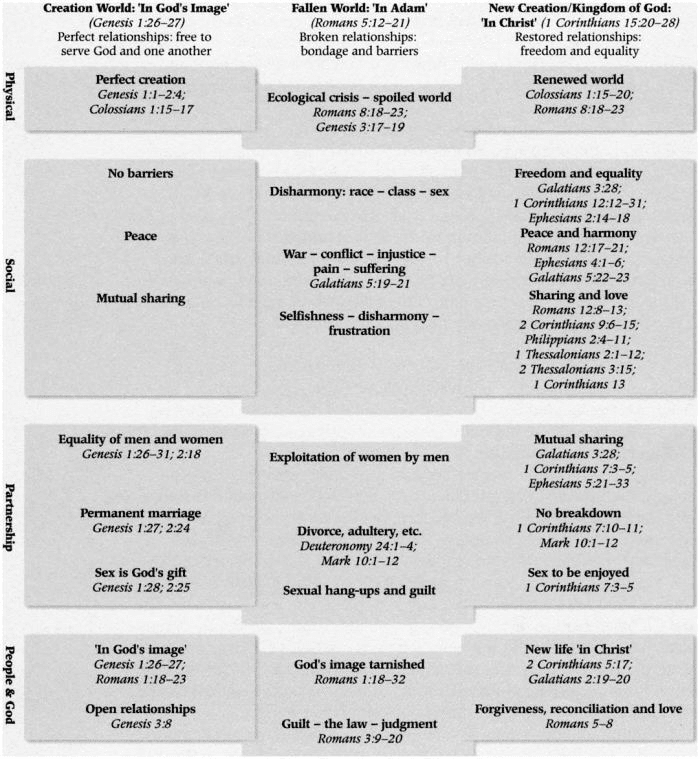
Salvation in Christ encompasses much more than personal spirituality. Both the material world and its people cry out for freedom (Rom 8:18-25), and it is this that God’s redemption is moving everything towards. Although the consummation is ‘not yet’, the people of God can, and should, work towards making this a reality ‘now’.
Chart from Drane, Introducing the New Testament.…
Does the Great Commission of Mt 28:18-20 supersede the cultural mandate of Gen 1:26-28? Does the command to ‘go and make disciples of all nations’ replace the requirement to fill and subdue the earth and to rule over all living things?
At first sight, it might seem that this is indeed the case. After all, the cultural mandate was given to Adam in Eden, as God’s image-bearer, in a state of innocency, prior to the Fall. …
Mostly, when Christians confess that ‘Jesus is Lord’, they mean, ‘Jesus is Lord of my heart’, or ‘Jesus is Lord in my church’.
The biblical scope of this phrase is, however, much more sweeping. The risen Lord himself declared: ‘All authority has been given to me in heaven and on earth’ (Matthew 28:18). And Paul writes that God the Father ‘put all things under [Christ’s] feet, and gave him to be head over all things to the church, which is his body, the fulness of him who fills all in all’ (Ephesians 1:22-23). …
What Christians mean when they say that Jesus Christ is risen from the dead may be helpfully clarified by saying what we do not mean.
1. The resurrected Christ is not a ghost. At first, that is what the disciples thought they had seen, but Jesus refuted the notion, (Lk 24:36–43). A ghost is a spirit without a body, but Jesus showed them that he had a real body.
2. The resurrection is not a resuscitation. …
In chapter 14 of The Art and Craft of Biblical Preaching, Michael Quicke, while acknowledging the difficulty of classifying preachers and preaching types, suggests that a fourfold structure may be helpful. What follows draws on that chapter, but includes my own thoughts as well.
1. Teacher preachers aim to impart scriptural instruction. They stay close to the biblical text, and seek to explain it and apply it. They will often preach consecutively through a book of the Bible, taking one section (such as a paragraph) at a time.…
There is great pressure on today’s preacher to be ‘positive’. “Don’t criticise me, judge me, accuse me,” hearers seem to be pleading. “Uplift me, inspire me, encourage me.”
To what extent should preachers give in to this pressure, and to what extend should they resist it? This question is addressed by Craig Brian Larson in chapter 68 of The Art and Craft of Biblical Preaching.
As Larson says,
One of our most important decisions when crafting a sermon is whether to frame it positively (what to do, what’s right, our hope in God, the promises) or negatively (what not to do, what’s wrong, the sinful human condition).…
She looks as if she has been the victim of a vicious mugging. She has been beaten within an inch of her life. Her body is covered with terrible wounds, but they are uncared-for, untended. Her condition is deteriorating. She needs help, quickly. And yet her pain and misery are self-inflicted. She’s brought it upon herself, and she’s doing nothing to put a stop to it.
That’s the picture that is drawn for us in Isa 1:5f. …