F.F. Bruce – a ‘liberal evangelical’?
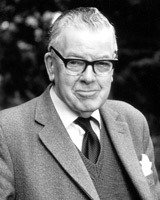
Frederick Fyvie Bruce (1910-1990) was one of the most distinguished of the evangelical biblical scholars who flourished during the second half of the 20th century.
I have often thought of Bruce as a ‘liberal evangelical’ (whereas I would characterise his fellow-Scot William Barclay as an ‘evangelical liberal’). Make of that what you will.
In Re-views by an Evangelical Biblical Scholar, Robert H. Gundry ponders Tim Grass’s biography: F.F. Bruce: A Life.
In the process of his review, Gundry summarises the (slightly uneasy?) marriage of liberal and conservative tendencies in Bruce’s thinking.
‘F.F.B. grew up in the Open Brethrenism of northeastern Scotland, his father being a farm worker-turned-itinerant evangelist whom F.F.B. often accompanied on preaching engagements and for whom on these occasions he read out Scripture passages. The local revival that started in 1858 gave birth to this Brethrenism, and to the end of his days F.F.B. personally and financially supported—despite his scholarly pursuits, one is tempted to say—the Christian evangelism and worldwide missionary work for which the Brethren are deservedly famous. Nor did dedication to scholarship curb his piety, as evidenced for example in the practice of family devotions (Bible reading and prayer) after breakfast each morning, plus frequent preaching (not just lecturing).’
Mildly Calvinistic beliefs
‘At the same time, northeast Scottish Brethrenism and F.F.B. himself were mildy Calvinistic (lacking belief in double predestination, limited atonement, and, in F.F.B.’s case, perseverance of the saints). Like his father and unlike most (Plymouth) Brethren, F.F.B. was nondispensational, once telling me that he did not know of anyone in the UK who still believed in a pretribulational rapture of the church (surely an overstatement designed to debunk the popularity of that belief in the US). According to Grass, F.F.B. even inclined later in life to postmillennialism. He definitely shifted from believing in the saints’ resurrection at Jesus’ return to believing in its taking place at their deaths if they did not survive till that return.’
Some ‘liberal’ tendencies
‘Other positions of his, often not well-known in broad evangelical circles, also made him theologically suspect among many Brethren: opposition to their allegorical interpretations of the Old Testament tabernacle and narrative; advocacy of women’s liberation in the church (but with a caution not to upset Christian harmony thereby); appreciation of Barthianism (which appreciation may have contributed to his encouraging me to spend a half year at Basel University, where Karl Barth held court but did not win me over); ecumenical sympathies (as opposed to ecclesiastical separatism); belief in three Isaiahs and in a second-century date for Daniel (though inclusive of sixth-century materials); denial of historical inerrancy in the Bible (though arguing for its essential historicity); post- and therefore non-Pauline authorship of 1–2 Timothy and Titus; reticence to harmonize apparent discrepancies in Scripture; sympathetic assessments of Marcion, Pelagius, and F. C. Baur (usually considered heretics by orthodox Christians); acceptance of Rudolf Bultmann as a true Christian (despite Bultmann’s condemnation of a theological interest in the historical Jesus contrary to F.F.B.’s own position that apart from the Jesus of history there is no gospel); openness to “fellowship with the Pope and Ian Paisley, though preferably not at the same time!”; willingness to acknowledge a strong case for including the Old Testament apocrypha in Protestant editions of the Bible; and disapproval of moves in the 1970s to tighten the doctrinal basis of the Tyndale Fellowship for Biblical Research, of which he was an early leader (a disapproval that recalls his saying to me, “Creeds are better sung than signed,” as though singing fosters a more devotional and less pilpulistic understanding of them).’
Conservative leanings
‘Alongside these sometimes mildly liberal tendencies, however, Grass points out balancing elements of both theological and behavioral conservatism. F.F.B. championed the Westminster Confession’s statement on the divine authority of Scripture, with emphasis on its and John Calvin’s view of the Scripture as self-authenticating through the inward witness of the Holy Spirit: hence, infallibility as regards the matters of salvation and godliness that the Bible was meant to address. F.F.B. also defended arguments from fulfilled prophecy and miracle and affirmed the moral corruption of human beings, salvation by grace through faith without any contribution of human achievement, Christ’s authority to execute judgment, the Christian gospel as the sole way of salvation (What would F.F.B. make of current interreligious dialogue?), and evangelism and godly living—rather than scholarship for its own sake—as the purposes for biblical research…
‘As to domestic culture, F.F.B.’s children were not allowed out to play on Sundays (where was Paul, his beloved “Apostle of Liberty”?), and the Bruces waited till their children had grown up before exercising Christian liberty by drinking alcohol at home (whereas imbibing has now become so prevalent among evangelicals that the practice of total abstinence amounts to an exercise of Christian liberty).’