Where is God?
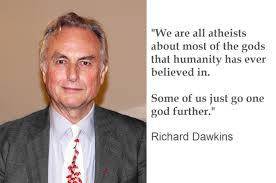
So Richard Dawkins is out on a lecture tour, promoting his new book, Science in the Soul. Rory Shiner writes about attending the Dawkins event in Perth, Australia.
Dawkins treated his audience to a passage from the book, in which he substitutes belief in God for belief in Thor, thus demonstrating (to his own satisfaction) the absurdity of the claims of theologians and believers.
Of course, humankind has had its gods for millennia: Thor, Zeus, Baal, Marduk, Ra, Mars, Jupiter, and so on. We don’t believe in these gods any more, and, says, Dawkins, he’s just continuing the process of debunking the claims of gods that never existed anyway. A standard version of this argument is that since Christians disbelieve in all gods except one, why stop there? Why not disbelieve in all gods, period? After all, you can search the cosmos from one end to the other, but no concrete evidence for the existence of this one God can be found anywhere.
The trouble with this argument is that it ignores what Christians (and other theists) mean by ‘God’. Drawing on a recent book by David Bentley Hart, Shiner notes that ‘God’ is nowhere to be found on the inventory of ‘stuff’ in the cosmos. He is not one of any number of ‘beings’; he is the source of all being and all existence.
Consider (writes Shiner) Shakespeare’s Hamlet. You will find in that play Claudius, Hamlet, Polinius, Horatio, Gertrude, Ophelia, Rosencrantz, and Francisco. But you will not find Shakespeare in Hamlet. Shakespeare is not in the text because he’s the creator of the text.
None of this excludes evidence and arguments for the existence of God, but these are of the nature of clues, rather than proofs. We don’t expect God to go ‘Boo!’ to us from behind a bush on a dark night. But we do find that in Jesus God has written himself into the play, and it is through Jesus Christ that we find our way to God.