George Whitefield and devotion to Christ
These are notes of a talk I gave many years ago.
In the letter of Paul to the Philippians, chapter 5, and verse 17, we read the following: ‘Join with others in following my example, brothers, and take note or those who live according to the pattern we gave you,’
Our task is to take note or a man who indeed lived according to the pattern given by the apostles; a man who could say with more honesty than most: ‘To me, to live is Christ, and to die is gain.’
George Whitefield was born at the Bell Inn, in Gloucester, in the year 1714. He was the youngest of seven children, and his father died when he was two. Not surprisingly, then, his family was poor, and young George had to leave school at an early age in order to help his mother run the Inn. But he had been a promising student, and in due time he made his way up to Oxford University, ‘a shy, retiring, shabbily dressed lad, with dark blue eyes and a singularly beautiful face.’ The University was not renowned in those days either for its religion or for its morals. But the heart of the young Whitefield was already deeply exercised about spiritual things. He fasted, he prayed, he attended public worship, but was as yet still a stranger to God’s grace. He found in Oxford a small group of men who were similarly concerned about the things of God; this little band was called the ‘Holy Club’, and its leaders were two brothers – John and Charles Wesley.
It was only after a mighty spiritual struggle that Whitefield came through to a living faith in Christ. But the change which God wrought in his life was radical and permanent. A year after his conversion he was ordained in Gloucester Cathedral. A week after this he preached his first sermon. It must have been quite a message, as a solemn complaint was made to the bishop that he had driven fifteen people out of their wits. The good bishop replied by saying that he hoped their madness would not be forgotten before the next Sunday!
Whitefield immediately began preaching with great power in and around London, and he soon had an immense popular following. But before long he was being urged by the Wesley brothers to throw in his lot with them in Georgia. And so he made the first of many journeys across the Atlantic, and became one of God’s chief instruments in the great American revival that we call the ‘Great Awakening.’ One of his projects in America was the building of an orphanage, which he supported and maintained for the rest of his life.
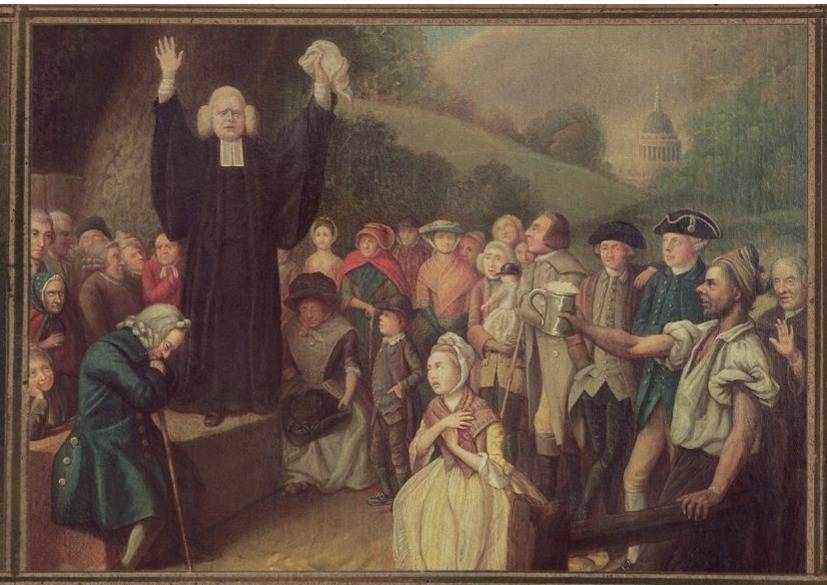
When at length he returned to England, he found that the tide of clerical opinion had turned against him. He was now branded as a fanatic, and many of the pulpits were closed to him. It was then that he took the momentous decision to take up field preaching. Thus it was that he reached thousands who otherwise would never have heard the gospel. He preached to rough miners at Kingswood, near Bristol, of whom we read, ‘Having no righteousness of their own to renounce, they were glad to hear of a Jesus who was the friend of publicans, and came not to call the righteous, but sinners to repentance. The first great discovery or their being affected was to see the white gutter, made by their tears which plentifully fell down their black cheeks as they came out of their coal pits. Hundreds upon hundreds or them were soon brought under deep conviction, which, as the event proved, happily ended in a sound and thorough conversion.’
Thus began an unchanging pattern of evangelistic enterprise which continued until his death in New England at the age of 56. He travelled to every corner of England and Wales. He visited Ireland twice, Scotland 15 times, America seven times. It has been estimated that he preached more than 18,000 sermons, and that he was heard by as many as ten million people. And God gave him almost unparalleled success in winning souls. When John Wesley preached his funeral sermon, he said:
‘Have we read or heard of any person who called so many thousands, so many myriads or sinners to repentance? …Have we read or heard of any one who has been the blessed instrument of bringing so many sinners from darkness to light, and from the power of Satan unto God?’
Such, then, is the barest outline of George Whitefield’s life. I should like to spend the remainder of my time considering what was perhaps the leading quality or characteristic of his life. I mean, his devotion to the Lord Jesus Christ. For I believe it is from a study of this aspect or his life that we ourselves can derive most benefit.
George Whitefield’s greatest ambition in life was to be ‘a thorough and earnest Christian’ (lain Murray). He would often say, ‘Let the name of George Whitefield, perish, if Christ be glorified!’ He was or the same mind as the Apostle who said, ‘I count everything as loss because or the surpassing worth of knowing Christ Jesus my Lord’ (Phil 3:7).
Let us look at some of the effects of this devotion to Christ:-
1. In the first place, Whitefield’s devotion to Christ was the driving force behind his wonderfully successful preaching.
He preached, not out of a love of money, nor out or a craving for popularity, but out of adoration and gratitude to his Lord and Saviour. At the very beginning of his ministry, we find him including these words in a letter to a friend: ‘Glorious Jesus, unloose my stammering tongue to tell thy love immense, unsearchable.’
It is true that Whitefield possessed wonderful natural abilities as a preacher. His voice has been described as sounding ‘like a deep and well-tuned organ, full of charm and pathos, rich in sweet expression, and with carrying powers rarely excelled’ (Marcus Loane). It was said that he could bring tears to his listeners’ eyes simply by the way he pronounced the word, ‘Mesopotamia’! Tradition has it that when he preached at Bristol, his voice was heard on Staincliffe Hill, a mile and a half away. He also had ‘a most vivid sense of drama, and could describe a scene…in such graphic style that it seemed to live before men’s eyes. His great picture of the ship caught at sea, with masts gone and hull down, came to a thrilling climax when his voice rang out with a bewildered cry, as though he were at a loss to know what next to do; and the sailors in the vast crowd thundered as one man in reply: “The long-boat! Man the long-boat!”‘ (Marcus Loane).
We are tempted to suppose, then, that Whitefield’s enormous success as an evangelist lay in the exercise of these natural abilities. But this would be a monumental mistake. The real secret or his power was the warmth and depth of his attachment to Christ. One of his biographers speaks of the ‘vivid spirituality’ which ‘inflamed his soul’, and goes on to say that ‘without this (his) eloquence would have been only elocution, and his sermons, instead or being mighty through God to the pulling down or strongholds, would have been (merely) theatrical orations’ (Luke Tyerman).
This is the secret of his boldness and directness as a preacher. ‘He met men face to face,’ says Bishop Ryle, ‘like one who had a message from God to them, “I have come here to speak to you about your soul.”‘ Once, when his hearers had become rather sleepy and lethargic, he suddenly stopped and then exclaimed, ‘If I had come to speak to you in my own name, you might well rest your elbows on your knee, and your heads on your hands, and sleep….But I have not come to you in my own name. No I have come to you in the name of the Lord of Hosts, and I must and will be heard.’
Whitefield’s devotion to Christ, then, was the driving, force behind the remarkable success of his preaching.
2. In the second place, Whitefield’s devotion to Christ sustained him through his many hardships and trials.
His burdens were heavy. There was, for one thing, the burden of almost life-long poverty. True, large sums of money flowed into his hands, but almost every penny flowed out again – going, for instance, to support, the work of the orphanage he founded in Georgia. There was, for another thing, the burden of violent persecution. Speaking about his ordination, he once said, ‘Thou, O God, ‘knowest that when the bishop put his hand upon my head, I looked for no other preferment than publicly to suffer for the Lamb of God.’ And suffer he did: he was pelted with eggs and battered with stones. ‘He was reviled as a sleek scoundrel who made fabulous sums from his appeals; he was assailed as an anarchist who was paving the way for a bloody revolution. He was lampooned on the stage in a blasphemous farce; he was maligned by the press in a scandalous style. More than once he was in peril of life, but he never wavered’ (Marcus Loane).
There were other burdens, his only child, a son, died at the age of four weeks. He himself suffered considerable ill-health due to asthma and other things. But he ever lived in the light of John 16: 53 – ‘In the world you will have trouble. But take heart! I have overcome the world.’
Nor must we suppose that it came easily or naturally to him to persevere in the face of adversity. ‘The Lord help me,’ he wrote, ‘to hold on and hold out unto the end. I dread the thoughts of flagging in the latter stages of my road. Jesus is able to keep me from being either weary or faint in my mind; in him, and in him alone, is all my strength to be found.’
‘Who shall separate us from the love of Christ?’ asks Paul. ‘Shall trouble or hardship or persecution or famine or nakedness or danger or sword?…No, in all these things we are more than conquerors through him who loved us,’ (Rom 8:35ff).
George Whitefield confirmed the truth of these words in his own experience.
It was his devotion to Christ, then, that carried him through hardship and trial.
3. In the last place, Whitefield’s devotion to Christ gave him great humility and love in his dealings with others.
As a preacher, he achieved enormous popularity at a very early age. This might well have ruined him. He made his share of mistakes, but learned humility through them. ‘Alas! alas!’ he wrote,’in how many things have I judged and acted wrong. I have been too rash and hasty in giving characters, both of places and persons. Being fond of Scripture language, I have often used a style too apostolical;…I have been too bitter in my zeal.’ God was pleased to show him his pride and to give him the mind of Christ, who made himself nothing, taking the very nature of a servant’ (Phil 2: 7). Towards true end of his life, he would often sign his letters, ‘Less than the least of all, George Whitefield.’
Replying to a Scottish minister, who evidently thought him too generous in his dealings with others, he replied:
‘Though I am a strenuous defender of the righteousness of Christ, and utterly detest Arminian principles, yet I know that God gave me the Holy Ghost before I was clear in either as to head-knowledge; and therefore, dear Sir, I am the more moderate to people who are not clear, supposing I see the divine image stamped upon their hearts. Mr. W[esley], Mr. L[aw] etc. Itake to be holy men of God, though they think far widely from me, and from each other in some particular branches of doctrine. . . . I shall approve and join with all who are good in every sect, and cast a mantle of love over all that are bad, so far as is consistent with a good conscience. This I can do without compromising; nay I should defile my conscience if I did otherwise.’
This humility and love is well seen in his attitude towards John Wesley. You have heard, perhaps, that there was for a time a rift between the two men, over a point of doctrine. Afterwards, someone asked Whitefield if he thought they would see John Wesley in heaven. ‘No, Sir,’ replied Whitefield; ‘I fear not. He will be so near the throne, and we shall be at such a distance, that we shall hardly get a sight of him!’
Once again: his humility and love were kindled and sustained by his devotion to Christ. ‘There is nothing I dread more than having my heart drawn away by earthly objects. When that time comes it will be over with me indeed…O that I might be enabled, even to the end, to evidence that nothing but a disinterested love to Christ and souls cause me to begin, go on, and hold out in pursuing the present work of God. I have seen so many, who once bid exceeding fair, and afterwards, Demas-like, preferred the world to Christ, that I cannot be too jealous over myself, or others whom I profess to love.’
George Whitefield died as he had lived. His devotion to the Lord Jesus carried him through to the end. He preached his last sermon on September 29th, 1770. ‘A friend remarked that he looked far from well, more fit indeed for bed than for the pulpit. “True, Sir,” Whitefield replied. And then he turned aside, clasped his hands, looked up, and said: “Lord Jesus, I am weary in thy work, but not of thy work; if I have not yet finished my course, let me go and speak for thee once more in the fields, seal thy truth, and come home and die.”‘ The end of that last sermon was as follows: “I go to my everlasting rest. My sun has risen, shone, and is setting, – nay, it is about to rise and shine forever. I have not lived in vain, and though I could live to preach Christ a thousand years, I die to be with him, which is far better.”
‘Join with others in following my example,’ says Paul, ‘and take note of those who live according to the pattern we gave you.’
I close with some words written about George Whitefield by the poet William Cowper:-
He loved the world that hated him: the tear
That dropped upon his Bible was sincere.
Assail’d by scandal, and the tongues of strife,
His only answer was – a blameless life.
Paul’s love of Christ, and steadiness unbrib’d,
Were copied close in him, ana well transcribed;
He followed Paul – his zeal a kindred flame,
His apostolic charity the same.
I’m not sure, years later, about all the sources I used. I do know that, among other things, I appreciated and made use of this talk, given sometime in the mid-1970s by Iain Murray.