Clerical attire
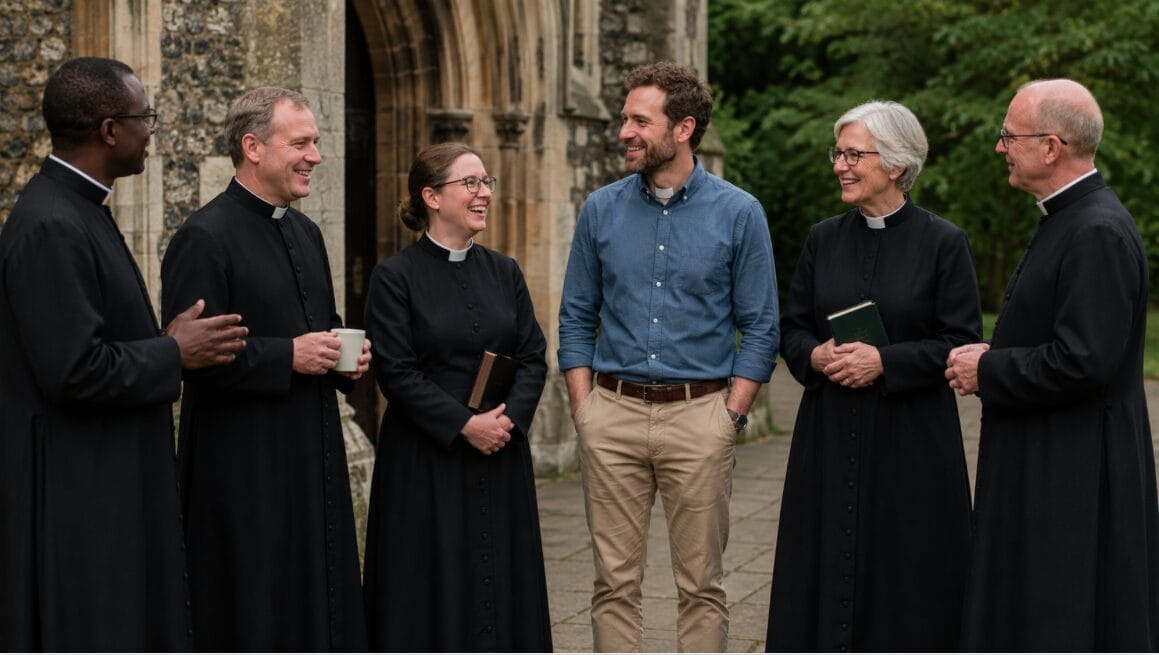
I would like to understand why, in Anglican and many other traditions, it is the custom for clergy to conduct their liturgical duties while wearing special clothing.
I was interested, then, to read this short article…
Angela Tilby (‘How Clergy Dress Sends a Message’, Church Times, 26 June 2026) explores the meaning and significance of clergy dress.
…and this longer one…
Ian Paul (‘How clergy dress sends a message—but which one, and why?’) Online.
Clothes, as Tilby remarks:
‘are always coded symbols. Jeans and trainers send a particular message, as do jackets and chinos, suits and shorts, dresses, skirts, tops, and jeans.’
What messages are being sent by the distinctive garb (clerical collar, cassock, etc.) of C of E clergy?
All clothing conveys some sort of message. Jeans, T-shirt and trainers communicate one sort of message; lounge suit, shirt and tie another. Clergy dress identifies the wearer as member of a particular caste.
History. Angela Tilby traces clerical garb back to Elizabethan days.
Ian Paul goes much further back, connecting the cassock with the Roman tunic. Whereas such a gament could be of various colours:
‘at the Reformation black gradually became dominant after the Reformation because it conveyed, sobriety, learning, seriousness, and humility—but it also reflected the dress of university scholars and educated professionals.’
But time moves on:
‘As secular fashion gradually shortened and became more varied during the Middle Ages, clergy tended to retain the older, longer style of clothing. This is a common pattern in history: institutions often preserve older forms of dress after the general population has moved on.’
And so the movement, over time, has been one from everyday wear to academic wear to clerical wear. (Concerning the second phase: in my school days, a few teachers still wore an academic gown to teach, and later, when I was a university lecturer, we all ‘dressed up’ on graduation day; and great fun it was too).
According to Ian Paul, the original purpose of the cassock was not to be distinctive but to conform (to a particular position within the social hierarchy). But institutions change slowly, and the the cassock has has become a mark of distinctiveness almost by accident.
Historically, clerical garb is related to the customary clothing of the educated classes. In the early days of the Church of England (Ian Paul informs us) laws regulated what people of various professions could wear. Today, we have a set of (often much looser) largely unwritten rules.
The clerical collar has a much more recent history compared to that of the cassock. It was rarely worn by English clergy before 1850. It was modelled on the high collar and white cravat of the English gentleman, and signalled the clergyman’s conformity to this class. Then, as fashion moved on, the church stayed still, and what was once a mark of conformity became a sign of distinctiveness.
Institutional conservatism is found in other organisations and professions. Ian Paul comments:
‘Judges’ wigs are a good example (and are also the subject of a similar debate). In seventeenth-century England, wigs were simply fashionable men’s wear. Judges, barristers and gentlemen all wore them. When wigs went out of fashion in the late eighteenth century, lawyers kept wearing them because they were part of professional dress, they marked continuity, and they came to distinguish the legal profession. But the original reason lawyers wore wigs was simply that everybody respectable did!’
Note the process:
(i) Everyone wears X because it is ordinary.
(ii) Fashion changes, but one institution is conservative.
(iii) That institution continues wearing X simply because it always has.
(iv) X becomes distinctive.
(v) Later generations ask, “Why do we wear X?”
(vi) Symbolic or theological explanations develop. These explanations are entirely post hoc and actually have nothing whatever to do with the origins of what is worn.
Status. Clergy dress indicates that the wearer has a certain position in society and within the church hierarchy. The first of these is less potent nowadays.
Continuity. Some would no doubt argue that clerical garb creates a sense of timelessness (‘Brothers, we are treading where the saints have trod’). But, by the same token, the same attire can suggest that the church is stuck in the past; that its ‘yesterday’ is more important than its ‘today’ or ‘tomorrow’.
Belonging. When ordinands wear, for the first time, their distinctive clerical dress, they are confirmed in their sense of ‘belonging’ to the caste. This in turn encourages the development of attitude, beliefs and behaviours that go with their role within the group. Individual variation diminishes, while conformity to institutional norms is amplified. These disadvantages would seem to outweigh any advantages.
Distance. The way we dress creates a sense of togetherness with those who dress similarly, but of distance from those who dress differently. This leads some to argue that clergy are more ‘accessible’ if they wear ‘ordinary’ clothes. The sense of distance tends to be increased when a person is dressed expensively or ornately. People perceive such a person as ‘elevated, remote, and “not one of us.”‘ Such a person is also perceived as having greater competence and authority. And, as Ian Paul remarks:
‘this results in increased compliance, greater deference, and a reduced willingness to challenge.’
Accessibility. Angela Tilby suggests that if you wear a clerical collar, some people may feel more able to talk to you on matters they might not feel able to share with others. But this can cut both ways: other people – especially younger, more secularised folk might be put off.
Anonymity. When I was training to be a Licensed Lay Minister (‘Reader’), we were told that clergy dress drew attention away from the wearer’s identity and personality, and towards their more impersonal role as priests.
Witness. Tilby writes:
‘It does not seem unreasonable to me to understand a sober-coloured clerical shirt as a sign of witness, not indicating superiority, but availability to God and others: a truncated form of monastic garb.’
Tilby follows this with a comment about ‘a society that has lost touch with scripture and, with it, all kinds of “habits” of understanding’. But I cannot see that the ‘habits of understanding ‘ that she is thinking of have much to do with being in touch with scripture.
Ian Paul asks, by way of conclusion:
‘Does Jesus call us to be distant, in a hierarchy, and set apart socially from those around us? Does he ask this of those called to distinct ministries?
And within the Church of England, with its excess number of leaders, and trust at a low ebb, do we really need more institutional conformity and a greater culture of deference?’
In 428AD Pope Celestine wrote:
‘We [clergy] should be distinguished from the common folk by our learning, not our garb; by our behaviour, not our clothes; by the purity of our minds, not our attire…’