Foxe’s ‘Book of Martyrs’
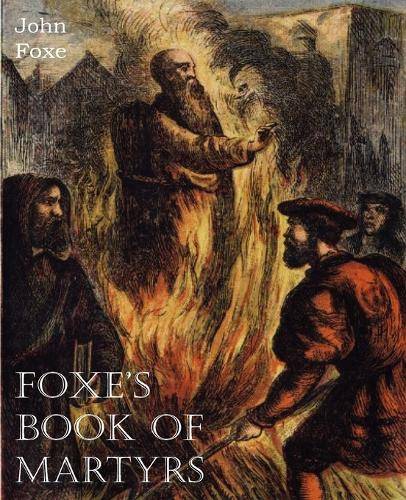
Mention of John Foxe’s Actes and Monuments, popularly known as the Book of Martyrs, has often cropped up in my reading.
I was aware that this book chronicled the persecution of English Protestant reformers by Roman Catholics, and that the work exerted a vast (pro-Protestant, anti-Catholic) influence from the time of its first publication in the 16th century right up until the 20th century.
I probably assumed that it was a work of propaganda, and could not be taken seriously as an historical record. How surprised I was, then, to listen to a discussion of the book on BBC Radio Four’s In Our Time. Melvyn Bragg presided over a discussion between three academics, who testified in glowing terms to Foxe’s careful research and to the historical accuracy of his accounts.
The blurb for the In Our Time programme says that
‘John Foxe was an early Protestant who was forced to flee the persecutions which ensued when the Catholic Mary came to the English throne in 1553. He was a horrified observer on the Continent as more than three hundred of his countrymen were burnt at the stake. In exile he began work on a substantial work of scholarship, bringing together eyewitness accounts of these horrifying deaths.
‘First published in 1563, Foxe’s Book of Martyrs was one of the most elaborate early books produced, and thanks to vivid woodcut illustrations reached an audience far beyond the literate elite. Its stories of Protestant martyrdom became powerful Church propaganda in the late sixteenth century and were used by those who wished to banish Catholicism from England permanently. But despite its use as an instrument of religious factionalism, Foxe’s work remains one of the key and most read books of the early modern period.’
Cross & Livingstone’s authoritative Dictionary of the Christian Church asserts that Foxe’s work
‘still retains major historical value, particularly in preserving early Protestant oral tradition and documents.’
One of the most horrific events related by Foxe is the case of Perotine Massey. This woman, who lived in St Peter Port on the island of Guernsey, had been investigated for involvement in the robbery of a silver cup but found to be innocent. She was instead accused of not attending church. She was condemned as a heretic but an attempt to strangle her failed and she fell into the fire below. She gave birth to a baby boy, which was at first rescued from the fire, but then, or the order of the bailiff, thrust back into the fire.