‘If the church were Christian’ – 10
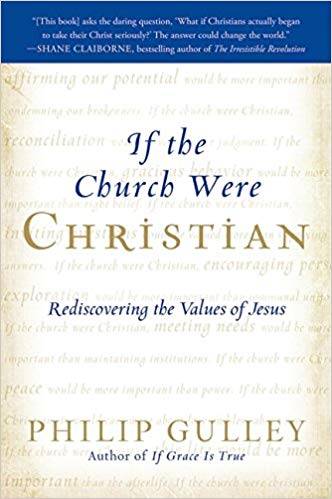
And so to the tenth and last chapter of Phillip Gulley’s book. If the church were more Christian, he says, ‘this life would be more important than the afterlife.’
To many people, the church offers an alternative reality, an escape from the real world. A big part of this is its obsession with our ultimate destiny in heaven or hell, contemplated without due regard to living well in the here and now. And this obsession stems from a need to control – to control who is ‘in’ and who is ‘out’. It skews our ethics, leading us to include or exclude according to criteria of our own making. It is precisely those who are most pre-occupied with the afterlife who neglect to live wisely in this present life.
Of course (says Gulley) there are moments when a hope in a blissful hereafter can be helpful and sustaining. But it can too easily prevent us from taking present concerns around suffering and injustice seriously. ‘This world is not my home, I’m just apassin’ through’ is not a good attitude to adopt.
The Bible, at its very beginning, has God giving humans the responsibility of caring for the world he had created. Preoccupation with an afterlife (if there is such a thing) makes us self-absorbed. We are not here to escape the world, but to mend it.
If saving the earth became more important to us than saving our souls, then certain things would follow. Some of these are summed up in the story of a couple whose lives were marked by a deliberate and consistent generosity, kindness, and joy. They were respected by all:-
‘Though deeply involved in the life of their Quaker meeting, theirs was not a faith that required propagation. Indeed, they seemed uneasy when conversation turned toward religion or theology and would usually excuse themselves to go do something useful. Ben and Dorotha sought no converts and held no creed except that of doing good.’
This couple’s vision contrasted, for Gulley, with that of many other Christians,
‘who viewed humanity as inherently corrupt and fallen, who had little concern for those beyond their faith, and who had a stunted imagination for what the world could be and little desire to change it.’
Gulley writes:-
‘To have those two visions so clearly presented at a formative stage in my faith enabled me to better discern the scope and focus of my own life and ministry. I decided not to invest any effort in saving people’s souls from a hell I didn’t believe in. Rather, I would work to expand my understanding of God, deepen my commitment to grace, and uplift the human condition.’
Let’s stop worrying about raising money to send missionaries to ‘the lost’, and instead work to provide those in need with clean water, medicine, stable government and sustainable agriculture.
Why expend our effort on saving people for an afterlife we don’t even know exists?
Gulley concludes:-
‘If the church were Christian, we would do what Jesus did—equip one another to live better in this world and stop fretting about the next one. To study the Gospels is to encounter a man who cared deeply about this life. His passion for justice, mercy, and grace shone through his words and works. An immediacy, a sense of urgency, marked his movement. This was not a man bent on winning souls for some far-off heaven on some distant day. When his disciples asked him how to pray, he told them to pray that God’s kingdom would come to earth. Now was the day of salvation. And what was that salvation? It was the day when all of humanity would be so imbued with God’s presence that we would hunger and thirst for righteousness. Salvation would be when heaven was in us, not when we were in heaven. It would happen when we stopped worrying about saving our own skin and cared more about saving and restoring the land and sea and sky and all who dwell therein.’
Response
I’ve been reading, and referring to, Michael Kruger’s comments about the book.
Kruger judges that Gulley, in his book generally, and in this chapter in particular:
1. Prioritizes the horizontal over the vertical. The human problem, for Gulley, is not so much that we have offended a holy God, but rather that we hurt one another in a multitude of ways. We need, therefore, to fix our present problems. Focusing on eternity is a distraction, at best.
2. Preaches morality, not salvation. ‘If the Church were Christian, (says Gulley), ‘we would do what Jesus did—equip one another to live better in this world and stop fretting about the next one.’ That statement is, as Kruger comments, ‘genuinely stunning’, for it is clear that Jesus was concerned about both the present world and the world to come (see Mt 10:28, for example).
3. Celebrates uncertainty while practicing certainty. Gulley writes: ‘I decided not to invest any effort in saving people’s souls from a hell I didn’t believe in.’ But this certainty that there is no hell (flies in the face of the entire New Testament revelation, including the teaching of Jesus himself) comes from one who positions himself as a humble seeker (‘I’ve not yet arrived at a definitive understanding of God and I don’t suspect I ever will’).
As usual, I am in close agreement with his evaluation.
I find that there are in this chapter, as in previous chapters, some germs of truth in what Gulley writes. The unselfish kindness of some who do not share our evangelical faith can put to shame many of those who do. The old chestnut about being ‘too heavenly-minded to be any earthly good’ does not completely lack substance.
But, overall, I find Gulley’s argument specious, and his approach tedious.
The argument in this chapter is specious, because it is simply not true that orthodox Christians systematically neglect to do good in this present world. As C.S. Lewis observed:-
‘If you read history you will find that the Christians who did most for the present world were precisely those who thought most of the next. It is since Christians have largely ceased to think of the other world that they have become so ineffective in this.’
As for citing Jesus as an authority, then Gulley seems to have been reading a different set of Gospels to the rest of us. While it is true that our Lord placed great stress of living rightly in this present life, it is quite false to claim that he did so while avoiding any emphasis on the life to come.
The approach is also tedious, in that Gulley serves up the same stereotypes time and again, chapter after chapter: we (the progressives) are the good guys, and they (the conservatives) are the bad guys. This heroes-and-villains style of story-telling may work in children’s comics, but not in the grown-up world.
Phillip Gulley wants to share a vision of the church that is truly Christian. That vision may or may not be a good one. But it can hardly be called a Christian vision in any meaningful sense at all.
Gulley, Philip. If the Church Were Christian. HarperOne. Kindle Edition. Chapter 10.