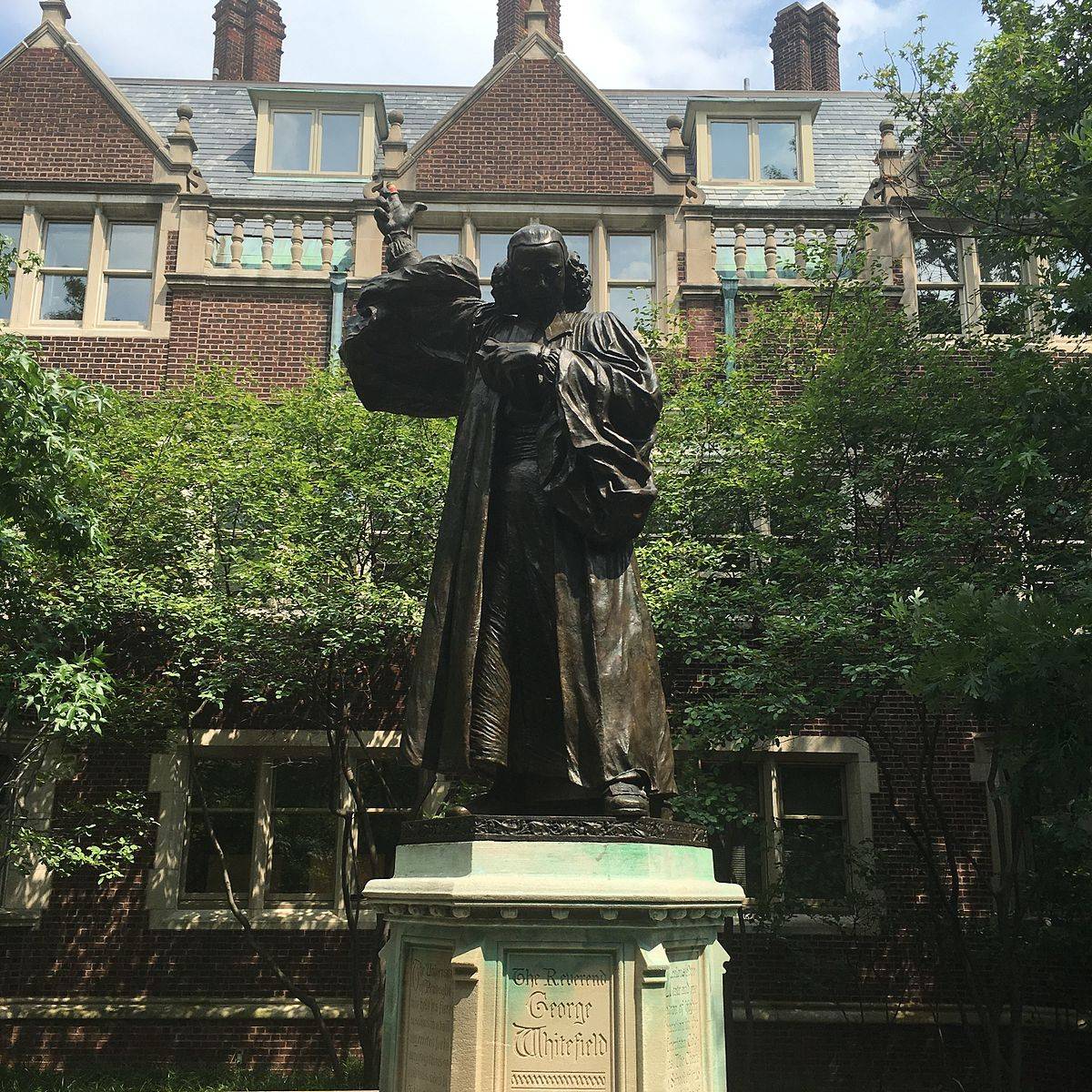
Now George Whitefield has been toppled
The Evangelical Times, August 2020 reports:
The University of Pennsylvania, also known as Penn, has decided to remove a statue of the 18th century evangelical preacher George Whitefield from its campus.
The university issued a statement saying, ‘The case for removing Whitefield is overwhelmingly strong. He was a well-known evangelical preacher in the mid-eighteenth century, who notably led a successful campaign to allow slavery in Georgia. This is undeniably one of Whitefield’s principal legacies.
‘Honouring him with a statue on our campus is inconsistent with our University’s core values, which guide us in becoming an ever more welcoming community that celebrates inclusion and diversity.’
University authorities have also pledged to set up a ‘Campus Iconography Group’ to ‘advise us on further steps to ensure that the placement and presence of statues and other prominent iconography better reflects our achievements and aspirations to increase the diversity of the Penn community’.
But an article in the US edition of The Spectator said, ‘While it’s true that Whitefield accepted a donation of slaves to work his orphanage in Georgia, his advocating for the fair treatment of Africans was ahead of its time.
‘Whitefield regularly admonished slave owners for mistreating their slaves and failing to educate them in Christianity. He once purchased 5,000 acres in Pennsylvania to advance slave education.’
The most common objection that I’ve heard to this rash of statue-toppling is that it is a denial of history; an attempt to air-brush uncomfortable facts out of the record.
I’m not sure that this particular objection holds much water. A statue does not merely record history: it celebrates it. So, if the statue represents a truly nasty person who clearly did more harm than good, then it probably should be removed from public view.
No: more cogent reasons can be found for condemning the present fad for taking down statues of the Great and the Good. Two in particular come to mind:
It demonstrates popular but childish tendency to divide people into ‘heroes’ (who can do no bad) and ‘villains’ (who can do no good). But life is simply not like that. Every one of our ‘heroes’ has feet of clay, and the sooner we realise this the better.
It shows an extraordinary arrogance on the part of our own contemporary society. We have become the final arbiters of right and wrong, of good and evil; of who deserves to stay up on their pedestal and who doesn’t. We might well quote the words of the Lord Jesus: ‘Let him who is without sin throw the first stone.’ The slave trade was a very evil thing; but a society that is responsible for destroying one quarter of unborn children had better start examining its own moral failings a little more humbly.